Graphs of Equations 11-9
An equation in two variables y = x + 2 produces an infinite number of ordered pairs
If we give x the value of 1, a corresponding value of y is determined
y = (1) + 2 = 3
The ordered pair is (1, 3)
If we let x = 4
y = (4) + 2 = 6
and we get the ordered pair (4, 6)
What happens if x = 0
y = (0) + 2 = 2 ( 0, 2)
or x = -1
y = (-1) + 2 = 1 ( -1, 1)
I like to remember ordered pairs---> ( ordered, pairs)
We graphed the line on a mini graph stickie.
The line is graphed using a ruler and connecting all the points we plotted. Put arrows at each end (since a line continues with out end) and write the line's equation right above the line.
For each value of x there is EXACTLY 1 value of y.
set of ordered pairs in which no two ordered pairs have the same x is called a FUNCTION
y = x + 2
in the future you will see it written as
f(x) = x + 2
so if x = 2
f(2) = (2) + 2 = 4
if x = 5
f(5) = (5) +4 = 9
We used a three column chart to compute our ordered pairs.
Tuesday, April 15, 2014

Friday, April 11, 2014
Algebra Honors ( Periods 6 & 7)
Percents 7-5
You have been doing THIS since 6th grade ( or even before!)
The word percent means per cent or hundredths or divided by
100.
29 percent = 29%= 29/100 = 0.29
2.6 percent = 2.6% = 2.6/100 = 26/1000 = 0.026
637 percent = 637% = 637/100 = 6 37/100 = 6.37
0.02 percent = 0.02% = 0.02/100 = 2/10,000 = 0.0002
¼ percent = ¼% = 0.25% = 0.25/100 = 25/10,000 = 0.0025
33 ⅓ percent = 33 ⅓% = 100/3% = 100/3 ÷ 100 = 1/3
It is easy to translate word problem questions about
percents if you use the methods reviewed in class:
Translating into
AN EQUATION
Remember when
translating into an equation “is” means =
and “of” means multiplication
Change the % into a decimal ( or fraction)
Change the % into a decimal ( or fraction)
Example 1
15% of 180 is what number?
0.15 (180) = x
or as a fraction
(15/100) (180) = x
In both cases you ge
x = 27
So 15% of 180 is 27.
Example 2
23 is 25% of what number?
23 = .25(x)
or as a fraction
23 = (25/100)(x)
Again in both cases you will arrive at
x = 92
23 is 25% of 92
Example 3
What percent of 64 is 48?
x(64) = 48
This time you need to remember you found
x = 48/64 which simplifies to ¾
You need to remember to change this into a %
¾ = 75%
This is more easily done using a fraction
(x/100)(64) = 48
x = 75
You just need to remember to add the percent symbol!
Let’s use those three examples but using the proportion
method;
Translating into
A PROPORTION
Remember when
translating into a proportion “is” means part and “of” means whole
Change the % into a fraction with 100 as the denominator. You will have 3 out of 4 numbers. The one missing is the one you are solving for—in each problem
Change the % into a fraction with 100 as the denominator. You will have 3 out of 4 numbers. The one missing is the one you are solving for—in each problem

That’s all you need to remember
Example 1
15% of 180 is what number?

You definitely want to simplify before using cross products
but you will get
x = 27
Example 2
23 is 25% of what number?

You definitely want to simplify before using cross products
but you will get
x = 92
Example 3
What percent of 64 is 48?

You definitely want to simplify before using cross products
but you will get
x = 75
so it is 75%
Always remember to check what the question is asking for—so you
label it appropriately.
When you solve an equation with decimal coefficients, you
can multiply both sides of the equation by a power of 10 (10, 100, and so
on) to get an equivalent equation with integral
coefficients.
Solve 1.2x = 36 +
0.4x
Multiply both sides by 10
when the coefficients are tenths
10(1.2x) = 10(36 + 0.4x)
12x = 360 + 4x
8x = 360
x= 45
{45}
8x = 360
x= 45
{45}
Solve 94 = 0.15x + 0.08(1000 - x)
Multiply BOTH SIDES by 100 when the coefficients are hundredths
100(94) = 100[0.15x + 0.08(1000 - x)]
9400 = 15x +8(1000 –x)
9400 = 15x + 8000 -8x
1400 = 7x
200 = x
{200}
Word Problem Example:
During a sale, a sporting goods store gave a 40% discount on sleeping bags. How much did Ross pay for a sleeping bag with an original price of $75?
Two different methods to find the same solution:
Method 1
Find 40% of $75? 0.40 × 75 = 30
Subtract the amount of discount from the original price
75-30 = $45
Ross paid $45 for the sleeping bag
Method 2
If the sleeping bag was discounted 40%, it then cost 100% -40% or 60% of its original price
Find 60% of 75 0.60 × 75 = 45
Ross paid $45 for the sleeping bag.
9400 = 15x + 8000 -8x
1400 = 7x
200 = x
{200}
Word Problem Example:
During a sale, a sporting goods store gave a 40% discount on sleeping bags. How much did Ross pay for a sleeping bag with an original price of $75?
Two different methods to find the same solution:
Method 1
Find 40% of $75? 0.40 × 75 = 30
Subtract the amount of discount from the original price
75-30 = $45
Ross paid $45 for the sleeping bag
Method 2
If the sleeping bag was discounted 40%, it then cost 100% -40% or 60% of its original price
Find 60% of 75 0.60 × 75 = 45
Ross paid $45 for the sleeping bag.
Algebra Honors ( Periods 6 & 7)
Fractional Equations 7.4
The total resistance R of an electrical circuit with two resistors R1 and R2, that are connected in parallel is given by the formula
1/ R1 +1/ R2 = 1/R
What do you notice about the difference between this equation and those with fractional coefficients?
This formula is an example of a fractional equation.
An equation with a variable in the denominator of one or more terms is called a fractional equation. To solve a fractional equation, you can multiply BOTH sides of the equation by the LCD or you could use the method of solving a proportion when the equation consists of one fraction equal to another fraction.
3/x -1/4 = 1/12
The LCD of the fractions is 12x
Multiply BOTH sides of the equation by the LCD, 12x
Notice that x ≠ 0 because in this case 3/0 is undefined
12x(3/x – ¼) = (1/12)(12x)
36 -3x = x
36 = 4x
x = 9
{9}
(2-x)/(3-x) = 4/9
There are two different ways to solve this
First by finding the LCD, which is 9(3-x) Notice that x ≠3 Why?
9(3-x)[(2-x)/(3-x) = (4/9)[9(3-x)]
18-9x =12-4x
6 = 5x
6/5 = x
{6/5}
OR solve as proportion
(2-x)/(3-x) = 4/9
(2-x)(9) = (4)(3-x)
18- 9x = 12- 4x
we are at the same spot as with the first method and we arrive at the same solution
6 = 5x
6/5 = x
{6/5}
The following gets a little more complicated to do and to display here...
Solve
(2/b2 - b) – 2/(b-1) = 1
Find the LCD by first factoring the denominators first
b2 - b = b(b-1) so the LCD of the two fractions in this equation is in fact
b2 - b BUT use it in factored form b(b-1) Notice: b ≠ 1 why?
(2/b2 - b) – 2/(b-1) = 1
[b(b-1][ (2/b2 - b) – 2/(b-1) ]= 1[b(b-1)]
which separates to
[b(b-1) (2/b2 - b)] – [b(b-1)2/(b-1)] = 1
[b(b-1) (2/b(b - 1)] – [b(b-1)2/(b-1)] = 1
2 -2b=b(b-1)
or
2 – 2b = b2 - b
solve for b now
0 = b2 - b + 2b -2
0 = b2 + b – 2
0 = (b-1)(b+2)
b = 1 and b = -2
Remember in this case b ≠ 1 because of the ORIGINAL EQUATION
the solution set is only
{-2)
Multiplying both sides of an equation by a variable expression sometimes results in an equation that has an extra root. You must check each root of the transformed equation to see if it satisfies the original equation.
The total resistance R of an electrical circuit with two resistors R1 and R2, that are connected in parallel is given by the formula
1/ R1 +1/ R2 = 1/R
What do you notice about the difference between this equation and those with fractional coefficients?
This formula is an example of a fractional equation.
An equation with a variable in the denominator of one or more terms is called a fractional equation. To solve a fractional equation, you can multiply BOTH sides of the equation by the LCD or you could use the method of solving a proportion when the equation consists of one fraction equal to another fraction.
3/x -1/4 = 1/12
The LCD of the fractions is 12x
Multiply BOTH sides of the equation by the LCD, 12x
Notice that x ≠ 0 because in this case 3/0 is undefined
12x(3/x – ¼) = (1/12)(12x)
36 -3x = x
36 = 4x
x = 9
{9}
(2-x)/(3-x) = 4/9
There are two different ways to solve this
First by finding the LCD, which is 9(3-x) Notice that x ≠3 Why?
9(3-x)[(2-x)/(3-x) = (4/9)[9(3-x)]
18-9x =12-4x
6 = 5x
6/5 = x
{6/5}
OR solve as proportion
(2-x)/(3-x) = 4/9
(2-x)(9) = (4)(3-x)
18- 9x = 12- 4x
we are at the same spot as with the first method and we arrive at the same solution
6 = 5x
6/5 = x
{6/5}
The following gets a little more complicated to do and to display here...
Solve
(2/b2 - b) – 2/(b-1) = 1
Find the LCD by first factoring the denominators first
b2 - b = b(b-1) so the LCD of the two fractions in this equation is in fact
b2 - b BUT use it in factored form b(b-1) Notice: b ≠ 1 why?
(2/b2 - b) – 2/(b-1) = 1
[b(b-1][ (2/b2 - b) – 2/(b-1) ]= 1[b(b-1)]
which separates to
[b(b-1) (2/b2 - b)] – [b(b-1)2/(b-1)] = 1
[b(b-1) (2/b(b - 1)] – [b(b-1)2/(b-1)] = 1
2 -2b=b(b-1)
or
2 – 2b = b2 - b
solve for b now
0 = b2 - b + 2b -2
0 = b2 + b – 2
0 = (b-1)(b+2)
b = 1 and b = -2
Remember in this case b ≠ 1 because of the ORIGINAL EQUATION
the solution set is only
{-2)
Multiplying both sides of an equation by a variable expression sometimes results in an equation that has an extra root. You must check each root of the transformed equation to see if it satisfies the original equation.
Tuesday, April 8, 2014
Math 6A (Periods 1 & 2)
Graphs of Ordered Pairs 11-8
A PAIR of numbers whose ORDER is important is called an
ordered pair!!
(ordered, pair)
(2,3) is not the same as (3,2)
The two perpendicular lines are called axes.
The x-axis deals with the 1st number of the ordered pair and the y-axis deals with the 2nd number of the ordered pair.
The AXES meet at a point called the Origin (0,0)
The plane is called the coordinate plane
There are 4 quadrants, Use Roman Numerals to name them!!
Quadrant I ---> both the x and y coordinates are positive
(x,y) (+,+)
Quadrant II --> the x coordinate is negative but the y is positive
(-x,y) (-,+)
Quadrant III -->. both the x and y coordinates are negative
(-x,-y) (-,-)
Quadrant IV --> the x coordinate is positive but the y coordinate is negative
(x,-y) (+,-)
A PAIR of numbers whose ORDER is important is called an
ordered pair!!
(ordered, pair)
(2,3) is not the same as (3,2)
The two perpendicular lines are called axes.
The x-axis deals with the 1st number of the ordered pair and the y-axis deals with the 2nd number of the ordered pair.
The AXES meet at a point called the Origin (0,0)
The plane is called the coordinate plane
There are 4 quadrants, Use Roman Numerals to name them!!
Quadrant I ---> both the x and y coordinates are positive
(x,y) (+,+)
Quadrant II --> the x coordinate is negative but the y is positive
(-x,y) (-,+)
Quadrant III -->. both the x and y coordinates are negative
(-x,-y) (-,-)
Quadrant IV --> the x coordinate is positive but the y coordinate is negative
(x,-y) (+,-)
Monday, April 7, 2014
Algebra Honors ( Periods 6 & 7)
Ratios 7-1
The ratio of one number to another is the
quotient when the first number is divided by the second number (and the 2nd
number does not equal 0)
Ratios =
fractions with meaning
A ratio is the comparison of a number a
and a non zero number b using division. The ratio a to b can be written three
ways-- and you read them all the same
1) as a
quotient using the division sign ÷ 1 ÷ 3
3) as a ratio
using a colon 1:3
A ratio of 7
to 4 can be written 7:4 or 7/4
A Ratio needs two numbers. DO NOT make it into a Mixed number!
A Ratio needs two numbers. DO NOT make it into a Mixed number!
32:48 becomes
2:3
 = 3x/2y
You can use ratios to compare 1
quantities of the SAME KIND
To write the ratio of two quantities
of the same kind
1) First express the measures in the
same unit
2) Then write their ratio
Write each ratio in simplest form
3h: 15 min

or 12:1
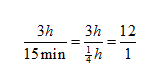
That’s the same ratio whether you
changed the numerator to minutes or the denominator to hours
9in: 5 ft

Write a ratio of the height of a tree
4m tall to the height of a sapling 50cm tall
1) Express both heights in centimeters

2) Express both heights in meters

When you solve a word problem, you may
need to express a ratio in a different form. If two numbers are in the ratio
3:5 you can use 3x and 5x to represent them, because

The lengths of the sides of a triangle
are in the ratio 3:4:5. The perimeter of the triangle is 24 in. Find the
lengths of each side.
Let the lengths of the sides be 3x,
4x, and 5x
3x + 4x + 5x = 24
12x= 24
x = 2
So the sides of the triangle are 6in,
8 in, and 10 in
Find the ratio of x to y
Collect x-terms on one side and y terms on the other. Then factor
Collect x-terms on one side and y terms on the other. Then factor
3x = 7y
Divide both sides by 3 and then divide
both sides by y

cx –ay = aby - bcx
collecting the x terms on one side and the y terms on the
other you have
cx + bcx = aby + ay
Now factor
x(c + bc) = y( ab + a)
divide both sides by c + bc
then divide both sides by y
you have
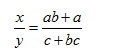
BUT… you can still factor
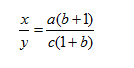
which can simplify to

Friday, April 4, 2014
Math 7 ( Period 4)
Solving Percent Problems 7.5
There are 2 methods: Equations and Proportions
For both methods, there are THREE parts of any percent
problem:
1) the BASE à
the number you are taking a percent of
2) the PERCENT rateà
the percent
3) the PERCENTAGE AMOUNT à
(base)(%)
EQUATION METHOD:
Just translate and solve for the missing number.
Remember:
isà
=
of à
multiply
EXAMPLES:
Finding the PERCENTAGE AMOUNT
Find 60% of 15
First realize that “Find” means “What is”
and change the percent to a decimal or a fraction
so
What is 60% of 15
n = (.60)(15)
n = 9
Using fractions we found
first that 60/100 simplifies to 3/5
so
n =(3/5)(15)
That simplifies to
n = 9
Finding the BASE:
35% of what number is
52.5
.35n = 52.5
simple one step equation
.35n/.35 = 52.5/.35
n = 150
Again, what if we used fractions
35% = 35/100 = 7/20
so
(7/20)n = 53.5
n = 150
Finding the PERCENT rate
What percent of 25 is 13?
25p = 13
p = 13/25
Now you need to make this a percent and that can be
accomplished by dividing
but you can also use equivalent fractions that is,
13/25 = 52/100 so that is 52%
PROPORTION METHOD
%/100 = is/of
Set this up each time and then substitute in what you know
Firstà
look for the 5 rate and put that in ( if you are given it)
Second à
find either the “of” or the “is”
Lastà Whatever is missing is what you are finding…
We did the three examples above as proportions
EXAMPLES:
Find 60% of 15
60/100 = x/15
Simplify and you get
3/5 = x/15
you can simplify even more and get
3/1 =x/3
so x = 3(3) = 9
35% of what number is
52.5
35/100 = 52.5/x
Simplifying again we get
7/20 = 52.5/x
Using cross products
7x = 20(52.5)
7x = 1050
so x = 150
What percent of 25 is 13?
This is the only one where we do not have the %
n%/100 = 13/25
Can we simplify first?
Yes
n%/4 = 13/1
so n = 4(13)
n = 52
Remember to add the percent sign
52%
Thursday, April 3, 2014
Math 7 ( Period 4)
Scale Drawings & Models 7.3
A scale drawing is
a diagram of an object in which the length and the width are proportional to
the actual length and width of the object
The scale for the
drawing gives the relationship between the drawing’s measurement and the actual
measurements, such as “ 1 in : 2ft.”
This scale means that 1 inch on the
drawing represents the actual distance of 2 feet.
The scale factor
for a scale drawing is the ratio of the length and width in the drawing to the
corresponding actual length and width (in the same units of measurements) for instance a sale of “.25 in : 2 ft” has a
scale factor of 1/96 because you need to
change either the inches to feet in the numerator or the feet to inches in the denominator to
have the same units of measurement.
2 ft is equivalent to 24 inches so you
have .25/24 when you simplify that you
get 1/96
Scale
ratios are usually rates… They have two different labels.
1.5 in : 1000 miles.
Scale rates have NO LABELS at all because both the model and the actual are expressed in the same label. The scale rate no longer has any labels and simplifies.
1.5 in : 1000 miles.
Scale rates have NO LABELS at all because both the model and the actual are expressed in the same label. The scale rate no longer has any labels and simplifies.

Using cross products you find that the missing side is 12 inches
ALWAYS SET UP THE PROPORTION WITH 2 KNOWN MEASUREMENTS.
We looked at the scale drawing of the theater stage on Page
328 and found the length of the back wall.
In the scale drawing .25 inches = 2 ft .
In the scale drawing .25 inches = 2 ft .
The back wall in the drawing
measures 1.5 inches Let x = the actual
length of the back wall
We set up a proportion

You could simplify BEFORE you cross multiply
but without you get .25x = 2(1.5)
but without you get .25x = 2(1.5)
divide both sides by .25
x = 12
12 feet
What if you had changed the scale to a scale with the same units of measures first? That
is changed the “.25 inches = 2 feet” to “.25 inches = 24 inches” So

Notice the difference – now everything is in inches and when
you solve it you get x = 144
BUT THAT IS IN INCHES…
and 144 inches = 12 feet… the same
answer you arrived at—without having to change to the same units of measure!!
In Geometry the
definition of similar polygons is that they have proportional sides and
congruent (equal) angles. The congruent angels keep the shape the same. The
proportional sides make the polygons smaller or larger.
So if you know that 2
triangles are similar, you can find a missing measurement of a side by setting
up a proportion.
Example: You know that 2 triangles are similar. One is larger
than the other You know the measurement of 2 sides of the smaller are 3 inches and 4 inches. You know that the
larger triangles corresponding shorter side is 9 inches.
COMPARE
PERIMETER AND AREA
Perimeter of a rectangle is 2l + 2w
So if a photo is 8 inches by 10 inches, the perimeter is
2(8) + 2(10) = 36 inches
If you reduce the size of the picture 50% on the copier
P = 2(4) + 2(5) = 18. So the perimeter is 50% smaller
Area of a rectangle = lw = 8(10) = 80 inches squared
Is the reduced photo’s area 40 inches squared?
NO 4(5) = 20 inches squares. WHY?
each of the sides is ½ the original so (1/2)(1/2) = ¼ of the original area..
20
is 1/4 of the original area of 80
Wednesday, April 2, 2014
Math 7 (Period 4)
Writing & Solving Proportions 7.2
An equation that states tow ratios are equal is called a
proportion.
The proportion

It has two
cross
products ad and bc.
products ad and bc.
In words: In a proportion the cross products are equal
In Algebra: if

With examples: because 2/5 = 4/10 you know that 2(10) = 4(5)
When you know three numbers in a proportion, you can find the
missing value by using cross products
Use cross products property to solve the proportion

3(15) = 5(m)
Now it is a one step equation
Divide both sides by 5
Now it is a one step equation
Divide both sides by 5
3(15)/5 = 5m/5
9 = m
9 = m
Be sure to compare quantities in the same order in a
proportion.
You are reading a novel—we talked about The Giver, one day you read 30 pages in 50 minutes. The next day
you read 24 more pages in 40 minutes. Did
you read at the same rate?
Setup a proportion
Does

Notices on both the pages are in the numerator
and the minutes are in the denominator.
Could we have written it

Yes. Notices on both the pages are in the denominator
now and the minutes are in the numerator.
We looked at the CORN BREAD RECIPE on Page 336
|
Amount
|
Ingredient
|
Directions
|
|
1 ¼ c
|
flour
|
Pre heat
oven to 400 º
|
|
¾ c
|
Corn meal
|
Grease 8
by 8 inch pan
|
|
¼ c
|
sugar
|
|
|
2 t
|
Baking powder
|
Combine
dry ingredients. Mix in milk,
|
|
1 c
|
Skim milk
|
oil and
egg. Pour into pan. Bake 20
|
|
½ t
|
salt
|
to 25
minutes
|
|
¼ c
|
oil
|
|
|
1
|
Egg,
beaten
|
9 servings
|
If you had 8 cups of corn meal, how many loaves of corn bread
could you make? Set up a proportion

(3/4)x = 8
solve

x = 32/3 which is 10 2/3 so you could make 10 loaves
To make 10 loaves of corn bread, how much sugar would you
need?
Again set up a proportion

Solve 10(¼) = s 10/4 = s or 2½ cups of sugar
Math 6A ( Periods 1 & 2)
Solving Equations 11-7
Now that we have learned about negative integers, we can solve an equation such as
x + 7 = 2
We need to subtract 7 from both sides of the equation
x + 7 = 2
- 7 = - 7
to do this use a side bar and use the rules for adding integers
Notice the signs are different so
ask yourself... Who wins? and By How Much?
stack the winner on top and take the difference
so
x + 7 = 2
- 7 = - 7
x = -5
t - -10 = 19
becomes -- with add the opposite---
t+ + 10 = 19
which is just
t + 10 = 19
so subtract 10 from both sides
t + 10 = 19
- 10 = - 10
t = 9
w - - 26 = -44
"Add the Opposite"
w + + 26 = -44
- 26 = - 26
x = -70
Know your integer rules and it becomes easy!!
Side bars are great, if you need them with difference signs!!
y -- 6 = 4
add the opposite and you get
y + 6 = 4
now you need to subtract 6 from both sides of the equation
y + 6 = 4
- 6 = - 6
Again the signs are different -- ask your self those all important questions
"Who Wins? and "By How Much?"
Use a side bar, stack the winner on top and take the difference. Make sure to use the winner's sign in your answer!!
y = 2
What about -5u = 125?
Whats happening to u?
It is being multiplied by -5... so you must divide by -5
-5u = 125
-5 -5
u = -25
or written easier to read -5u/-5 = 125/-5
u = -25
(1/-9)c = 33
Need to multiply both sides by the reciprocal of (1/-9) which is (-9/1)
(-9/1)(1/-9)c = 33(-9/1)
c = -297
2- STEP EQUATIONS
What about
3u - 1 = -7
You need to do the reverse of PEMDAS... remember unwrapping the present? We did the exact opposite of what we had done to wrap the present!!
so
3u - 1 = -7
+ 1 = + 1
3u = -6
Now divide by 3 on both sides
3u/3 = -6/3
u = -2
3z - - 15 = 9
add the opposite first and you get
3x + 15 = 9
In order to solve this 2 step equation
we need to do the reverse of PEMDAS-- as we did with unwrapping the present so many months ago
3x + 15 = 9
subtract 15 from both sides of the equation
3x + 15 = -9
- 15 = - 15
This time the sides are the same-- so just add them and use their sign
3x + 15 = -9
- 15 = - 15
3x = -24
Now divide both sides by 3
3x = -24
3 3
x = -8
Make sure to BOX your answer!!
What about this one
(1/2)(x) + 3 = 0
subtract 3 from both sides
(1/2)x = -3
Multiple by the reciprocal of 1/2 which is 2/1
(2/1)(1/2)x = -3(2/1)
x = -6
Again box your answer.
What about x = -6 + 3x
OH dear... we have variables on BOTH sides of the equations... we need to get the variables on one side all the constants on the other.
We need to isolate the variable!!
x = -6 + 3x
What if we add six to both sides
x = -6 + 3x
+6 = + 6
x + 6 = 3x
now we need to subtract x from both sides
x + 6 = 3x
- x - x
6 = 2x
so now divide both sides by 2
6/2 = 2x/2
3 = x
How about this one
3 - r = -5 + r
- 3 = - 3
-r = -8 + r
if subtract r from both sides, I will get rid of the +r on the right side
-r = -8 + r
- r = -r
-2r = -8
Now divide by -2 on both sides
-2r/-2 = -8/-2
r = 4
Now that we have learned about negative integers, we can solve an equation such as
x + 7 = 2
We need to subtract 7 from both sides of the equation
x + 7 = 2
- 7 = - 7
to do this use a side bar and use the rules for adding integers
Notice the signs are different so
ask yourself... Who wins? and By How Much?
stack the winner on top and take the difference
so
x + 7 = 2
- 7 = - 7
x = -5
t - -10 = 19
becomes -- with add the opposite---
t+ + 10 = 19
which is just
t + 10 = 19
so subtract 10 from both sides
t + 10 = 19
- 10 = - 10
t = 9
w - - 26 = -44
"Add the Opposite"
w + + 26 = -44
- 26 = - 26
x = -70
Know your integer rules and it becomes easy!!
Side bars are great, if you need them with difference signs!!
y -- 6 = 4
add the opposite and you get
y + 6 = 4
now you need to subtract 6 from both sides of the equation
y + 6 = 4
- 6 = - 6
Again the signs are different -- ask your self those all important questions
"Who Wins? and "By How Much?"
Use a side bar, stack the winner on top and take the difference. Make sure to use the winner's sign in your answer!!
y = 2
What about -5u = 125?
Whats happening to u?
It is being multiplied by -5... so you must divide by -5
-5u = 125
-5 -5
u = -25
or written easier to read -5u/-5 = 125/-5
u = -25
(1/-9)c = 33
Need to multiply both sides by the reciprocal of (1/-9) which is (-9/1)
(-9/1)(1/-9)c = 33(-9/1)
c = -297
2- STEP EQUATIONS
What about
3u - 1 = -7
You need to do the reverse of PEMDAS... remember unwrapping the present? We did the exact opposite of what we had done to wrap the present!!
so
3u - 1 = -7
+ 1 = + 1
3u = -6
Now divide by 3 on both sides
3u/3 = -6/3
u = -2
3z - - 15 = 9
add the opposite first and you get
3x + 15 = 9
In order to solve this 2 step equation
we need to do the reverse of PEMDAS-- as we did with unwrapping the present so many months ago
3x + 15 = 9
subtract 15 from both sides of the equation
3x + 15 = -9
- 15 = - 15
This time the sides are the same-- so just add them and use their sign
3x + 15 = -9
- 15 = - 15
3x = -24
Now divide both sides by 3
3x = -24
3 3
x = -8
Make sure to BOX your answer!!
What about this one
(1/2)(x) + 3 = 0
subtract 3 from both sides
(1/2)x = -3
Multiple by the reciprocal of 1/2 which is 2/1
(2/1)(1/2)x = -3(2/1)
x = -6
Again box your answer.
What about x = -6 + 3x
OH dear... we have variables on BOTH sides of the equations... we need to get the variables on one side all the constants on the other.
We need to isolate the variable!!
x = -6 + 3x
What if we add six to both sides
x = -6 + 3x
+6 = + 6
x + 6 = 3x
now we need to subtract x from both sides
x + 6 = 3x
- x - x
6 = 2x
so now divide both sides by 2
6/2 = 2x/2
3 = x
How about this one
3 - r = -5 + r
- 3 = - 3
-r = -8 + r
if subtract r from both sides, I will get rid of the +r on the right side
-r = -8 + r
- r = -r
-2r = -8
Now divide by -2 on both sides
-2r/-2 = -8/-2
r = 4
Math 6A ( Periods 1 & 2)
Quotients of Integers 11-6
Now that we have learned about negative integers, we can solve an equation such as
x + 7 = 2
We need to subtract 7 from both sides of the equation
x + 7 = 2
- 7 = - 7
to do this use a side bar and use the rules for adding integers
Notice the signs are different so
ask yourself... Who wins? and By How Much?
stack the winner on top and take the difference
so
x + 7 = 2
- 7 = - 7
x = -5
t - -10 = 19
becomes -- with add the opposite---
t+ + 10 = 19
which is just
t + 10 = 19
so subtract 10 from both sides
t + 10 = 19
- 10 = - 10
t = 9
w - - 26 = -44
"Add the Opposite"
w + + 26 = -44
- 26 = - 26
x = -70
Know your integer rules and it becomes easy!!
Side bars are great, if you need them with difference signs!!
y -- 6 = 4
add the opposite and you get
y + 6 = 4
now you need to subtract 6 from both sides of the equation
y + 6 = 4
- 6 = - 6
Again the signs are different -- ask your self those all important questions
"Who Wins? and "By How Much?"
Use a side bar, stack the winner on top and take the difference. Make sure to use the winner's sign in your answer!!
y = 2
What about -5u = 125?
Whats happening to u?
It is being multiplied by -5... so you must divide by -5
-5u = 125
-5 -5
u = -25
or written easier to read -5u/-5 = 125/-5
u = -25
(1/-9)c = 33
Need to multiply both sides by the reciprocal of (1/-9) which is (-9/1)
(-9/1)(1/-9)c = 33(-9/1)
c = -297
2- STEP EQUATIONS
What about
3u - 1 = -7
You need to do the reverse of PEMDAS... remember unwrapping the present? We did the exact opposite of what we had done to wrap the present!!
so
3u - 1 = -7
+ 1 = + 1
3u = -6
Now divide by 3 on both sides
3u/3 = -6/3
u = -2
3z - - 15 = 9
add the opposite first and you get
3x + 15 = 9
In order to solve this 2 step equation
we need to do the reverse of PEMDAS-- as we did with unwrapping the present so many months ago
3x + 15 = 9
subtract 15 from both sides of the equation
3x + 15 = -9
- 15 = - 15
This time the sides are the same-- so just add them and use their sign
3x + 15 = -9
- 15 = - 15
3x = -24
Now divide both sides by 3
3x = -24
3 3
x = -8
Make sure to BOX your answer!!
What about this one
(1/2)(x) + 3 = 0
subtract 3 from both sides
(1/2)x = -3
Multiple by the reciprocal of 1/2 which is 2/1
(2/1)(1/2)x = -3(2/1)
x = -6
Again box your answer.
What about x = -6 + 3x
OH dear... we have variables on BOTH sides of the equations... we need to get the variables on one side all the constants on the other.
We need to isolate the variable!!
x = -6 + 3x
What if we add six to both sides
x = -6 + 3x
+6 = + 6
x + 6 = 3x
now we need to subtract x from both sides
x + 6 = 3x
- x - x
6 = 2x
so now divide both sides by 2
6/2 = 2x/2
3 = x
How about this one
3 - r = -5 + r
- 3 = - 3
-r = -8 + r
if subtract r from both sides, I will get rid of the +r on the right side
-r = -8 + r
- r = -r
-2r = -8
Now divide by -2 on both sides
-2r/-2 = -8/-2
r = 4
Now that we have learned about negative integers, we can solve an equation such as
x + 7 = 2
We need to subtract 7 from both sides of the equation
x + 7 = 2
- 7 = - 7
to do this use a side bar and use the rules for adding integers
Notice the signs are different so
ask yourself... Who wins? and By How Much?
stack the winner on top and take the difference
so
x + 7 = 2
- 7 = - 7
x = -5
t - -10 = 19
becomes -- with add the opposite---
t+ + 10 = 19
which is just
t + 10 = 19
so subtract 10 from both sides
t + 10 = 19
- 10 = - 10
t = 9
w - - 26 = -44
"Add the Opposite"
w + + 26 = -44
- 26 = - 26
x = -70
Know your integer rules and it becomes easy!!
Side bars are great, if you need them with difference signs!!
y -- 6 = 4
add the opposite and you get
y + 6 = 4
now you need to subtract 6 from both sides of the equation
y + 6 = 4
- 6 = - 6
Again the signs are different -- ask your self those all important questions
"Who Wins? and "By How Much?"
Use a side bar, stack the winner on top and take the difference. Make sure to use the winner's sign in your answer!!
y = 2
What about -5u = 125?
Whats happening to u?
It is being multiplied by -5... so you must divide by -5
-5u = 125
-5 -5
u = -25
or written easier to read -5u/-5 = 125/-5
u = -25
(1/-9)c = 33
Need to multiply both sides by the reciprocal of (1/-9) which is (-9/1)
(-9/1)(1/-9)c = 33(-9/1)
c = -297
2- STEP EQUATIONS
What about
3u - 1 = -7
You need to do the reverse of PEMDAS... remember unwrapping the present? We did the exact opposite of what we had done to wrap the present!!
so
3u - 1 = -7
+ 1 = + 1
3u = -6
Now divide by 3 on both sides
3u/3 = -6/3
u = -2
3z - - 15 = 9
add the opposite first and you get
3x + 15 = 9
In order to solve this 2 step equation
we need to do the reverse of PEMDAS-- as we did with unwrapping the present so many months ago
3x + 15 = 9
subtract 15 from both sides of the equation
3x + 15 = -9
- 15 = - 15
This time the sides are the same-- so just add them and use their sign
3x + 15 = -9
- 15 = - 15
3x = -24
Now divide both sides by 3
3x = -24
3 3
x = -8
Make sure to BOX your answer!!
What about this one
(1/2)(x) + 3 = 0
subtract 3 from both sides
(1/2)x = -3
Multiple by the reciprocal of 1/2 which is 2/1
(2/1)(1/2)x = -3(2/1)
x = -6
Again box your answer.
What about x = -6 + 3x
OH dear... we have variables on BOTH sides of the equations... we need to get the variables on one side all the constants on the other.
We need to isolate the variable!!
x = -6 + 3x
What if we add six to both sides
x = -6 + 3x
+6 = + 6
x + 6 = 3x
now we need to subtract x from both sides
x + 6 = 3x
- x - x
6 = 2x
so now divide both sides by 2
6/2 = 2x/2
3 = x
How about this one
3 - r = -5 + r
- 3 = - 3
-r = -8 + r
if subtract r from both sides, I will get rid of the +r on the right side
-r = -8 + r
- r = -r
-2r = -8
Now divide by -2 on both sides
-2r/-2 = -8/-2
r = 4
Subscribe to:
Posts (Atom)
