Welcome to Room K 101's Blog

Check out the Weekly Notes from your class

With Math ... you can do anything

Showing posts with label chapter 7-1. Show all posts

Monday, October 19, 2015

Algebra Honors ( Periods 4 & 7)

Multiplication Properties of Exponents 7-1
Monomial: A number, variable, or product of a number and variables with NON-NEGATIVE INTEGER EXPONENTS.
Negative integer exponents mean that a variable is in the denominator. Numbers can be in the denominator.
Integer exponents mean that you can’t have variables with square roots or other roots (these would be fractional exponents)
Therefore, monomials are ONE TERM and terms are separated by addition or subtraction NOT multiplication or division.
A constant is a monomial that is a real number (it can be negative, positive, a fraction/decimal or in a radical sign)
Linear expressions have each variable to the 1 power. Nonlinear expressions have either one variable to a power of 2 or more OR multiple variables attached together.

The base of an exponent is the number or variable at the bottom.
The exponent is the little superscript number at the top.
This is called exponential form or a power of the base raised to the specific exponent.
Expanded form is when you show the repeated multiplication.
Standard or simplified form is the number answer (simplified for a variable is the same as the exponential)
34 is exponential form or we say it’s 3 raised to the power of 4
3●3●3●3 is expanded form
81 is standard form

ODD/EVEN RULES WITH POWERS AND NEGATIVE:
An odd number of negatives = negative
An even number of negatives = positive
So
An odd power with a negative integer in a ( ) = negative
An even power with a negative integer in a ( ) = positive
BUT
An EVEN power with a negative power WITHOUT ( ) = NEGATIVE…there’s only ONE negative here and that’s odd…I call this negative the ZAPPER because it zaps the answer at the very end of the simplifying
An odd power without ( ) = still negative…there’s only ONE negative here and that’s odd

EXAMPLES:

EVALUATING WITH POWERS:
If you are given a variable to a power, you simply plug and chug the value given for the variable.
USUALLY YOU SHOULD PLACE THE VARIABLE IN ( ) WHEN PLUGGING IN:
a2 – b4 if a = 2 and b =3
(2) 2 – (3) 4 = 4 - 81 = -77
VS this case where you’re doing an operation INSIDE the (  ) FIRST, then doing the power:
(a – b) 4 = (2 – 3) 4 = (-1)4 = 1

Algebra ( Period 1)

Multiplication Properties of Exponents 7-1
Monomial: A number, variable, or product of a number and variables with NON-NEGATIVE INTEGER EXPONENTS.
Negative integer exponents mean that a variable is in the denominator. Numbers can be in the denominator.
Integer exponents mean that you can’t have variables with square roots or other roots (these would be fractional exponents)
Therefore, monomials are ONE TERM and terms are separated by addition or subtraction NOT multiplication or division.
A constant is a monomial that is a real number (it can be negative, positive, a fraction/decimal or in a radical sign)
Linear expressions have each variable to the 1 power. Nonlinear expressions have either one variable to a power of 2 or more OR multiple variables attached together.

The base of an exponent is the number or variable at the bottom.
The exponent is the little superscript number at the top.
This is called exponential form or a power of the base raised to the specific exponent.
Expanded form is when you show the repeated multiplication.
Standard or simplified form is the number answer (simplified for a variable is the same as the exponential)
34 is exponential form or we say it’s 3 raised to the power of 4
3●3●3●3 is expanded form
81 is standard form

ODD/EVEN RULES WITH POWERS AND NEGATIVE:
An odd number of negatives = negative
An even number of negatives = positive
So
An odd power with a negative integer in a ( ) = negative
An even power with a negative integer in a ( ) = positive
BUT
An EVEN power with a negative power WITHOUT ( ) = NEGATIVE…there’s only ONE negative here and that’s odd…I call this negative the ZAPPER because it zaps the answer at the very end of the simplifying
An odd power without ( ) = still negative…there’s only ONE negative here and that’s odd

EXAMPLES:


EVALUATING WITH POWERS:
If you are given a variable to a power, you simply plug and chug the value given for the variable.
USUALLY YOU SHOULD PLACE THE VARIABLE IN ( ) WHEN PLUGGING IN:
a2 – b4 if a = 2 and b =3
(2) 2 – (3) 4 = 4 - 81 = -77
VS this case where you’re doing an operation INSIDE the (  ) FIRST, then doing the power:
(a – b) 4 = (2 – 3) 4 = (-1)4 = 1

Monday, April 7, 2014

Algebra Honors ( Periods 6 & 7)

Ratios 7-1

The ratio of one number to another is the quotient when the first number is divided by the second number (and the 2nd number does not equal 0) 

Ratios = fractions with meaning 
A ratio is the comparison of a number a and a non zero number b using division. The ratio a to b can be written three ways-- and you read them all the same
1) as a quotient using the division sign ÷   1 ÷ 3
32) as a fraction  1/3
3) as a ratio using a colon  1:3

A ratio of 7 to 4 can be written 7:4 or 7/4
A Ratio needs two numbers. DO NOT make it into a Mixed number!

32:48 becomes 2:3

   = 3x/2y


You can use ratios to compare 1 quantities of the SAME KIND
To write the ratio of two quantities of the same kind
1) First express the measures in the same unit
2) Then write their ratio

Write each ratio in simplest form
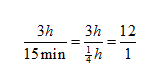
3h: 15 min


or 12:1


That’s the same ratio whether you changed the numerator to minutes or the denominator to hours

9in: 5 ft


Write a ratio of the height of a tree 4m tall to the height of a sapling 50cm tall
1) Express both heights in centimeters


2) Express both heights in meters


When you solve a word problem, you may need to express a ratio in a different form. If two numbers are in the ratio 3:5 you can use 3x and 5x to represent them, because


The lengths of the sides of a triangle are in the ratio 3:4:5. The perimeter of the triangle is 24 in. Find the lengths of each side.

Let the lengths of the sides be 3x, 4x, and 5x
3x + 4x + 5x = 24
12x= 24
x = 2
So the sides of the triangle are 6in, 8 in, and 10 in


Find the ratio of x to y 
Collect x-terms on one side and y terms on the other. Then factor
3x = 7y
Divide both sides by 3 and then divide both sides by y


cx –ay = aby - bcx
collecting  the x terms on one side and the y terms on the other you have
cx + bcx = aby + ay
Now factor
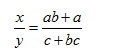
x(c + bc) = y( ab + a)
divide both sides by c + bc
then divide both sides by y
you have


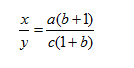
BUT… you can still factor


which can simplify to