Fractional Equations 7.4
The total resistance R of an electrical circuit with two resistors R1 and R2, that are connected in parallel is given by the formula
1/ R1 +1/ R2 = 1/R
What do you notice about the difference between this equation and those with fractional coefficients?
This formula is an example of a fractional equation.
An equation with a variable in the denominator of one or more terms is called a fractional equation. To solve a fractional equation, you can multiply BOTH sides of the equation by the LCD or you could use the method of solving a proportion when the equation consists of one fraction equal to another fraction.
3/x -1/4 = 1/12
The LCD of the fractions is 12x
Multiply BOTH sides of the equation by the LCD, 12x
Notice that x ≠ 0 because in this case 3/0 is undefined
12x(3/x – ¼) = (1/12)(12x)
36 -3x = x
36 = 4x
x = 9
{9}
(2-x)/(3-x) = 4/9
There are two different ways to solve this
First by finding the LCD, which is 9(3-x) Notice that x ≠3 Why?
9(3-x)[(2-x)/(3-x) = (4/9)[9(3-x)]
18-9x =12-4x
6 = 5x
6/5 = x
{6/5}
OR solve as proportion
(2-x)/(3-x) = 4/9
(2-x)(9) = (4)(3-x)
18- 9x = 12- 4x
we are at the same spot as with the first method and we arrive at the same solution
6 = 5x
6/5 = x
{6/5}
The following gets a little more complicated to do and to display here...
Solve
(2/b2 - b) – 2/(b-1) = 1
Find the LCD by first factoring the denominators first
b2 - b = b(b-1) so the LCD of the two fractions in this equation is in fact
b2 - b BUT use it in factored form b(b-1) Notice: b ≠ 1 why?
(2/b2 - b) – 2/(b-1) = 1
[b(b-1][ (2/b2 - b) – 2/(b-1) ]= 1[b(b-1)]
which separates to
[b(b-1) (2/b2 - b)] – [b(b-1)2/(b-1)] = 1
[b(b-1) (2/b(b - 1)] – [b(b-1)2/(b-1)] = 1
2 -2b=b(b-1)
or
2 – 2b = b2 - b
solve for b now
0 = b2 - b + 2b -2
0 = b2 + b – 2
0 = (b-1)(b+2)
b = 1 and b = -2
Remember in this case b ≠ 1 because of the ORIGINAL EQUATION
the solution set is only
{-2)
Multiplying both sides of an equation by a variable expression sometimes results in an equation that has an extra root. You must check each root of the transformed equation to see if it satisfies the original equation.
Thursday, March 22, 2012

Tuesday, March 20, 2012
Algebra Honors (Period 6 & 7)
Equations with Fractional Coefficients 7-3
Solving an equation with fractional coefficients can be easily accomplished by using the LCD of all the fractions in the equation. Clearing the equation of all fractions BEFORE attempting to solve the equation is probably the best way
easy examples:
x/3 + x/7 = 10
The LCD of the fractions is 21
so multiply BOTH SIDES by 21
21(x/3 + x/7) = 10 (21)
7x + 3x = 210
10x = 210
x = 21
{21}
3a/5 – a/2 = 1/20
The LCD of the fractions is 20
20(3a/5 – a/2) = 1/20(20)
4(3a) -10a = 1
12a- 10a = 1
2a = 1
a = ½
{1/2}
x/3- (x+2)/5 = 2
The LCD of the fractions is 15
15[x/3- (x+2)/5] = 2(15)
5x –(3)(x+2) = 30
5x -3x-6 = 30
2x = 36
x = 18
2n + n/3 = n/4 + 5
The LCD is 12
12(2n + n/3) = (n/4 +5)(12)
24n + 4n = 3n + 60
28n = 3n + 60
25n = 60
n = 60/25 = 12/5
{12/5}
More complicated:
(1/4)(n + 2) – (1/6)(n – 2) = 3/2
The LCD is 12
12[(1/4)(n + 2) – (1/6)(n – 2)] = (3/2)(12)
3(n+2) – 2(n-2) = 18
3n + 6 -2n + 4 = 18
n = 8
{8}
Solving some word problems:
one eighth of a number is ten less than one third of the number. Find the number.
Let x = the number.
n/8 = n/3 – 10
LCD is 24
(24)(n/8)= (n/3-10)24
3n = 8n – 240
-5n = -240
5n = 240
n = 48
{48}
Solving an equation with fractional coefficients can be easily accomplished by using the LCD of all the fractions in the equation. Clearing the equation of all fractions BEFORE attempting to solve the equation is probably the best way
easy examples:
x/3 + x/7 = 10
The LCD of the fractions is 21
so multiply BOTH SIDES by 21
21(x/3 + x/7) = 10 (21)
7x + 3x = 210
10x = 210
x = 21
{21}
3a/5 – a/2 = 1/20
The LCD of the fractions is 20
20(3a/5 – a/2) = 1/20(20)
4(3a) -10a = 1
12a- 10a = 1
2a = 1
a = ½
{1/2}
x/3- (x+2)/5 = 2
The LCD of the fractions is 15
15[x/3- (x+2)/5] = 2(15)
5x –(3)(x+2) = 30
5x -3x-6 = 30
2x = 36
x = 18
2n + n/3 = n/4 + 5
The LCD is 12
12(2n + n/3) = (n/4 +5)(12)
24n + 4n = 3n + 60
28n = 3n + 60
25n = 60
n = 60/25 = 12/5
{12/5}
More complicated:
(1/4)(n + 2) – (1/6)(n – 2) = 3/2
The LCD is 12
12[(1/4)(n + 2) – (1/6)(n – 2)] = (3/2)(12)
3(n+2) – 2(n-2) = 18
3n + 6 -2n + 4 = 18
n = 8
{8}
Solving some word problems:
one eighth of a number is ten less than one third of the number. Find the number.
Let x = the number.
n/8 = n/3 – 10
LCD is 24
(24)(n/8)= (n/3-10)24
3n = 8n – 240
-5n = -240
5n = 240
n = 48
{48}
Monday, March 19, 2012
Math 6 Honors ( Periods 1, 2, & 3)
Solving Equations 11-7
Now that we have learned about negative integers, we can solve an equation such as
x + 7 = 2
We need to subtract 7 from both sides of the equation
x + 7 = 2
- 7 = - 7
to do this use a side bar and use the rules for adding integers
Notice the signs are different so
ask yourself... Who wins? and By How Much?
stack the winner on top and take the difference
so
x + 7 = 2
- 7 = - 7
x = -5
t - -10 = 19
becomes -- with add the opposite---
t+ + 10 = 19
which is just
t + 10 = 19
so subtract 10 from both sides
t + 10 = 19
- 10 = - 10
t = 9
w - - 26 = -44
"Add the Opposite"
w + + 26 = -44
- 26 = - 26
x = -70
Know your integer rules and it becomes easy!!
Side bars are great, if you need them with difference signs!!
y -- 6 = 4
add the opposite and you get
y + 6 = 4
now you need to subtract 6 from both sides of the equation
y + 6 = 4
- 6 = - 6
Again the signs are different -- ask your self those all important questions
"Who Wins? and "By How Much?"
Use a side bar, stack the winner on top and take the difference. Make sure to use the winner's sign in your answer!!
y = 2
What about -5u = 125?
Whats happening to u?
It is being multiplied by -5... so you must divide by -5
-5u = 125
-5 -5
u = -25
or written easier to read -5u/-5 = 125/-5
u = -25
(1/-9)c = 33
Need to multiply both sides by the reciprocal of (1/-9) which is (-9/1)
(-9/1)(1/-9)c = 33(-9/1)
c = -297
2- STEP EQUATIONS
What about
3u - 1 = -7
You need to do the reverse of PEMDAS... remember unwrapping the present? We did the exact opposite of what we had done to wrap the present!!
so
3u - 1 = -7
+ 1 = + 1
3u = -6
Now divide by 3 on both sides
3u/3 = -6/3
u = -2
3z - - 15 = 9
add the opposite first and you get
3x + 15 = 9
In order to solve this 2 step equation
we need to do the reverse of PEMDAS-- as we did with unwrapping the present so many months ago
3x + 15 = 9
subtract 15 from both sides of the equation
3x + 15 = -9
- 15 = - 15
This time the sides are the same-- so just add them and use their sign
3x + 15 = -9
- 15 = - 15
3x = -24
Now divide both sides by 3
3x = -24
3 3
x = -8
Make sure to BOX your answer!!
What about this one
(1/2)(x) + 3 = 0
subtract 3 from both sides
(1/2)x = -3
Multiple by the reciprocal of 1/2 which is 2/1
(2/1)(1/2)x = -3(2/1)
x = -6
Again box your answer.
What about x = -6 + 3x
OH dear... we have variables on BOTH sides of the equations... we need to get the variables on one side all the constants on the other.
We need to isolate the variable!!
x = -6 + 3x
What if we add six to both sides
x = -6 + 3x
+6 = + 6
x + 6 = 3x
now we need to subtract x from both sides
x + 6 = 3x
- x - x
6 = 2x
so now divide both sides by 2
6/2 = 2x/2
3 = x
How about this one
3 - r = -5 + r
- 3 = - 3
-r = -8 + r
if subtract r from both sides, I will get rid of the +r on the right side
-r = -8 + r
- r = -r
-2r = -8
Now divide by -2 on both sides
-2r/-2 = -8/-2
r = 4
Now that we have learned about negative integers, we can solve an equation such as
x + 7 = 2
We need to subtract 7 from both sides of the equation
x + 7 = 2
- 7 = - 7
to do this use a side bar and use the rules for adding integers
Notice the signs are different so
ask yourself... Who wins? and By How Much?
stack the winner on top and take the difference
so
x + 7 = 2
- 7 = - 7
x = -5
t - -10 = 19
becomes -- with add the opposite---
t+ + 10 = 19
which is just
t + 10 = 19
so subtract 10 from both sides
t + 10 = 19
- 10 = - 10
t = 9
w - - 26 = -44
"Add the Opposite"
w + + 26 = -44
- 26 = - 26
x = -70
Know your integer rules and it becomes easy!!
Side bars are great, if you need them with difference signs!!
y -- 6 = 4
add the opposite and you get
y + 6 = 4
now you need to subtract 6 from both sides of the equation
y + 6 = 4
- 6 = - 6
Again the signs are different -- ask your self those all important questions
"Who Wins? and "By How Much?"
Use a side bar, stack the winner on top and take the difference. Make sure to use the winner's sign in your answer!!
y = 2
What about -5u = 125?
Whats happening to u?
It is being multiplied by -5... so you must divide by -5
-5u = 125
-5 -5
u = -25
or written easier to read -5u/-5 = 125/-5
u = -25
(1/-9)c = 33
Need to multiply both sides by the reciprocal of (1/-9) which is (-9/1)
(-9/1)(1/-9)c = 33(-9/1)
c = -297
2- STEP EQUATIONS
What about
3u - 1 = -7
You need to do the reverse of PEMDAS... remember unwrapping the present? We did the exact opposite of what we had done to wrap the present!!
so
3u - 1 = -7
+ 1 = + 1
3u = -6
Now divide by 3 on both sides
3u/3 = -6/3
u = -2
3z - - 15 = 9
add the opposite first and you get
3x + 15 = 9
In order to solve this 2 step equation
we need to do the reverse of PEMDAS-- as we did with unwrapping the present so many months ago
3x + 15 = 9
subtract 15 from both sides of the equation
3x + 15 = -9
- 15 = - 15
This time the sides are the same-- so just add them and use their sign
3x + 15 = -9
- 15 = - 15
3x = -24
Now divide both sides by 3
3x = -24
3 3
x = -8
Make sure to BOX your answer!!
What about this one
(1/2)(x) + 3 = 0
subtract 3 from both sides
(1/2)x = -3
Multiple by the reciprocal of 1/2 which is 2/1
(2/1)(1/2)x = -3(2/1)
x = -6
Again box your answer.
What about x = -6 + 3x
OH dear... we have variables on BOTH sides of the equations... we need to get the variables on one side all the constants on the other.
We need to isolate the variable!!
x = -6 + 3x
What if we add six to both sides
x = -6 + 3x
+6 = + 6
x + 6 = 3x
now we need to subtract x from both sides
x + 6 = 3x
- x - x
6 = 2x
so now divide both sides by 2
6/2 = 2x/2
3 = x
How about this one
3 - r = -5 + r
- 3 = - 3
-r = -8 + r
if subtract r from both sides, I will get rid of the +r on the right side
-r = -8 + r
- r = -r
-2r = -8
Now divide by -2 on both sides
-2r/-2 = -8/-2
r = 4
Wednesday, March 14, 2012
Pi Day
HAPPY PI DAY
HAPPY PI DAY! WHAT AN IRRATIONAL DAY!!!!
BE IRRATIONAL.. AND TRANSCENDENTAL
... here are the facts:
Today we celebrate Π (Pi), a very cool number. Π is a comparison between the measurements of the circumference to the diameter of a circle—any circle.
Pi is an IRRATIONAL number. That means it has no pattern and never terminates.
It CANNOT be written as a fraction with an integer in the numerator and denominator.
We use 3.14 and 22/7 as APPROXIMATIONS of pi.
These are not the exact values. The only symbol that tells the exact value is Π. Pi is a ratio, a comparison between two numbers.
You will be able to discover many interesting facts about pi—even finding it on your own.
Here's some links to click on if you're interested in the mystery of Pi:
History of pi
Find your birthday in pi
The first ten thousand digits of pi
Here is a rap I really like...
Lose Yourself in the Digits of pi
... and of course... here are the songs we sang
Happy Pi Day (to the tune of “Happy Birthday”)
Happy PI day to you
Happy PI day to you
Happy PI day everybody
Happy PI day to you
Oh, Number Pi (to the tune of “Oh, Christmas Tree”)
Oh, Number Pi
Oh, Number Pi
Your digits are unending.
Oh Number Pi
Oh Number Pi
No pattern are you sending
You’re three point one four one five nine
And even more if we had time,
Oh, number Pi
Oh, number Pi
For circle lengths unbending.
Oh, number Pi
Oh, number Pi
You are a number very sweet
Oh, number Pi
Oh, number Pi
Your uses are so very neat.
There’s 2 Pi r and Pi r squared
A half a circle and you’re there,
Oh, number Pi
Oh, number Pi
We know that Pi’s a tasty treat
Pi Day Song (to the tune of “Jingle Bells”)
Pi day songs
All day long
Oh what fun it is
To sing a jolly pi day song
In a fun math class
Like this
Verse;
Circles in the snow
Around and round we go
How far did we have to run?
Diameter times pi! (Refrain)
We wish you a Happy Pi Day (to the tune of “We wish you a Merry Xmas”)
We wish you a happy Pi Day
We wish you a happy Pi Day
We wish you a happy Pi Day
To you and to all
Pi numbers for you
For you and for all
Pi numbers in the month of March
So three point one four!!
HAPPY PI DAY! WHAT AN IRRATIONAL DAY!!!!
BE IRRATIONAL.. AND TRANSCENDENTAL
... here are the facts:
Today we celebrate Π (Pi), a very cool number. Π is a comparison between the measurements of the circumference to the diameter of a circle—any circle.
Pi is an IRRATIONAL number. That means it has no pattern and never terminates.
It CANNOT be written as a fraction with an integer in the numerator and denominator.
We use 3.14 and 22/7 as APPROXIMATIONS of pi.
These are not the exact values. The only symbol that tells the exact value is Π. Pi is a ratio, a comparison between two numbers.
You will be able to discover many interesting facts about pi—even finding it on your own.
Here's some links to click on if you're interested in the mystery of Pi:
History of pi
Find your birthday in pi
The first ten thousand digits of pi
Here is a rap I really like...
Lose Yourself in the Digits of pi
... and of course... here are the songs we sang
Happy Pi Day (to the tune of “Happy Birthday”)
Happy PI day to you
Happy PI day to you
Happy PI day everybody
Happy PI day to you
Oh, Number Pi (to the tune of “Oh, Christmas Tree”)
Oh, Number Pi
Oh, Number Pi
Your digits are unending.
Oh Number Pi
Oh Number Pi
No pattern are you sending
You’re three point one four one five nine
And even more if we had time,
Oh, number Pi
Oh, number Pi
For circle lengths unbending.
Oh, number Pi
Oh, number Pi
You are a number very sweet
Oh, number Pi
Oh, number Pi
Your uses are so very neat.
There’s 2 Pi r and Pi r squared
A half a circle and you’re there,
Oh, number Pi
Oh, number Pi
We know that Pi’s a tasty treat
Pi Day Song (to the tune of “Jingle Bells”)
Pi day songs
All day long
Oh what fun it is
To sing a jolly pi day song
In a fun math class
Like this
Verse;
Circles in the snow
Around and round we go
How far did we have to run?
Diameter times pi! (Refrain)
We wish you a Happy Pi Day (to the tune of “We wish you a Merry Xmas”)
We wish you a happy Pi Day
We wish you a happy Pi Day
We wish you a happy Pi Day
To you and to all
Pi numbers for you
For you and for all
Pi numbers in the month of March
So three point one four!!
Tuesday, March 13, 2012
Math 6 Honors ( Periods 1, 2, & 3)
Quotients of Integers 11-6
We all remember 2⋅ 5 = 10
and we know corresponding information
10÷ 5 = 2
The quotient of two positive OR two negative integers is POSITIVE!!
The quotient of a positive AND a negative integer is NEGATIVE!!
The same rules of multiplication apply to division. The same life story!! :-)
+ ÷ + = +
+ ÷ - = -
- ÷ + = -
- ÷ - = +
Although we talked about the sum of two integers always being an integer and
the difference of two integers always being an integers...
the QUOTIENT of two integers is NOT ALWAYS an integer!!
10/4 = 2 1/2 --> which is NOT an integer!!
We also reviewed:
10/0 --> is undefined!!
whereas,
0/10 = 0
98/-14 = -7
Simplify the following:
6 × 8 + -3 × 5
7 × 5 + -3 × 8
Make sure you perform operations using PEMDAS
(also called Aunt Sally's rules or even Order of Operation O3)
6 × 8 + -3 × 5
7 × 5 + -3 × 8
= 3
Let n be a positive integer
-n is its opposite.
In class we discovered that
n ÷ -1 = -n
-n ÷ -n = 1
-n × n = -1n2
n2 ÷ -n = -n
We all remember 2⋅ 5 = 10
and we know corresponding information
10÷ 5 = 2
The quotient of two positive OR two negative integers is POSITIVE!!
The quotient of a positive AND a negative integer is NEGATIVE!!
The same rules of multiplication apply to division. The same life story!! :-)
+ ÷ + = +
+ ÷ - = -
- ÷ + = -
- ÷ - = +
Although we talked about the sum of two integers always being an integer and
the difference of two integers always being an integers...
the QUOTIENT of two integers is NOT ALWAYS an integer!!
10/4 = 2 1/2 --> which is NOT an integer!!
We also reviewed:
10/0 --> is undefined!!
whereas,
0/10 = 0
98/-14 = -7
Simplify the following:
6 × 8 + -3 × 5
7 × 5 + -3 × 8
Make sure you perform operations using PEMDAS
(also called Aunt Sally's rules or even Order of Operation O3)
6 × 8 + -3 × 5
7 × 5 + -3 × 8
= 3
Let n be a positive integer
-n is its opposite.
In class we discovered that
n ÷ -1 = -n
-n ÷ -n = 1
-n × n = -1n2
n2 ÷ -n = -n
Monday, March 12, 2012
Products of Integers 11-4 & 11-5
3 ⋅ -2 = -6
Its really repeated addition
or
-2 + -2 + -2 which we learned a few sections ago was equal to -6.
The product of a positive integer and a negative integer is a negative integer.
The product of ZERO and any integer is ALWAYS ZERO!!
a⋅0 = 0
Math imitates life...and Karma(?)
What was the story I told in class... it applies to
Multiplication & Division ...
+ ⋅ + = +
- ⋅ + = -
+ ⋅ - = -
- ⋅ - = +
The product of -1 and any integer equals the opposite of that integer.
(-1)(a) = -a
The product of two negative integers is a positive integer
For a product with NO ZERO factors:
-->if the number of NEGATIVE factors is odd, the product is negative
-->if the number of NEGATIVE factors is even, then the product is positive
Every integer and its opposite have equal squares!!
Remember-- if its all multiplication use the Associative & Commutative Properties of Multiplication to make your work EASIER!!
3 ⋅ -2 = -6
Its really repeated addition
or
-2 + -2 + -2 which we learned a few sections ago was equal to -6.
The product of a positive integer and a negative integer is a negative integer.
The product of ZERO and any integer is ALWAYS ZERO!!
a⋅0 = 0
Math imitates life...and Karma(?)
What was the story I told in class... it applies to
Multiplication & Division ...
+ ⋅ + = +
- ⋅ + = -
+ ⋅ - = -
- ⋅ - = +
The product of -1 and any integer equals the opposite of that integer.
(-1)(a) = -a
The product of two negative integers is a positive integer
For a product with NO ZERO factors:
-->if the number of NEGATIVE factors is odd, the product is negative
-->if the number of NEGATIVE factors is even, then the product is positive
Every integer and its opposite have equal squares!!
Remember-- if its all multiplication use the Associative & Commutative Properties of Multiplication to make your work EASIER!!
Thursday, March 8, 2012
Solving Problems Involving Quadratic Equations 12-6
You can use quadratic equations to solve problems...
We used the examples in the book to start with:
The park commission wants a new recantangluar sign with an area of 25 m2 for the visitor center. The lenthght of the sign is to be 4 m longer than the width . To the nearest tenth of a meter, what wil be the length and the width of the sign?
Always make sure you check before AND after-- to see wht the problem is really asking for...
Let x = the width in meters
then x + 4 = the length in meters
Use the formula for the area of a recntagle to write an exquation
x(x+4) = 25
solve it
x(x +4) = 25 becomes
x2 + 4x = 25
You can use two methods: the quadratic formula would be my second choice since completing the square works easily here
x2 + 4x + 4 = 25 + 4
(x + 2)2 = 29
x + 2 = ±√29
You can use your calculator, or the table of square roots... or approximately easily using the method taught in class earlier this year
but to the nearest tenth you get
-2 + √29 ≈3.4
-2 - √29 ≈-7.4
Since you can't have a negative root since a negative length has no meaning... you know the width must be about 3.4 meters and therefore the length is 3.4 +4 or approximately 7.4 meters
Problem 2:
The sum of a number and its square is 156. Find the number
Let x = the number
then
x2 + x = 156
x2 + x - 156 =0
Using the skills you have for factoring
(x +13)(x-12) = 0
so
x = 13 and x = 12
You have two solutions to this question!!
Problem 3:
The altitude of a triangle is 9 cm less than the base. The area is 143 cm2
What are the altitude and base?
Remember the formula for the area of a triangle is A = ½bh
Let b = the length of the base
then the altitude ( the height) is b-9
so
½(b)(b-9) = 143
b2 -9b = 286
b2 -9b - 286 = 0
(b -22)(b +13) = 0
b = 22 and b= -13
You can't have a negative length so
the base is 22 cm and the altitude is 13 cm
An object that moves through the air and is solely under the influence of gravity is called a projectile. The approximate height (h) in meters of a projectile at t seconds after it begins its flight from the ground with initial upward velocity v0 is given by the formula
h = -5t2 + v0t
We can find when such a projectile is at ground level (h=0) by solving
0 = -5t2 + v0t.
If a projectile begins its flight at height c, its approximate height at time t is
h = -5t2 + v0t + c .
We can find when it hits the ground by solving h=0 or
0 = -5t2 + v0t +c.
When a projectile is thrown into the air with an initial vertical velocity of r feet per second, its distance (d) in feet above the starting point t seconds after it is thrown is approximately
d = rt – 16t2
You can use quadratic equations to solve problems...
We used the examples in the book to start with:
The park commission wants a new recantangluar sign with an area of 25 m2 for the visitor center. The lenthght of the sign is to be 4 m longer than the width . To the nearest tenth of a meter, what wil be the length and the width of the sign?
Always make sure you check before AND after-- to see wht the problem is really asking for...
Let x = the width in meters
then x + 4 = the length in meters
Use the formula for the area of a recntagle to write an exquation
x(x+4) = 25
solve it
x(x +4) = 25 becomes
x2 + 4x = 25
You can use two methods: the quadratic formula would be my second choice since completing the square works easily here
x2 + 4x + 4 = 25 + 4
(x + 2)2 = 29
x + 2 = ±√29
You can use your calculator, or the table of square roots... or approximately easily using the method taught in class earlier this year
but to the nearest tenth you get
-2 + √29 ≈3.4
-2 - √29 ≈-7.4
Since you can't have a negative root since a negative length has no meaning... you know the width must be about 3.4 meters and therefore the length is 3.4 +4 or approximately 7.4 meters
Problem 2:
The sum of a number and its square is 156. Find the number
Let x = the number
then
x2 + x = 156
x2 + x - 156 =0
Using the skills you have for factoring
(x +13)(x-12) = 0
so
x = 13 and x = 12
You have two solutions to this question!!
Problem 3:
The altitude of a triangle is 9 cm less than the base. The area is 143 cm2
What are the altitude and base?
Remember the formula for the area of a triangle is A = ½bh
Let b = the length of the base
then the altitude ( the height) is b-9
so
½(b)(b-9) = 143
b2 -9b = 286
b2 -9b - 286 = 0
(b -22)(b +13) = 0
b = 22 and b= -13
You can't have a negative length so
the base is 22 cm and the altitude is 13 cm
An object that moves through the air and is solely under the influence of gravity is called a projectile. The approximate height (h) in meters of a projectile at t seconds after it begins its flight from the ground with initial upward velocity v0 is given by the formula
h = -5t2 + v0t
We can find when such a projectile is at ground level (h=0) by solving
0 = -5t2 + v0t.
If a projectile begins its flight at height c, its approximate height at time t is
h = -5t2 + v0t + c .
We can find when it hits the ground by solving h=0 or
0 = -5t2 + v0t +c.
When a projectile is thrown into the air with an initial vertical velocity of r feet per second, its distance (d) in feet above the starting point t seconds after it is thrown is approximately
d = rt – 16t2
Wednesday, March 7, 2012
Math 6 Honors ( Periods 1, 2, & 3)
Subtracting Integers 11-3
The life story about someone who was so negative-- you wanted to take a little negativity away but since you can't do that you add a little positiveness-- works in math as well!!
Instead of subtracting ... "ADD THE OPPOSITE!"
We proved it in class with our little red and yellow tiles... If you need to review, make your own out of red and yellow paper-- or whatever colors you want!!
In life-- to take away a little negative-- add some positive
To take away an integer... add its opposite.
Rule from our textbook
for all integers a and b
a - b = a + (the opposite of b) or
a - b = a + (-b)
Instead of subtracting.. "ADD THE OPPOSITE"
make sure you do the check, check.. you need to have two check marks.. one changing the subtraction to addition and the other changing the sign of the 2nd number to its opposite.
5 - - 2=
5 + + 2= 7
-2 - 5 =
- 2 + - 5 =
before I give you the answer look... we are looking at
-2 + -5
We are adding two negatives.. so we are back to the rules from Section 11-2...
when adding the same sign just add the number and use their sign so
- 2 + - 5 = -7
But what about -2 - -5 ?
adding the opposite, we get
-2 + + 5 .
Now, the signs are different so the rule from Section 11-2 is
ask yourself... "Who wins?" and "By how much?"
Okay, here the positive wins so I know the answer will be +
and by how much means.. to take the difference
5-2 = 3
so -2 + + 5 = +3
Do you need to put the + sign? No, but I like to in the beginning to show that I checked WHO WON!!
What about
-120 - -48?
add the opposite
-120 + + 48 follows the
Different signs rule... so
ask yourself
Who wins? answer: the negative.. so I know the answer will be negative..
And "By How Much?" take the difference 120-48 = 72
so
-120 + + 48 = -72
NEVER EVER CHANGE THE FIRST NUMBER'S SIGN!!
WALK THE LINE, the number line-- that is!!
Remember... Attitude is such a little thing... but it makes a BIG difference!!
Always start with a positive attitude!!
When you walk the line, Which way are you always facing when you start???
Always attempt to get everything into addition so we can follow the rules of Section 11-2 Adding Integers.
1) SAME SIGN rule---> just add the numbers and use their sign
-4 + -5 = -9
2) DIFFERENT SIGNS rule
ask yourself those 2 important questions
a) Who wins? (answer is either negative or positive)
b) By how much? (Take the difference)
Page 376 answers to # 2-18 (evens)
2. -9
4. -5
6. 22
8. -9
10. -74
12. -32
14. -160
16. 498
18. -284
The life story about someone who was so negative-- you wanted to take a little negativity away but since you can't do that you add a little positiveness-- works in math as well!!
Instead of subtracting ... "ADD THE OPPOSITE!"
We proved it in class with our little red and yellow tiles... If you need to review, make your own out of red and yellow paper-- or whatever colors you want!!
In life-- to take away a little negative-- add some positive
To take away an integer... add its opposite.
Rule from our textbook
for all integers a and b
a - b = a + (the opposite of b) or
a - b = a + (-b)
Instead of subtracting.. "ADD THE OPPOSITE"
make sure you do the check, check.. you need to have two check marks.. one changing the subtraction to addition and the other changing the sign of the 2nd number to its opposite.
5 - - 2=
5 + + 2= 7
-2 - 5 =
- 2 + - 5 =
before I give you the answer look... we are looking at
-2 + -5
We are adding two negatives.. so we are back to the rules from Section 11-2...
when adding the same sign just add the number and use their sign so
- 2 + - 5 = -7
But what about -2 - -5 ?
adding the opposite, we get
-2 + + 5 .
Now, the signs are different so the rule from Section 11-2 is
ask yourself... "Who wins?" and "By how much?"
Okay, here the positive wins so I know the answer will be +
and by how much means.. to take the difference
5-2 = 3
so -2 + + 5 = +3
Do you need to put the + sign? No, but I like to in the beginning to show that I checked WHO WON!!
What about
-120 - -48?
add the opposite
-120 + + 48 follows the
Different signs rule... so
ask yourself
Who wins? answer: the negative.. so I know the answer will be negative..
And "By How Much?" take the difference 120-48 = 72
so
-120 + + 48 = -72
NEVER EVER CHANGE THE FIRST NUMBER'S SIGN!!
WALK THE LINE, the number line-- that is!!
Remember... Attitude is such a little thing... but it makes a BIG difference!!
Always start with a positive attitude!!
When you walk the line, Which way are you always facing when you start???
Always attempt to get everything into addition so we can follow the rules of Section 11-2 Adding Integers.
1) SAME SIGN rule---> just add the numbers and use their sign
-4 + -5 = -9
2) DIFFERENT SIGNS rule
ask yourself those 2 important questions
a) Who wins? (answer is either negative or positive)
b) By how much? (Take the difference)
Page 376 answers to # 2-18 (evens)
2. -9
4. -5
6. 22
8. -9
10. -74
12. -32
14. -160
16. 498
18. -284
Tuesday, March 6, 2012
Math 6 Honors ( Periods 1, 2, & 3)
Adding Integers 11-2
Rules: The sum of two positive integers is a positive integer.
The sum of two negative integers is a negative integer.
So- if the two numbers have the same sign, use their sign and just add the numbers.
-15 + -13 = - 28
-10 + -4 = -14
Rules: The sum of a positive integer and a negative integer is :
POSITIVE… IF the positive number has a greater absolute value
NEGATIVE… IF the negative number has a greater absolute value
ZERO… IF both numbers have the same absolute value
Think of a game between two teams- The POSITIVE TEAM and The NEGATIVE TEAM.
30 + -16 … ask yourself the all important question…
“WHO WINS?
in this case the positive and then ask
“BY HOW MUCH?”
take the difference 14
14 + - 52…
“WHO WINS?”
the negative… “BY HOW MUCH?”
38
so the answer is -38
(-2 + 3) + - 6 you can work this 2 ways
(-2 + 3) + - 6 = 1 + -6 = -5 or
using all the properties that work for whole numbers
Commutative and Associative properties of addition
can change expression to (-2 + -6) + 3 or -8 + 3 = -5 you still arrive at the same solution.
You want to use these properties when you are adding more than 2 integers.
First look for zero pairs—you can cross them out right away!!
3 + (-3) = 0
-9 + 9 = 0
Then you can use C(+) to move the integers around to make it easier to add them together rather than adding them in the original order. In addition, you can use A(+) to group your positive and negative numbers in ways that make it easier to add as well.
One surefire way is to add all the positives up… and then add all the negatives up.
At this point ask yourself that all important question… WHO WINS? …
use the winner’s sign..
and then ask yourself..
BY HOW MUCH?
example:
-4 + 27 +(-6) + 5 + (-4) + (6) + (-27) + 13
Taking a good scan of the numbers, do you see any zero pairs?
YES—so cross them out and you are left with
-4 + 5 + (-4) + 13
add your positives 5 + 13 = 18
add your negatives and use their sign – 4 + -4 = -8
Okay, Who wins? the positive
By how much? 10
so
-4 + 27 +(-6) + 5 + (-4) + (6) + (-27) + 13 = 10
Rules: The sum of two positive integers is a positive integer.
The sum of two negative integers is a negative integer.
So- if the two numbers have the same sign, use their sign and just add the numbers.
-15 + -13 = - 28
-10 + -4 = -14
Rules: The sum of a positive integer and a negative integer is :
POSITIVE… IF the positive number has a greater absolute value
NEGATIVE… IF the negative number has a greater absolute value
ZERO… IF both numbers have the same absolute value
Think of a game between two teams- The POSITIVE TEAM and The NEGATIVE TEAM.
30 + -16 … ask yourself the all important question…
“WHO WINS?
in this case the positive and then ask
“BY HOW MUCH?”
take the difference 14
14 + - 52…
“WHO WINS?”
the negative… “BY HOW MUCH?”
38
so the answer is -38
(-2 + 3) + - 6 you can work this 2 ways
(-2 + 3) + - 6 = 1 + -6 = -5 or
using all the properties that work for whole numbers
Commutative and Associative properties of addition
can change expression to (-2 + -6) + 3 or -8 + 3 = -5 you still arrive at the same solution.
You want to use these properties when you are adding more than 2 integers.
First look for zero pairs—you can cross them out right away!!
3 + (-3) = 0
-9 + 9 = 0
Then you can use C(+) to move the integers around to make it easier to add them together rather than adding them in the original order. In addition, you can use A(+) to group your positive and negative numbers in ways that make it easier to add as well.
One surefire way is to add all the positives up… and then add all the negatives up.
At this point ask yourself that all important question… WHO WINS? …
use the winner’s sign..
and then ask yourself..
BY HOW MUCH?
example:
-4 + 27 +(-6) + 5 + (-4) + (6) + (-27) + 13
Taking a good scan of the numbers, do you see any zero pairs?
YES—so cross them out and you are left with
-4 + 5 + (-4) + 13
add your positives 5 + 13 = 18
add your negatives and use their sign – 4 + -4 = -8
Okay, Who wins? the positive
By how much? 10
so
-4 + 27 +(-6) + 5 + (-4) + (6) + (-27) + 13 = 10
Algebra Honors (Period 6 & 7)
Methods of Solutions 12-5
You have learned four different methods of solving quadratics.. picking the best one is the challenge
Here are some tips on when to use each method:
Quadratic Formula--> when to use: ax2 +bx + c = 0 (It always works) Great when you have a calculator
Factoring--> when to use: ax2 +bx + c = 0 you see the factors easily or you have ax2 +bx = 0
Using the Property of SQRT's --> when to use: ax2 + c = 0
Completing the square --> when to use: x2 +bx + c = 0 especially when b is even
Which method would you use for the following?
x2 +5x - 6 = 0
Answer: Factoring
x2 -2x = 1
Answer: Completing the square
11x2 = 44
Answer: SQRTing
3x2 -5x = 4
Answer: Quadratic Formula
You have learned four different methods of solving quadratics.. picking the best one is the challenge
Here are some tips on when to use each method:
Quadratic Formula--> when to use: ax2 +bx + c = 0 (It always works) Great when you have a calculator
Factoring--> when to use: ax2 +bx + c = 0 you see the factors easily or you have ax2 +bx = 0
Using the Property of SQRT's --> when to use: ax2 + c = 0
Completing the square --> when to use: x2 +bx + c = 0 especially when b is even
Which method would you use for the following?
x2 +5x - 6 = 0
Answer: Factoring
x2 -2x = 1
Answer: Completing the square
11x2 = 44
Answer: SQRTing
3x2 -5x = 4
Answer: Quadratic Formula
Monday, March 5, 2012
Algebra Honors (Period 6 & 7)
Graphs of Quadratic Equations:The Discriminant 12-4
Sometimes it is NOT necessary to draw the graph of an equation.
Knowing the relationships between an equation and its graph— you can obtain important information from the equation itself.
Today’s lesson illustrates the relationship between the number of roots of a quadratic equation and the number of x-intercepts of the related parabola.
In the parabola the x coordinate of a point where the curve intersects the x axis is called an x-intercept of the curve.
Looking at the parabola on page 572 you notice that this parabola has two x-intercepts, -1 and 3 because y = 0 for both of these values of x.
you can also see that
x2- 2x – 3 = 0 or (x +1)(x-3) = 0
has -1 and 3 as its roots, solutions, zeros… {-1,3}
The algebraic fact that a quadratic equation can have two, one or no real number roots corresponds to the fact that a parabola can have two, one or no x-intercepts…
and we can find that out by just working with the quadratic equations—rather than having to graph…
However… let’s graph a few
Example 1: x2 + 4x + 1 = 0
find –b/2a
-4/2 = -2
f(-2) = (-2)2 + 4(-2) + 1 = 4 -8 + 1 = -3
so (-2,-3) is the vertex
x = -2 is the axis of symmetry
Create an x y table
f(-1) = (-1)2 +4(-1) + 1 = 1 -4 +1 = -2
f(0) = 02 + 4(0) + 1 = 1
x y
-1 -2
0 1
Now solve
Solving x2 + 4x + 1 = 0
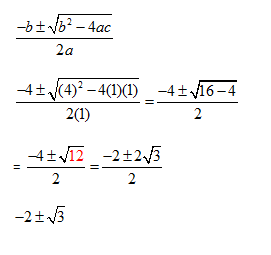
Now graph
Number of roots: two real roots Number of x-intercepts: two
Example 2 : x2 + 2x + 1 = 0
find -b/2a -2/2 = -1
f(-1) = (-1)2 + 2(-1) + 1 = 1 -2 + 1 = 0
(-1.0) is the vertex
and x = -1 is the axis of symmetry
create an xy table
f(0)=02 + 2(0) + 1 = 1
f(1) = (1)2 +2(1) + 1 = 4
x y
0 1
1 4
Now graph
Now Solve
Solving x2 + 2x + 1 = 0
We can solve easily but let’s use the quadratic formula

= -1
The solution set is {-1}
Number of roots: 1 real root Number of x- intercepts: one
Example 3: x2 -4x + 7 = 0
find –b/2a= +4/2 = 2
f(2) = (2)2 -4(2) + 7 = 4 -8 + 7 = 3
vertex ( 2, 3)
and x= 2 is the axis of symmetry
create an xy table
f(1) = (1)2 -4(1) + 7
f(0) = (0)2 -4(0) + 7
x y
1 4
0 7
Now graph
Now solve
x2 -4x + 7 = 0

There is NO REAL number root since does not represent a real number
Number of roots: no real number roots Number of x intercepts: None
In each of these examples the value of b2-4ac in the quadratic formula is the key to the number of real roots.

When b2-4ac is negative, there is no real number root of the equation ax2 + bx + c = 0 because square roots of negative numbers do not exist in the set of real numbers.
Because the value of b2-4ac discriminates, or points out differences, among these 3 cases above, it is called the discriminant of the quadratic equation.
The discriminant is only part of the quadratic formula and simpliy helps one determine the number of roots.
Sometimes it is NOT necessary to draw the graph of an equation.
Knowing the relationships between an equation and its graph— you can obtain important information from the equation itself.
Today’s lesson illustrates the relationship between the number of roots of a quadratic equation and the number of x-intercepts of the related parabola.
In the parabola the x coordinate of a point where the curve intersects the x axis is called an x-intercept of the curve.
Looking at the parabola on page 572 you notice that this parabola has two x-intercepts, -1 and 3 because y = 0 for both of these values of x.
you can also see that
x2- 2x – 3 = 0 or (x +1)(x-3) = 0
has -1 and 3 as its roots, solutions, zeros… {-1,3}
The algebraic fact that a quadratic equation can have two, one or no real number roots corresponds to the fact that a parabola can have two, one or no x-intercepts…
and we can find that out by just working with the quadratic equations—rather than having to graph…
However… let’s graph a few
Example 1: x2 + 4x + 1 = 0
find –b/2a
-4/2 = -2
f(-2) = (-2)2 + 4(-2) + 1 = 4 -8 + 1 = -3
so (-2,-3) is the vertex
x = -2 is the axis of symmetry
Create an x y table
f(-1) = (-1)2 +4(-1) + 1 = 1 -4 +1 = -2
f(0) = 02 + 4(0) + 1 = 1
x y
-1 -2
0 1
Now solve
Solving x2 + 4x + 1 = 0
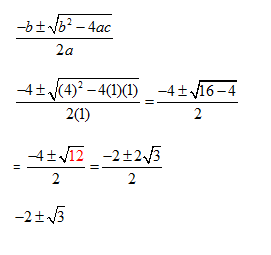
Now graph
Number of roots: two real roots Number of x-intercepts: two
Example 2 : x2 + 2x + 1 = 0
find -b/2a -2/2 = -1
f(-1) = (-1)2 + 2(-1) + 1 = 1 -2 + 1 = 0
(-1.0) is the vertex
and x = -1 is the axis of symmetry
create an xy table
f(0)=02 + 2(0) + 1 = 1
f(1) = (1)2 +2(1) + 1 = 4
x y
0 1
1 4
Now graph
Now Solve
Solving x2 + 2x + 1 = 0
We can solve easily but let’s use the quadratic formula

= -1
The solution set is {-1}
Number of roots: 1 real root Number of x- intercepts: one
Example 3: x2 -4x + 7 = 0
find –b/2a= +4/2 = 2
f(2) = (2)2 -4(2) + 7 = 4 -8 + 7 = 3
vertex ( 2, 3)
and x= 2 is the axis of symmetry
create an xy table
f(1) = (1)2 -4(1) + 7
f(0) = (0)2 -4(0) + 7
x y
1 4
0 7
Now graph
Now solve
x2 -4x + 7 = 0

There is NO REAL number root since does not represent a real number
Number of roots: no real number roots Number of x intercepts: None
In each of these examples the value of b2-4ac in the quadratic formula is the key to the number of real roots.

When b2-4ac is negative, there is no real number root of the equation ax2 + bx + c = 0 because square roots of negative numbers do not exist in the set of real numbers.
Because the value of b2-4ac discriminates, or points out differences, among these 3 cases above, it is called the discriminant of the quadratic equation.
The discriminant is only part of the quadratic formula and simpliy helps one determine the number of roots.
Math 6 Honors ( Periods 1, 2, & 3)
Negative Numbers 11-1
On a horizontal number line we use negative numbers for the coordinates of points to the left of zero. We denote the number called ‘negative four’ by the symbol -4. The symbol -4 is normally read ‘ negative 4’ but we can also say ‘ the opposite of 4.’
The graphs of 4 and -4 are the same distance from 0—>but in opposite directions. Thus they are opposites. -4 is the opposite of 4.
The opposite of 0 is 0
Absolute Value is a distance concept. Absolute value is the distance of a number from 0 on a number line. The absolute value of a number can NEVER be negative!!
Counting (also known as Natural) numbers: 1, 2, 3, 4, ….
Whole numbers 0, 1, 2, 3, 4….
Integers are natural numbers and their opposites AND zero
…-4, -3, -2, -1, 0, 1, 2, 3, 4….
The opposite of 0 is 0.
The integer 0 is neither positive nor negative.
The farther we go to the right on a number line--- the bigger the number. We can compare two integers by looking at their position on a number line.
if x < 0 what do we know? x is negative number if x > 0, what do we know? x is a positive number
We have been practicing representing integers by their graphs, that is, by points on a number line.
Make sure that your number line includes arrows at both ends and a line indicating where zero falls on your number line.
The graph of a number MUST have a closed dot right on the number line at that specific number.
Please see our textbook page 366 for an accurate example.
On a horizontal number line we use negative numbers for the coordinates of points to the left of zero. We denote the number called ‘negative four’ by the symbol -4. The symbol -4 is normally read ‘ negative 4’ but we can also say ‘ the opposite of 4.’
The graphs of 4 and -4 are the same distance from 0—>but in opposite directions. Thus they are opposites. -4 is the opposite of 4.
The opposite of 0 is 0
Absolute Value is a distance concept. Absolute value is the distance of a number from 0 on a number line. The absolute value of a number can NEVER be negative!!
Counting (also known as Natural) numbers: 1, 2, 3, 4, ….
Whole numbers 0, 1, 2, 3, 4….
Integers are natural numbers and their opposites AND zero
…-4, -3, -2, -1, 0, 1, 2, 3, 4….
The opposite of 0 is 0.
The integer 0 is neither positive nor negative.
The farther we go to the right on a number line--- the bigger the number. We can compare two integers by looking at their position on a number line.
if x < 0 what do we know? x is negative number if x > 0, what do we know? x is a positive number
We have been practicing representing integers by their graphs, that is, by points on a number line.
Make sure that your number line includes arrows at both ends and a line indicating where zero falls on your number line.
The graph of a number MUST have a closed dot right on the number line at that specific number.
Please see our textbook page 366 for an accurate example.
Thursday, March 1, 2012
Algebra Honors (Period 6 & 7)
The Quadratic Formula: 12-3
Method 5:
THE QUADRATIC FORMULA
Let's all sing it to "Pop Goes the Weasel!
" x = -b plus or minus the square root of b squared minus 4ac all over 2a
x =
-b ± √ (b2 - 4ac)
2a
Notice how the first part is the x value of the vertex -b/2a
The plus or minus square root of b squared minus 4ac represents how far away the two x intercepts (or roots) are from the vertex!!!!
Very few real world quadratics can be solved by factoring or square rooting each side.
And completing the square always works, but it long and cumbersome!
All quadratics can be solved by using the QUADRATIC FORMULA.
You will find out that some quadratics have NO REAL solutions, which means that there are no x intercepts - the parabola does not cross the x axis!
Think about what kinds of parabolas would do this....ones that are smiles that have a vertex above the x or ones that are frowns that have a vertex below the x axis.
You will find out in Algebra II that these parabolas have IMAGINARY roots
So now you know 5 ways that you know to find the roots:
1. graph
2. factor if possible
3. square root each side
4. complete the square - that's what the quadratic formula is based on!
5. plug and chug in the Quadratic Formula - This method always works if there's a REAL solution!
DON'T FORGET TO PUT THE QUADRATIC IN STANDARD FORM BEFORE PLUGGING THE VALUES INTO THE QUADRATIC FORMULA!
You should know that for the quadratic formula, you don't need the "a" coefficient to be positive!
That's important if you use factoring, SQRTing each side, and completing the square.
But for the quadratic formula, either way, you'll get the same roots!
EXAMPLE: x2 + 8x = 48
You can move the 48 over or move the x2 + 8x over and you'll get the same answers!
Let's look at:
"a" coefficient positive *****vs***** "a" coefficient negative
x2 + 8x - 48 = 0 ****VS**** -x2 - 8x + 48 = 0
First x2 + 8x - 48 = 0
-8 ± √[64 - 4(1)(-48)]
2(1)
-8 ± √(64 + 192)
2
-8 ± √(256)
2
-8 ± 16
2
(-8 + 16)/2 and (-8 - 16)/2
8/2 and -24/2
4 and -12
Now let's compare -x2 - 8x + 48 = 0
8 ± √[64 - 4(-1)(48)]
-2(1)
8 ± √(64 + 192)
-2
8 ± √(256)
-2
8 ± 16
-2
(8 + 16)/-2 and (8 - 16)/-2
24/-2 and -8/-2
-12 and 4
So all the signs are simply the opposite of each other and therefore the answers are the same
Method 5:
THE QUADRATIC FORMULA
Let's all sing it to "Pop Goes the Weasel!
" x = -b plus or minus the square root of b squared minus 4ac all over 2a
x =
-b ± √ (b2 - 4ac)
2a
Notice how the first part is the x value of the vertex -b/2a
The plus or minus square root of b squared minus 4ac represents how far away the two x intercepts (or roots) are from the vertex!!!!
Very few real world quadratics can be solved by factoring or square rooting each side.
And completing the square always works, but it long and cumbersome!
All quadratics can be solved by using the QUADRATIC FORMULA.
You will find out that some quadratics have NO REAL solutions, which means that there are no x intercepts - the parabola does not cross the x axis!
Think about what kinds of parabolas would do this....ones that are smiles that have a vertex above the x or ones that are frowns that have a vertex below the x axis.
You will find out in Algebra II that these parabolas have IMAGINARY roots
So now you know 5 ways that you know to find the roots:
1. graph
2. factor if possible
3. square root each side
4. complete the square - that's what the quadratic formula is based on!
5. plug and chug in the Quadratic Formula - This method always works if there's a REAL solution!
DON'T FORGET TO PUT THE QUADRATIC IN STANDARD FORM BEFORE PLUGGING THE VALUES INTO THE QUADRATIC FORMULA!
You should know that for the quadratic formula, you don't need the "a" coefficient to be positive!
That's important if you use factoring, SQRTing each side, and completing the square.
But for the quadratic formula, either way, you'll get the same roots!
EXAMPLE: x2 + 8x = 48
You can move the 48 over or move the x2 + 8x over and you'll get the same answers!
Let's look at:
"a" coefficient positive *****vs***** "a" coefficient negative
x2 + 8x - 48 = 0 ****VS**** -x2 - 8x + 48 = 0
First x2 + 8x - 48 = 0
-8 ± √[64 - 4(1)(-48)]
2(1)
-8 ± √(64 + 192)
2
-8 ± √(256)
2
-8 ± 16
2
(-8 + 16)/2 and (-8 - 16)/2
8/2 and -24/2
4 and -12
Now let's compare -x2 - 8x + 48 = 0
8 ± √[64 - 4(-1)(48)]
-2(1)
8 ± √(64 + 192)
-2
8 ± √(256)
-2
8 ± 16
-2
(8 + 16)/-2 and (8 - 16)/-2
24/-2 and -8/-2
-12 and 4
So all the signs are simply the opposite of each other and therefore the answers are the same
Algebra Honors (Period 6 & 7)
Completing the Square: 12-2
METHOD 4:
Now this is completely new to you!!!
When does the square root = ± square root method work well?
When the side with the variable is a PERFECT SQUARE! We saw that in the previous section.
perfect square = k ( when k ≥ 0)
So what if that side is not a perfect BINOMIAL SQUARED?
It may be possible to trasform it into one... by COMPLETING THE SQUARE
You can follow steps to make it into one!
Why is this good?
Because then you can just square root each side to find the roots!
THIS METHOD ALWAYS WORKS!
EXAMPLE:
x2 - 3x -18 = 0
(Head's up-- I wouldn't use this method here because I can see that it factors easily... into (x-6)(x+3) = 0 so the solution set is {-3,6}
However, knowing what I need to get for my solutions might be a good way to practice Completing the square..
so
x2 - 3x = 18
Step 1) b/2
That is, take half of the b coefficient ,
or in this case (- 3/2)
Step 2) Square b/2
(b/2)2
(-3/2 ⋅ -3/2 = 9/4)
Step 3) Add (b/2)2 to both sides of the equation
x2 - 10x + 9/4 = 18 +9/4
Step 4) Factor to a binomial square
(x - 3/2)2 = 18 + 9/4 = 81/4
Step 5) Square root each side and solve
√(x - 3/2)2 = √ 81/4
x - 3/2 = ± 9/2
x = 3/2 ± 9/2
x = 3/2 + 9/2 AND x = 3/2 - 9/2
x = 6 and x = -3
{-3, 6}
We got the same solutions !! Yay!!
x2 - 10x = 0
Not a TRINOMIAL SQUARE so it would not factor to a BINOMIAL SQUARED.
But here's how you can make it one!
Step 1) b/2
That is, take half of the b coefficient ,
or in this case (- 10/2 = -5)
Step 2) Square b/2
(b/2)2
(-5 x -5 = 25)
Step 3) Add (b/2)2 to both sides of the equation
x2 - 10x + 25 = +25
Step 4) Factor to a binomial square
(x - 5)2 = 25
Step 5) Square root each side and solve
√(x - 5)2 = √ 25
x - 5 = ± 5
Step 6) ADD 5 TO BOTH SIDES
x - 5 = ± 5
+ 5 = +5
x = 5 ± 5
Step 7) Simplify if possible
x = 5 + 5 and x = 5 - 5
x = 10 and x = 0
So the 2 roots (solutions/zeros/x intercepts) are 0 and 10.
YOU DON'T NEED TO GRAPH THE PARABOLA, BUT IF YOU DID, IT WOULD CROSS THE X AXIS AT 0 AND 10.
I don't know where the vertex is, but I don't need to because it's not the solution to the quadratic (although I certainly could find the vertex by using x = -b/2a)
Notice that I could also factor x2 - 10x = 0 to get the solution more easily.
So don't complete the square if the quadratic factors easily!
IF THERE IS A "c", first move the c constant to the other side of the equation before completing the square:
x2 - 10x - 11 = 0
x2 - 10x - 11 + 11 = 0 + 11
x2 - 10x = 11
NOW COMPLETE THE SQUARE AS ABOVE:
x2 - 10x + 25 = +25 + 11
(x - 5)2 = 36
√ (x - 5)2 = √ 36
x - 5 = ± 6
x = 5 ± 6
x = 11 and x = -1
Again, this one factored easily so I wouldn't have even used completing the square. ALWAYS CHECK IF IT FACTORS FIRST!
Now an example that DOES NOT FACTOR: x2 - 10x - 18 = 0
x2 - 10x - 18 = 0
x2 - 10x - 11 + 18 = 0 + 18
x2 - 10x = 18
NOW COMPLETE THE SQUARE AS ABOVE:
x2 - 10x + 25 = +25 + 18
(x - 5)2 = 43
√ (x - 5)2 = √ 43
x - 5 = ± √ 43
x = 5 ± √ 43
x = 5 + √ 43 and x = 5 - √ 43
When there is an IRRATIONAL square root, always SIMPLIFY if possible!
IF THERE IS AN "a" COEFFICIENT, YOU MUST DIVIDE EACH TERM BY IT BEFORE YOU CAN COMPLETE THE SQUARE:
Example: 2x2 - 3x - 1 = 0
Move the 1 to the other side of the equation: 2x2 - 3x = 1
Divide each term by the "a" coefficient:
x2 - 3/2 x = 1/2
Now find the completing the square term and add it to both sides:
[(-3/2)(-3/2)]2 = 9/16
x2 - 3/2 x + 9/16 = 1/2 + 9/16
(x - 3/4)2 =8/16 + 9/16
(x - 3/4)2 = 17/16
√[(x - 3/4)2 ] = ±√ [17/16]
x - 3/4 = ±[√17] /4
x = 3/4 ±[√ 17] /4
x = (3 ± [√17]) /4
or written better x =
3 ± √ 17
4
METHOD 4:
Now this is completely new to you!!!
When does the square root = ± square root method work well?
When the side with the variable is a PERFECT SQUARE! We saw that in the previous section.
perfect square = k ( when k ≥ 0)
So what if that side is not a perfect BINOMIAL SQUARED?
It may be possible to trasform it into one... by COMPLETING THE SQUARE
You can follow steps to make it into one!
Why is this good?
Because then you can just square root each side to find the roots!
THIS METHOD ALWAYS WORKS!
EXAMPLE:
x2 - 3x -18 = 0
(Head's up-- I wouldn't use this method here because I can see that it factors easily... into (x-6)(x+3) = 0 so the solution set is {-3,6}
However, knowing what I need to get for my solutions might be a good way to practice Completing the square..
so
x2 - 3x = 18
Step 1) b/2
That is, take half of the b coefficient ,
or in this case (- 3/2)
Step 2) Square b/2
(b/2)2
(-3/2 ⋅ -3/2 = 9/4)
Step 3) Add (b/2)2 to both sides of the equation
x2 - 10x + 9/4 = 18 +9/4
Step 4) Factor to a binomial square
(x - 3/2)2 = 18 + 9/4 = 81/4
Step 5) Square root each side and solve
√(x - 3/2)2 = √ 81/4
x - 3/2 = ± 9/2
x = 3/2 ± 9/2
x = 3/2 + 9/2 AND x = 3/2 - 9/2
x = 6 and x = -3
{-3, 6}
We got the same solutions !! Yay!!
x2 - 10x = 0
Not a TRINOMIAL SQUARE so it would not factor to a BINOMIAL SQUARED.
But here's how you can make it one!
Step 1) b/2
That is, take half of the b coefficient ,
or in this case (- 10/2 = -5)
Step 2) Square b/2
(b/2)2
(-5 x -5 = 25)
Step 3) Add (b/2)2 to both sides of the equation
x2 - 10x + 25 = +25
Step 4) Factor to a binomial square
(x - 5)2 = 25
Step 5) Square root each side and solve
√(x - 5)2 = √ 25
x - 5 = ± 5
Step 6) ADD 5 TO BOTH SIDES
x - 5 = ± 5
+ 5 = +5
x = 5 ± 5
Step 7) Simplify if possible
x = 5 + 5 and x = 5 - 5
x = 10 and x = 0
So the 2 roots (solutions/zeros/x intercepts) are 0 and 10.
YOU DON'T NEED TO GRAPH THE PARABOLA, BUT IF YOU DID, IT WOULD CROSS THE X AXIS AT 0 AND 10.
I don't know where the vertex is, but I don't need to because it's not the solution to the quadratic (although I certainly could find the vertex by using x = -b/2a)
Notice that I could also factor x2 - 10x = 0 to get the solution more easily.
So don't complete the square if the quadratic factors easily!
IF THERE IS A "c", first move the c constant to the other side of the equation before completing the square:
x2 - 10x - 11 = 0
x2 - 10x - 11 + 11 = 0 + 11
x2 - 10x = 11
NOW COMPLETE THE SQUARE AS ABOVE:
x2 - 10x + 25 = +25 + 11
(x - 5)2 = 36
√ (x - 5)2 = √ 36
x - 5 = ± 6
x = 5 ± 6
x = 11 and x = -1
Again, this one factored easily so I wouldn't have even used completing the square. ALWAYS CHECK IF IT FACTORS FIRST!
Now an example that DOES NOT FACTOR: x2 - 10x - 18 = 0
x2 - 10x - 18 = 0
x2 - 10x - 11 + 18 = 0 + 18
x2 - 10x = 18
NOW COMPLETE THE SQUARE AS ABOVE:
x2 - 10x + 25 = +25 + 18
(x - 5)2 = 43
√ (x - 5)2 = √ 43
x - 5 = ± √ 43
x = 5 ± √ 43
x = 5 + √ 43 and x = 5 - √ 43
When there is an IRRATIONAL square root, always SIMPLIFY if possible!
IF THERE IS AN "a" COEFFICIENT, YOU MUST DIVIDE EACH TERM BY IT BEFORE YOU CAN COMPLETE THE SQUARE:
Example: 2x2 - 3x - 1 = 0
Move the 1 to the other side of the equation: 2x2 - 3x = 1
Divide each term by the "a" coefficient:
x2 - 3/2 x = 1/2
Now find the completing the square term and add it to both sides:
[(-3/2)(-3/2)]2 = 9/16
x2 - 3/2 x + 9/16 = 1/2 + 9/16
(x - 3/4)2 =8/16 + 9/16
(x - 3/4)2 = 17/16
√[(x - 3/4)2 ] = ±√ [17/16]
x - 3/4 = ±[√17] /4
x = 3/4 ±[√ 17] /4
x = (3 ± [√17]) /4
or written better x =
3 ± √ 17
4
Subscribe to:
Posts (Atom)
