Welcome to Room K 101's Blog

Check out the Weekly Notes from your class

With Math ... you can do anything

Wednesday, September 20, 2017

Math 8

CHAPTER 2-5: Multistep Equations

IDENTITY OR NO POSSIBLE SOLUTION EQUATIONS:
An identity equation is where ANY NUMBER can be substituted for the VARIABLE, the equation will be TRUE. What will happen is that while you’re balancing the equations, you will ultimately end up with the SAME EXACT EXPRESSION ON EACH SIDE of the equation.
You can keep going, but as soon as you have the same thing on both sides, you know you have an IDENTITY EQUATION. If you keep going, the variable will disappear on both sides of the equation, leaving you with a numeric equation (a number of both sides of the equal sign). That numeric equation will be TRUE.

Therefore, ALL REAL NUMBERS will work so we say there are INFINITELY MANY SOLUTIONS.

A no possible solution equation is one where no matter what number you substitute into the equation, the equation will be FALSE.
What will happen is that after you balance the equations, you will ultimately end up without any variable on either side, just like the Identity Equation, but this time, the numbers will be DIFFERENT (which can never be true).

THERE IS NO POSSIBLE SOLUTION OR THE NULL SET ∅
NOTICE SOMETHING ELSE ABOUT
SOLVING EQUATIONS IN GENERAL:
WHENEVER YOU HAVE THE SAME EXACT TERM WITH THE SAME SIGN ON DIFFERENT SIDES OF THE EQUATION, YOU CAN SIMPLY CROSS THEM OUT BECAUSE  WHEN YOU USE THE ADDITIVE INVERSE PROPERTY ON BOTH SIDES TO BALANCE, BOTH TERMS WILL DROP OUT!

If there’s Distributive Property, generally, you will distribute first (there are times when you have the choice to divide first and I’ll show you that in class)

Simplify each side of the equation first...combine like terms on the same side!

Then use the ADDITIVE INVERSE PROPERTY to move variables to the other side of the equation so that all variables are on the same side.

Usually, we try to move the smaller coefficient to the larger because sometimes this avoids negative coefficients,
BUT that is not always the case, and you may move to whatever side you choose!

Here’s a way to remember to use the OPPOSITE SIGN when you move terms to the other side of the equation:
OPPOSITE SIDES
use the
OPPOSITE SIGN

However if like terms are on the same side of the equation, use the sign of the coefficient that you’re given and simply combine them by using integer rules:
SAME SIDE
use the
SAME SIGN

EXAMPLE OF COLLECTING TERMS FIRST:
Sometimes, you will have to COLLECT LIKE TERMS ON THE SAME SIDE OF THE EQUATION before balancing:
8y + 12 – (-2y) = -6
10y + 12 = -6
10y = -18
y = -18/10 =  -9/5


TWO STEPS WITH DISTRIBUTIVE PROPERTY
Usually, you want to do DISTRIBUTE FIRST!
UNLESS THE FACTOR OUTSIDE THE ( ) CAN BE DIVIDED
OUT OF BOTH SIDES PERFECTLY! (which I will show you in class)

EXAMPLE:
5y - 2(2y + 8) = 16
5y - 4y - 16 = 16 [distribute]
y - 16 = 16 [collect like terms]
y = 32 [solve by adding 16 to both sides]

EXAMPLE WHEN YOU DON'T NEED TO DISTRIBUTE FIRST:
-3(4 + 3x) = -9
4 + 3x = 3 [Don't distribute! Divide by -3. The -3 goes into both sides perfectly!)
3x = -1 [Subtract 4 from both sides]
x = -1/3 [Divide both sides by 3]

EXAMPLE WHERE YOU NEED TO BOTH COMBINE ON THE SAME SIDE FIRST, AND THEN MOVE THE VARIABLES TO THE SAME SIDE:
3y - 10 - y = -10y + 12
The 3y and -y are on the SAME SIDE, so just use the SAME SIGNS as in the equation and combine them using integer rules:
2y - 10 = -10y + 12
Now the 2y and the -10y are on OPPOSITE SIDES of the equation so use the OPPOSITE SIGN to move the -10y to the left side:
2y - 10 = -10y + 12
                                     +10   +10y
12y - 10 = 12

NOW DO THE TWO-STEP ;)
12y - 10 = 12
+ 10 +10
12y = 22
12 12

y = 11/6

Monday, September 18, 2017

Math 8

CHAPTER 2-4: Solving Equations with Variables on Both Sides of the Equation

Simplify each side of the equation first.

Then use the ADDITIVE INVERSE PROPERTY to move variables to the other side of the equation so that all variables are on the same side.

Usually, we try to move the smaller coefficient to the larger because sometimes this avoids negative coefficients,
BUT that is not always the case, and you may move to whatever side you choose!

Here’s a way to remember to use the OPPOSITE SIGN when you move terms to the other side of the equation:
OPPOSITE SIDES
use the
OPPOSITE SIGN

However if like terms are on the same side of the equation, use the sign of the coefficient that you’re given and simply combine them by using integer rules:
SAME SIDE
use the
SAME SIGN

EXAMPLE:
3y - 10 - y = -10y + 12
The 3y and -y are on the SAME SIDE, so just use the SAME SIGNS as in the equation and combine them using integer rules:
2y - 10 = -10y + 12
Now the 2y and the -10y are on OPPOSITE SIDES of the equation so use the OPPOSITE SIGN to move the -10y to the left side:
2y - 10 = -10y + 12
                                     +10   +10y
12y - 10 = 12

NOW DO THE TWO-STEP ;)
12y - 10 = 12
+ 10 +10
12y = 22
12 12
y = 11/6
FINDING THE VALUE OF AN UNKNOWN SO THAT 2 PERIMETERS OR AREAS ARE THE SAME:
This type of problem is a perfect example of using the Distributive Property with variable on both sides of an equation.
Example 4 on p. 99
You have 2 rectangles whose areas are the same. One rectangle has sides of x and 10 cm. and the other rectangle has sides of x + 3 and 6 cm.
Set up the following equation and solve:
10x = 6(x + 3)
10x = 6x + 18
4x = 18
x = 18/4 = 9/2 cm
CHECK THAT THE RECTANGLES DO HAVE THE SAME AREA IF x = 9/2 OR 4.5 cm
First rectangle: Sides are 4.5 and 10 so A = (4.5)(10) = 45 cm2
Second rectangle: Sides are 4.5 + 3 or 7.5 cm and 6 cm. so A = (7.5)(6) = 45 cm2
You have 2 rectangles whose perimeters are the same. One rectangle has sides of x and 6 cm. and the other rectangle has sides of 2x + 2 and x cm.
Set up the following equation and solve:
2x + 2(6) = 2(2x + 2) + 2x
2x + 12 = 4x + 4 + 2x
2x + 12 = 6x + 4
12 = 4x + 4
8 = 4x
x = 2
CHECK THAT THE RECTANGLES DO HAVE THE SAME PERIMETER IF x = 2 cm
First rectangle: Sides are 2 and 6 so P = 2(2) + 2(6) = 16 cm

Second rectangle: Sides are 2 and 2(2) + 2 = 6 so P = 2(2) + 2(6) = 16 cm

Friday, September 15, 2017

Algebra & Algebra Honors

Interpreting Graphs of Functions 1-8
There are several key features of different functions that help you identify what type of function it is and also interpret how it’s going to act.
 
LINEAR OR NONLINEAR:
If a graph has a curve, it’s nonlinear. If it’s a straight line, it’s linear.
You can see this easily when it’s graphed.
On the graphing calculator, you’ll discover that if the x power is 1, it’s a line (linear)
When we change the x power to 2 or 3 or higher, it’s nonlinear.
INTERCEPTS:
These are points where the graph intersects the x or y axis.
x-intercept: where the graph intersects the x axis…the coordinate would be of the form (x, 0)
y-intercept: where the graph intersects the y axis…the coordinate would be of the form (0, y)
If the graph goes through the ORIGIN, both intercepts would be (0, 0)
A horizontal line would not have an x-intercept UNLESS the line is the x axis (the y value would always be 0 or y = 0)
A vertical line would not have an y-intercept UNLESS the line is the y axis (the x value would always be 0 or x = 0)
IS IT POSSIBLE FOR A GRAPH TO HAVE MORE THAN ONE X OR Y INTERCEPT???
If it’s a line (linear), NO. A line can’t come back around again.
However, if a graph has a curve (nonlinear), YES it can…it can intersect say the x axis and then curve around and intersect the x axis again.
MOVING THE Y-INTERCEPTS UP OR DOWN:Adding a POSITIVE constant at the end of a function moves the graph UP and adding a NEGATIVE constant moves it DOWN.
y = x goes through the origin           y = x + 2 moves it up 2            y = x – 3 moves it down 3
 SLOPE:
When the coefficient of x is POSITIVE, it looks like you’re going up the mountain.
When the coefficient of x is +1, the slope going up is a 45 degree angle.
As the coefficient of x gets greater than 1, the steepness of the line INCREASES.
As the coefficient goes into the range between 0 and 1 (a fraction or decimal), the slope starts to level out.
When the coefficient is negative the line switches direction and looks like you’re going down the mountain.
 SYMMETRY:Just as you learned in geometry, line symmetry means that one half of a graph looks like
the other half along some vertical line.

We’ll see that y = x2 is symmetrical along the y axis.
If we move the graph to the right so it’s all in the first quadrant and look at it as the trajectory of a ball, the symmetry could be interpreted as it took the same amount of time for the ball to rise up in the air as it did to come down.
POSITIVE AND NEGATIVE PARTS OF A GRAPH: This is pretty obvious!
A function is positive where the graph is ABOVE the x axis…the RANGE is positive above the x axis.
A function is negative where the graph is BELOW the x axis…the RANGE is negative below the x axis.
INCREASING AND DECREASING PARTS OF A GRAPH:When the graph is going UP, the function is INCREASING.
When the graph is going DOWN, the function is DECREASING.
REMEMBER WE’RE LOOKING AT THE GRAPH FROM LEFT TO RIGHT!
EXTREMA:Extrema comes from the word extreme so we’re talking about extreme values of a function…either high range values or low range values (y values)
There are two kinds of extrema: minimums and maximums
A minimum means that there are no other y values (range values) lower anywhere in the function
A maximum means that there are no other y values (range values) higher anywhere in the function
A RELATIVE minimum means there are no other y values lower NEARBY (but there may be lower points in another region of the function)
A RELATIVE maximum means there are no other y values higher NEARBY (but there may be higher points in another region of the function)
 END BEHAVIOR:
Every graph has an “end” on both sides of the domain values (x values)
As x gets smaller towards negative infinity (meaning you’re going to the left on the x axis), we look at what the function values are doing (the y or range values)…Is the function also going to negative infinity (down)?....Is it going to positive infinity (up)?
As x gets larger towards positive infinity (meaning you’re going to the right on the x axis), we look at what the function values are doing (the y or range values)…Is the function also going to negative infinity (down)?....Is it going to positive infinity (up)?
Generally, we summarize end behavior by comparing what x (the domain) is doing to what y (the range or function value) is doing at the same time:
 As x decreases—>y also decreases OR  y increases
As x increasesà y also increases OR y decreases

DOMAIN AND RANGE ON A GRAPH:You already know that the x values are the domain and y values are the range.
On a graph, we look at all the possible x values to determine if the domain is all real numbers or if it’s limited in some way.
We do the same thing with the range.
For example: f(x) = x2
This is a U shaped graph that only goes up from the origin so the range is limited to y ≥ 0
The domain would be all real numbers because you can square any number and, looking at the graph, you can see that eventually the graph will go to both negative and positive infinity to the left and to the right.

REAL WORLD INTERPRETATIONS OF GRAPHS:
Sales of a company:
By looking at a graph of sales over time, you can analyze how the company is doing.
The increasing parts of the graph mean that the company is growing while the reverse is also true.
If you see a flat part of the graph, that part would show the company is staying the same.
Between an increasing and decreasing part of sales would be a relative max to sales…meaning for some reason the company is in decline.
Between a decreasing and increasing part of sales would be a relative min to sales…meaning for some reason the company is doing well again.
The end behavior over time TO THE RIGHT would predict the success of the company in the future. (to the left would be the actual history of sales)


Thursday, September 14, 2017

Math 8

CHAPTER 2-2: SOLVE TWO-STEP EQUATIONS
1. Use the ADDITION/SUBTRACTION PROPERTIES OF EQUALITY
(get rid of addition or subtraction)
2. Use the MULTIPLICATION/DIVISION PROPERTIES OF EQUALITY
(get rid of multiplication/division)

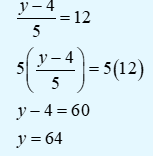
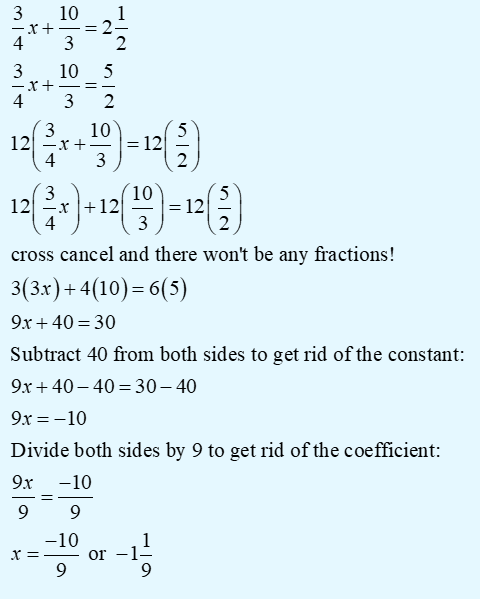
If both the constant is a fraction and the coefficient is also a fraction, sometimes it’s better to get rid of the denominators by multiply by the LCM of all the denominators first:
When there is addition or subtraction in the numerator and a constant (number) in the denominator, multiply by the denominator first!
Then you’ll have a simple one-step equation after that ;)
EXAMPLE:

Wednesday, September 13, 2017

Math 8

CHAPTER 2-1: Equations in One Variable

REVIEW OF SIMPLE EQUATIONS! One and Two Step!
GOAL? Determine the value of the variable
HOW? Isolate the variable (get it alone on one side of equation)
WHAT DO I DO? Use inverse (opposite) operations to "get rid" of everything on the side with the variable
WHAT SHOULD MY FOCUS BE WHEN EQUATIONS GET COMPLICATED?
Always focus on the variable(s) first!!!!!!!
We'll be meeting our old BFFs from 7th grade!

EQUATION BALANCING PROPERTIES OF EQUALITY:
Whatever YOU DO TO BALANCE an equation,
that operation is the property of equality that was used.
If you have x + 3 = 10, you used the SUBTRACTION PROPERTY OF EQUALITY because you need to SUBTRACT 3 from each side equally.
If you have x - 3 = 10, you used the ADDITION PROPERTY OF EQUALITY because you need to ADD 3 from each side equally.
If you have 3x = 10, you used the DIVISION PROPERTY OF EQUALITY because you need to DIVIDE each side equally by 3.
If you have x/3 = 10, you used the MULTIPLICATION PROPERTY OF EQUALITY because you need to MULTIPLY each side equally by 3.
SOMETIMES, WE SAY THERE ARE ONLY 2 BALANCING PROPERTIES OF EQUALITY
CAN YOU GUESS WHICH 2 ARE "DROPPED OUT"?
Since we say we never subtract and we really never divide, it's those 2.
GOING BACK TO OUR PREVIOUS EXAMPLES:
If you have x + 3 = 10, you could say that we ADDED -3 to each side equally; therefore, we used the ADDITION (not subtraction) PROPERTY.
If you have 3x = 10, you could say that we MULTIPLIED each side equally by 1/3; therefore, we used the MULTIPLICATION (not division) PROPERTY.
(We always multiply by the MULTIPLICATIVE INVERSE).

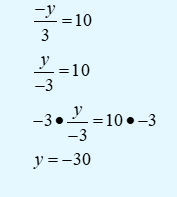
Special type of one-step equation are those where the VARIABLE IS NEGATIVE.
Remember: You’re solving for the POSITIVE VARIABLE.
There are a couple of ways to do this.
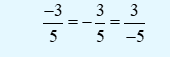
DID YOU KNOW THAT YOU CAN MOVE A NEGATIVE SIGN
IN 3 DIFFERENT PLACES ON ANY FRACTION????
So if you see a negative sign on a variable in a fraction, you can move the negative sign!
We use the MULTIPLICATIVE INVERSE PROPERTY to balance the equation and ISOLATE the variable on one side.
The multiplicative inverse of a number is its reciprocal.

The multiplicative inverse of ¾ is 4/3.
If the fraction is NEGATIVE, so is its multiplicative inverse:
Example: If you have -3 ½ , first make it improper: -7/2, and then its multiplicative inverse (reciprocal) is -2/7.
MULTIPLY BY THE RECIPROCAL ON BOTH SIDES TO SOLVE A ONE-STEP EQUATION WHERE THE COEFFICIENT IS A FRACTION.

FOR DECIMALS, SIMPLY DIVIDE EACH SIDE BY THE DECIMAL AND DO THE DIVISION USING YOUR UNDERSTANDING OF LONG DIVISION WITH DECIMALS.
I’ll also show you how to get rid of the decimals as a different approach.

If you’d like to try this approach for decimals:
Multiply both sides of the equation by a POWER OF 10 big enough to get rid of the all the decimals (make them all integers).

Example: 3.45x = .005
You would need to multiply both sides by 1000 so that both sides would no longer have decimals:
1000(3.45x) = 1000(.005)
3450x = 5

Now you would divide by 3450 on both sides.

Note: You’ll still get a decimal answer, but while you’re solving you don’t have decimals.
This works really well when all the terms have the same place value!

If the coefficient is a fraction, you’ll get the answer in ONE-STEP if you use the MULTIPLICATIVE INVERSE PROPERTY and multiply both sides equally by the RECIPROCAL of the coefficient.
Example:
¾ x = 15
(4/3)(¾ x) = (15)(4/3)
x = 20
MAKE SURE YOU ALWAYS CROSS CANCEL if possible!!!

Algebra & Algebra Honors

Function 1-7
Function: a relation (set of ordered pairs) where there is EXACTLY ONE output for each input. Each element of the domain has EXACTLY ONE element in the range. THE X VALUES NEVER REPEAT!

Vertical Line Test: If the relation is represented with a GRAPH, this test is the easiest way to see if an x value repeats. Draw vertical lines up and down continuously on the graph and see if a line intersects with (hits) more than one point. If it does, it’s a relation, but not a function. If it doesn’t, it’s a function.

***Discrete function: a function where the ordered pairs are not connected (For example, you can’t purchase a part of a candy bar at 7-11)

***Continuous function: a function where the ordered pairs are connected in a smooth curve (For example, if you’re driving in a car, the distance ever increases continuously)

Function notation: f(x): If a relation is a function, you can write the equation using y as a variable as the function value OR you can use f(x) as the function value. You read this as “the function of x” or the function value for the given x value.  Note that “f” is NOT A VARIABLE…it’s an abbreviation for the word FUNCTION…so don’t ever divide by f
Example: y = 2x + 3 OR f(x) = 2x + 3 represent the same function.
To find f(2) in the above function, simply plug in 2 for x and evaluate: f(2) = 2(2) + 3 = 7 so f(2) = 7

WHAT’S BETTER ABOUT f(2)=7 vs y=7 although they mean the same thing?  In function notation, you know both the domain value and the range value!    Using other letters with function notation:

Another good thing about function notation is that you can use specific letters that show the relationship between two variables. For example, the cost of what you spend depends on how much you buy. Say you’re only buying pizzas for a big party. Let c represent the cost of the pizza and p represent the number of pizzas you purchase. The function notation of c(p) would be expressed in words as “the cost of the pizza”.  Notice: the variable inside the ( ) is the input/independent variable/domain and the outside variable is the output/dependent variable/range. … What you spend depends on the number of pizzas you order!

 You can multiply or divide functions. The way you express this is to simple show the operations on the f(x):   2[f(x)] means to double the function  Example: If f(x) = 2x + 3 then   2[f(x)] = 2(2x + 3) = 4x + 6


 LINEar function: A set of ordered pairs that draws a straight line (that’s not vertical)

NonLINEar function: A set of ordered pairs that does NOT draw a straight line

Tuesday, September 5, 2017

Algebra/ Algebra Honors

CHAPTER 1-3: Properties (2 days)
Re-introducing you to lots of old friends today!
WHAT ARE PROPERTIES?  They are characteristics of math operations that can be identified

WHY ARE THEY YOUR FRIENDS? (BFFs or Best Friends Forever) You can count on properties.
They always work. There are NO COUNTER EXAMPLES!
THEY ALLOW YOU TO WRITE EQUIVALENT EXPRESSIONS FOR AN EXPRESSION AND THE NEW EXPRESSION MAY BE EASIER TO USE!!
COUNTEREXAMPLE = an example that shows that something does NOT WORK
(counters what you have said)

PROPERTIES ARE THE EXCEPTIONS TO AUNT SALLY
Some properties give you a choice when it's all multiplication OR all addition
There are no counterexamples for these two operations.
BUT THEY DO NOT WORK FOR SUBTRACTION OR DIVISION
(lots of counterexamples!  10 - 2 does not equal 2 - 10
15 ÷ 5 does not equal 5 ÷ 15)
JUSTIFYING

Because you can ALWAYS count on PROPERTIES, you can use them to JUSTIFY what you do mathematically.
JUSTIFY = giving a reason for doing what you did, and those reasons are your BFFS, the properties!
There are 2 parts to justifying:
1) First of all, what did you change OR if you’re looking at what someone else did, WHAT CHANGED?
(Did the order change? Did the (  ) change? Has anything been simplified?)

2) What allowed you (or them) to make that change?
(Commutative? Associative? Distributive?)

Example: You’re given (565)(5)(2) but you change it to:  (5)(2)(565) and get quickly (10)(565) = 5650
JUSTIFY! (what did you do to find the answer)
1) You changed the ORDER
2) Commutative Property of Multiplication allows you to change the order

Example: You’re given (565)(5)(2) but you change it to:  (565)[(5)(2)] and get quickly (565)(10) = 5650
JUSTIFY! (what did you do to find the answer)
1) You put in a set of [  ]  
2) Associative Property of Multiplication allows you to either add are take away a set of parentheses

WHY DOES AUNT SALLY DISLIKE PROPERTIES INTENSELY???
BECAUSE PROPERTIES ARE EXCEPTIONS TO HER RULES (ORDER OF OPERATIONS OR PEMDAS)!!!
She’s happy though that sometimes your justification can be ORDER OF OPERATIONS (in other words you just simplified  or did the math in the proper order of PEMDAS)

AGAIN WHY DO WE LOVE PROPERTIES???
WHY SHOULD YOU CARE????
 Because they make the math easier sometimes!
BUT AUNT SALLY HATES THEM BECAUSE THEY ALLOW US TO BREAK HER RULES!!
I.      COMMUTATIVE PROPERTY
PROPERTIES ARE OUR FRIENDS! (mathematically speaking)
YOU CAN ALWAYS DEPEND ON THEM --- THEY HAVE NO COUNTEREXAMPLES!

COMMUTATIVE PROPERTY (works for all multiplication or all addition)
You can SWITCH THE ORDER and still get the same sum or product.
This is the property YOU CAN HEAR because you've switched the order.
a + b = b + a OR ab = ba
Therefore, we say that both sides of the equations have EQUIVALENT (=) EXPRESSIONS
SO WHY SHOULD YOU CARE????
Because it makes the math easier sometimes!
Which would you rather multiply:
(2)(543)(5) OR (2)(5)(543) ???
II.   ASSOCIATIVE PROPERTY
ANOTHER FRIEND!
This friend allows you to GROUP all multiplication or all addition ANYWAY YOU CHOOSE!
a + (b + c) = (a + b) + c
a(bc) = (ab)c
Why? TO MAKE THE MATH EASIER OF COURSE!
This is the property that YOU CAN SEE instead of hearing because you use ( ) but DON'T CHANGE THE ORDER AS IT IS GIVEN.
EXAMPLE: [(543)(5)](2)
Aunt Sally would say you must do the 543 by the 5 first since it's in [ ]
But our friend the Associative Property allows us to simply move the [ ]
[(543)(5)](2) = (543)[(5)(2)] which is so much easier to multiply in your head!!!
TWO MORE FRIENDS: 
III.      THE IDENTITY PROPERTIES OF ADDITION AND MULTIPLICATION
For addition, we know that adding zero to anything will not change the IDENTITY of what you started with: a + 0 = a (what you started with)
0 is known as the ADDITIVE IDENTITY.

For multiplication, we know that multiplying 1 by anything will not change the IDENTITY of what you started with: (1)(a) = a (what you started with)
1 is known as the MULTIPLICATIVE IDENTITY.
Sometimes 1 is "incognito" (disguised!)
We use this concept all the time to get EQUIVALENT FRACTIONS.
Say we have 3/4 but we want the denominator to be 12
We multiply both the numerator and the denominator by 3 and get 9/12
We actually used the MULTIPLICATIVE IDENTITY of 1, but it was disguised as 3/3
ANYTHING OVER ITSELF = 1 (except zero because dividing by zero is UNDEFINED!)
a + b - c = 1
a + b - c

We also use this property to SIMPLIFY fractions. We "cross cancel" all the parts on the top and the bottom that equal 1 (your parents would say that we are reducing the fraction)
                              6abc = 3bc since both the numerator and denominator can be divided by 2a.
                               2a
IV.  PROPERTIES OF EQUALITY
(these are also called AXIOMS)

REFLEXIVE:
a = a
3 = 3
In words: It looks exactly the same on both sides! (like reflecting in a mirror)
This seems ridiculous, but in Geometry it's used all the time.
I'll show you that in class.

SYMMETRIC:
a = b then b = a
3 + 5 = 8 then 8 = 3 + 5
In words: You can switch the sides of an equation.
We use this all the time to switch the sides if the variable ends up on the right side:
12 = 5y -3
The Symmetric property allows us to switch sides:
5y - 3 = 12


TRANSITIVE:
                        If a = b and b = c then a = c
                        3 + 5 = 8, and 2 + 6 = 8 then 3 + 5 = 2 + 6
                        In words: If 2 things both equal a third thing, then we can just say that the first 2 things are equal.
                        If Jane is 14 years old and Bobby is 14 years old, then we can say that Jane and Bobby are the same age
                        It's like cutting out the "middle man"!


I've got a pattern that will help you recognize the difference between these 3 properties specifically.
If you put these 3 properties in order alphabetically, they'll be in order this way:
The Reflexive Property only has ONE equation
The Symmetric Property only has TWO equations
The Transitive Property only has THREE equations
SO REMEMBER THIS: R,S,T…1,2,3!


V.      SUBSTITUTION:
Very similar to Transitive
If a = b, then a may be SUBSTITUTED in for b in any other expression.
If 3 + 5 = 8 then 3 + 5 may be substituted for 8 in any other expression:
50 + 8 = 58
50 + (3 + 5) also = 58
In Algebra, we use substitution all the time to substitute a value in for a variable:
3 + n if n = 10
3 + 10 would be an equivalent expression because n = 10 so we can replace n with 10 in the original expression


VI.  INVERSE PROPERTIES:
ADDITIVE INVERSE:
Adding opposites signs of the same term = 0.
This "friend" saves us time when adding a lot of integers together (THAT’S WHY WE SAY “YAY”!)...always look for opposites FIRST and cross them out!
a + (-a) = 0

MULTIPLICATIVE INVERSE:
Multiplying by the reciprocal of a term = 1.
(a)(1/a) = 1
(4/5)(5/4) = 1
(-2)(-1/2) = 1
This friend helps because you can make math easier with fractions by allowing you to cross cancel!

Both inverses are used in equation balancing.

Wednesday, August 23, 2017

Our Class Blog

Our Class Blog

Welcome to our class blog... where you can earn extra credit by adding your own relevant comments about our class notes for the day... or where you can find answers from others in your class. Check here often, especially if you have been absent. You might just find out the math strategy that works for you!!