Welcome to Room K 101's Blog

Check out the Weekly Notes from your class

With Math ... you can do anything

Showing posts with label Math 8. Show all posts

Tuesday, September 26, 2017

Math 8

CHAPTER 2-3: WRITING TWO-STEP EQUATIONS
Algebraic expressions just are the ones that have variables
Numeric expressions have only numbers
Equations must have an = sign while expressions do not
STRATEGY #1:TRANSLATE WORD BY WORD
Always try this first.
Just be careful of less THAN and subtracted FROM because these are switched from the order that you read/say them:
A number less THAN 12 is 12 – n but if you say a number less 12, this would be n – 12
12 subtracted FROM a number is n – 12, but 12 subtract a number would be 12 – n
The only other translation to be careful of is when you multiply a SUM or DIFFERENCE by a number or variable:
12 times the SUM of a number and 5 is 12(n + 5), but the sum of 12 times a number and 5 would  be 12n + 5
12 times the DIFFERENCE of a number and 5 is 12(n – 5), but the difference of 12 times a number and 5 would be 12n – 5
If you have 2 or more unknowns, use different variables:
The difference of a number and ANOTHER number would be x - y


STRATEGY #2: DRAWING A PICTURE
(When in doubt, draw it out! ;)
I have 5 times the number of quarters as I have dimes.
I translate to: 5Q = D
I check: If I assume that I have 20 quarters, then 5(20) = 100 dimes
Does this make sense? That would mean I have a lot more dimes than quarters.
The original problem says I have a lot more quarters!
My algebra is WRONG! I need to switch the variables.
5D = Q
I check: If I assume that I have 20 quarters, then 5D = 20
D = 4
Does this make sense? YES! I have 20 quarters and only 4 dimes.
Sometimes it helps to make a quick picture.
Imagine 2 piles of coins.
The pile of quarters is 5 times as high as the pile of dimes.
You can clearly see that you would need to multiply the number of dimes
to make that pile the same height as the number of quarters!


STRATEGY #3: MAKE A T-CHART (really and x-y table)
Let’s say you know that every bagel you buy costs the same amount of money, $.65. You buy bagels and spend $4.55. Write the algebraic equation and then solve for the number of bagels that you purchased.
Number of Bagels
Price
1
.65
2
1.30
3
1.95
b
.65b
By looking at the pattern from the left column to the right column, you find that the number of bagels TIMES the unit rate of the price/bagel gives you the total purchase price. Now you use a variable like b to come up with the algebraic expression for the purchase of any number of bagels, .65b.
Finally, set up the algebraic equation for the amount of money you spent (given in the problem):
.65b = 4.55
You can also do this for two-step equations. Let’s say you’re joining a gym and there is an initiation fee of $50 and then a monthly fee of $20 a month. Focus on the amount that is happening repeatedly because that is going to be your coefficient of the variable…since that is the amount that will “vary”, as opposed to the $50 one-time fee that will never change.
You can do this with or without a table!
Number of Months
Price
0
50
1
70
2
90
3
110
m
20m + 50
$20m + $50 = your cost
Say the problem asks how many months you’ve been going if you’ve paid $170:
20m + 50 = 170
Solve for the number of months:
20m = 120

m = 6 months

Wednesday, September 20, 2017

Math 8

CHAPTER 2-5: Multistep Equations

IDENTITY OR NO POSSIBLE SOLUTION EQUATIONS:
An identity equation is where ANY NUMBER can be substituted for the VARIABLE, the equation will be TRUE. What will happen is that while you’re balancing the equations, you will ultimately end up with the SAME EXACT EXPRESSION ON EACH SIDE of the equation.
You can keep going, but as soon as you have the same thing on both sides, you know you have an IDENTITY EQUATION. If you keep going, the variable will disappear on both sides of the equation, leaving you with a numeric equation (a number of both sides of the equal sign). That numeric equation will be TRUE.

Therefore, ALL REAL NUMBERS will work so we say there are INFINITELY MANY SOLUTIONS.

A no possible solution equation is one where no matter what number you substitute into the equation, the equation will be FALSE.
What will happen is that after you balance the equations, you will ultimately end up without any variable on either side, just like the Identity Equation, but this time, the numbers will be DIFFERENT (which can never be true).

THERE IS NO POSSIBLE SOLUTION OR THE NULL SET ∅
NOTICE SOMETHING ELSE ABOUT
SOLVING EQUATIONS IN GENERAL:
WHENEVER YOU HAVE THE SAME EXACT TERM WITH THE SAME SIGN ON DIFFERENT SIDES OF THE EQUATION, YOU CAN SIMPLY CROSS THEM OUT BECAUSE  WHEN YOU USE THE ADDITIVE INVERSE PROPERTY ON BOTH SIDES TO BALANCE, BOTH TERMS WILL DROP OUT!

If there’s Distributive Property, generally, you will distribute first (there are times when you have the choice to divide first and I’ll show you that in class)

Simplify each side of the equation first...combine like terms on the same side!

Then use the ADDITIVE INVERSE PROPERTY to move variables to the other side of the equation so that all variables are on the same side.

Usually, we try to move the smaller coefficient to the larger because sometimes this avoids negative coefficients,
BUT that is not always the case, and you may move to whatever side you choose!

Here’s a way to remember to use the OPPOSITE SIGN when you move terms to the other side of the equation:
OPPOSITE SIDES
use the
OPPOSITE SIGN

However if like terms are on the same side of the equation, use the sign of the coefficient that you’re given and simply combine them by using integer rules:
SAME SIDE
use the
SAME SIGN

EXAMPLE OF COLLECTING TERMS FIRST:
Sometimes, you will have to COLLECT LIKE TERMS ON THE SAME SIDE OF THE EQUATION before balancing:
8y + 12 – (-2y) = -6
10y + 12 = -6
10y = -18
y = -18/10 =  -9/5


TWO STEPS WITH DISTRIBUTIVE PROPERTY
Usually, you want to do DISTRIBUTE FIRST!
UNLESS THE FACTOR OUTSIDE THE ( ) CAN BE DIVIDED
OUT OF BOTH SIDES PERFECTLY! (which I will show you in class)

EXAMPLE:
5y - 2(2y + 8) = 16
5y - 4y - 16 = 16 [distribute]
y - 16 = 16 [collect like terms]
y = 32 [solve by adding 16 to both sides]

EXAMPLE WHEN YOU DON'T NEED TO DISTRIBUTE FIRST:
-3(4 + 3x) = -9
4 + 3x = 3 [Don't distribute! Divide by -3. The -3 goes into both sides perfectly!)
3x = -1 [Subtract 4 from both sides]
x = -1/3 [Divide both sides by 3]

EXAMPLE WHERE YOU NEED TO BOTH COMBINE ON THE SAME SIDE FIRST, AND THEN MOVE THE VARIABLES TO THE SAME SIDE:
3y - 10 - y = -10y + 12
The 3y and -y are on the SAME SIDE, so just use the SAME SIGNS as in the equation and combine them using integer rules:
2y - 10 = -10y + 12
Now the 2y and the -10y are on OPPOSITE SIDES of the equation so use the OPPOSITE SIGN to move the -10y to the left side:
2y - 10 = -10y + 12
                                     +10   +10y
12y - 10 = 12

NOW DO THE TWO-STEP ;)
12y - 10 = 12
+ 10 +10
12y = 22
12 12

y = 11/6

Monday, September 18, 2017

Math 8

CHAPTER 2-4: Solving Equations with Variables on Both Sides of the Equation

Simplify each side of the equation first.

Then use the ADDITIVE INVERSE PROPERTY to move variables to the other side of the equation so that all variables are on the same side.

Usually, we try to move the smaller coefficient to the larger because sometimes this avoids negative coefficients,
BUT that is not always the case, and you may move to whatever side you choose!

Here’s a way to remember to use the OPPOSITE SIGN when you move terms to the other side of the equation:
OPPOSITE SIDES
use the
OPPOSITE SIGN

However if like terms are on the same side of the equation, use the sign of the coefficient that you’re given and simply combine them by using integer rules:
SAME SIDE
use the
SAME SIGN

EXAMPLE:
3y - 10 - y = -10y + 12
The 3y and -y are on the SAME SIDE, so just use the SAME SIGNS as in the equation and combine them using integer rules:
2y - 10 = -10y + 12
Now the 2y and the -10y are on OPPOSITE SIDES of the equation so use the OPPOSITE SIGN to move the -10y to the left side:
2y - 10 = -10y + 12
                                     +10   +10y
12y - 10 = 12

NOW DO THE TWO-STEP ;)
12y - 10 = 12
+ 10 +10
12y = 22
12 12
y = 11/6
FINDING THE VALUE OF AN UNKNOWN SO THAT 2 PERIMETERS OR AREAS ARE THE SAME:
This type of problem is a perfect example of using the Distributive Property with variable on both sides of an equation.
Example 4 on p. 99
You have 2 rectangles whose areas are the same. One rectangle has sides of x and 10 cm. and the other rectangle has sides of x + 3 and 6 cm.
Set up the following equation and solve:
10x = 6(x + 3)
10x = 6x + 18
4x = 18
x = 18/4 = 9/2 cm
CHECK THAT THE RECTANGLES DO HAVE THE SAME AREA IF x = 9/2 OR 4.5 cm
First rectangle: Sides are 4.5 and 10 so A = (4.5)(10) = 45 cm2
Second rectangle: Sides are 4.5 + 3 or 7.5 cm and 6 cm. so A = (7.5)(6) = 45 cm2
You have 2 rectangles whose perimeters are the same. One rectangle has sides of x and 6 cm. and the other rectangle has sides of 2x + 2 and x cm.
Set up the following equation and solve:
2x + 2(6) = 2(2x + 2) + 2x
2x + 12 = 4x + 4 + 2x
2x + 12 = 6x + 4
12 = 4x + 4
8 = 4x
x = 2
CHECK THAT THE RECTANGLES DO HAVE THE SAME PERIMETER IF x = 2 cm
First rectangle: Sides are 2 and 6 so P = 2(2) + 2(6) = 16 cm

Second rectangle: Sides are 2 and 2(2) + 2 = 6 so P = 2(2) + 2(6) = 16 cm

Thursday, September 14, 2017

Math 8

CHAPTER 2-2: SOLVE TWO-STEP EQUATIONS
1. Use the ADDITION/SUBTRACTION PROPERTIES OF EQUALITY
(get rid of addition or subtraction)
2. Use the MULTIPLICATION/DIVISION PROPERTIES OF EQUALITY
(get rid of multiplication/division)

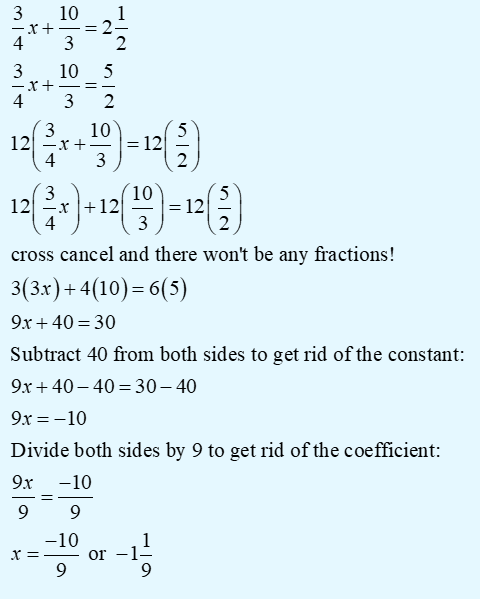
If both the constant is a fraction and the coefficient is also a fraction, sometimes it’s better to get rid of the denominators by multiply by the LCM of all the denominators first:
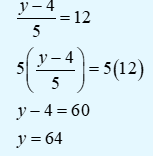
When there is addition or subtraction in the numerator and a constant (number) in the denominator, multiply by the denominator first!
Then you’ll have a simple one-step equation after that ;)
EXAMPLE:

Wednesday, September 13, 2017

Math 8

CHAPTER 2-1: Equations in One Variable

REVIEW OF SIMPLE EQUATIONS! One and Two Step!
GOAL? Determine the value of the variable
HOW? Isolate the variable (get it alone on one side of equation)
WHAT DO I DO? Use inverse (opposite) operations to "get rid" of everything on the side with the variable
WHAT SHOULD MY FOCUS BE WHEN EQUATIONS GET COMPLICATED?
Always focus on the variable(s) first!!!!!!!
We'll be meeting our old BFFs from 7th grade!

EQUATION BALANCING PROPERTIES OF EQUALITY:
Whatever YOU DO TO BALANCE an equation,
that operation is the property of equality that was used.
If you have x + 3 = 10, you used the SUBTRACTION PROPERTY OF EQUALITY because you need to SUBTRACT 3 from each side equally.
If you have x - 3 = 10, you used the ADDITION PROPERTY OF EQUALITY because you need to ADD 3 from each side equally.
If you have 3x = 10, you used the DIVISION PROPERTY OF EQUALITY because you need to DIVIDE each side equally by 3.
If you have x/3 = 10, you used the MULTIPLICATION PROPERTY OF EQUALITY because you need to MULTIPLY each side equally by 3.
SOMETIMES, WE SAY THERE ARE ONLY 2 BALANCING PROPERTIES OF EQUALITY
CAN YOU GUESS WHICH 2 ARE "DROPPED OUT"?
Since we say we never subtract and we really never divide, it's those 2.
GOING BACK TO OUR PREVIOUS EXAMPLES:
If you have x + 3 = 10, you could say that we ADDED -3 to each side equally; therefore, we used the ADDITION (not subtraction) PROPERTY.
If you have 3x = 10, you could say that we MULTIPLIED each side equally by 1/3; therefore, we used the MULTIPLICATION (not division) PROPERTY.
(We always multiply by the MULTIPLICATIVE INVERSE).

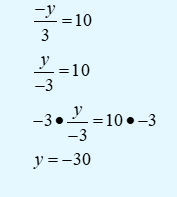
Special type of one-step equation are those where the VARIABLE IS NEGATIVE.
Remember: You’re solving for the POSITIVE VARIABLE.
There are a couple of ways to do this.
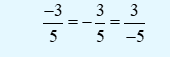
DID YOU KNOW THAT YOU CAN MOVE A NEGATIVE SIGN
IN 3 DIFFERENT PLACES ON ANY FRACTION????
So if you see a negative sign on a variable in a fraction, you can move the negative sign!
We use the MULTIPLICATIVE INVERSE PROPERTY to balance the equation and ISOLATE the variable on one side.
The multiplicative inverse of a number is its reciprocal.

The multiplicative inverse of ¾ is 4/3.
If the fraction is NEGATIVE, so is its multiplicative inverse:
Example: If you have -3 ½ , first make it improper: -7/2, and then its multiplicative inverse (reciprocal) is -2/7.
MULTIPLY BY THE RECIPROCAL ON BOTH SIDES TO SOLVE A ONE-STEP EQUATION WHERE THE COEFFICIENT IS A FRACTION.

FOR DECIMALS, SIMPLY DIVIDE EACH SIDE BY THE DECIMAL AND DO THE DIVISION USING YOUR UNDERSTANDING OF LONG DIVISION WITH DECIMALS.
I’ll also show you how to get rid of the decimals as a different approach.

If you’d like to try this approach for decimals:
Multiply both sides of the equation by a POWER OF 10 big enough to get rid of the all the decimals (make them all integers).

Example: 3.45x = .005
You would need to multiply both sides by 1000 so that both sides would no longer have decimals:
1000(3.45x) = 1000(.005)
3450x = 5

Now you would divide by 3450 on both sides.

Note: You’ll still get a decimal answer, but while you’re solving you don’t have decimals.
This works really well when all the terms have the same place value!

If the coefficient is a fraction, you’ll get the answer in ONE-STEP if you use the MULTIPLICATIVE INVERSE PROPERTY and multiply both sides equally by the RECIPROCAL of the coefficient.
Example:
¾ x = 15
(4/3)(¾ x) = (15)(4/3)
x = 20
MAKE SURE YOU ALWAYS CROSS CANCEL if possible!!!