Completing the Square: 12-2
METHOD 4:
Now this is completely new to you!!!
When does the square root = ± square root method work well?
When the side with the variable is a PERFECT SQUARE! We saw that in the previous section.
perfect square = k ( when k ≥ 0)
So what if that side is not a perfect BINOMIAL SQUARED?
It may be possible to trasform it into one... by COMPLETING THE SQUARE
You can follow steps to make it into one!
Why is this good?
Because then you can just square root each side to find the roots!
THIS METHOD ALWAYS WORKS!
EXAMPLE:
x2 - 3x -18 = 0
(Head's up-- I wouldn't use this method here because I can see that it factors easily... into (x-6)(x+3) = 0 so the solution set is {-3,6}
However, knowing what I need to get for my solutions might be a good way to practice Completing the square..
so
x2 - 3x = 18
Step 1) b/2
That is, take half of the b coefficient ,
or in this case (- 3/2)
Step 2) Square b/2
(b/2)2
(-3/2 ⋅ -3/2 = 9/4)
Step 3) Add (b/2)2 to both sides of the equation
x2 - 3x + 9/4 = 18 +9/4
Step 4) Factor to a binomial square
(x - 3/2)2 = 18 + 9/4
= 81/4
Step 5) Square root each side and solve
√(x - 3/2)2 = √ 81/4
x - 3/2 = ± 9/2
x = 3/2 ± 9/2
x = 3/2 + 9/2 AND x = 3/2 - 9/2
x = 6 and x = -3
{-3, 6}
We got the same solutions !! Yay!!
x2 - 10x = 0
Not a TRINOMIAL SQUARE so it would not factor to a BINOMIAL SQUARED.
But here's how you can make it one!
Step 1) b/2
That is, take half of the b coefficient ,
or in this case (- 10/2 = -5)
Step 2) Square b/2
(b/2)2
(-5 x -5 = 25)
Step 3) Add (b/2)2 to both sides of the equation
x2 - 10x + 25 = +25
Step 4) Factor to a binomial square
(x - 5)2 = 25
Step 5) Square root each side and solve
√(x - 5)2 = √ 25
x - 5 = ± 5
Step 6) ADD 5 TO BOTH SIDES
x - 5 = ± 5
+ 5 = +5
x = 5 ± 5
Step 7) Simplify if possible
x = 5 + 5 and x = 5 - 5
x = 10 and x = 0
So the 2 roots (solutions/zeros/x intercepts) are 0 and 10.
YOU DON'T NEED TO GRAPH THE PARABOLA, BUT IF YOU DID, IT WOULD CROSS THE X AXIS AT 0 AND 10.
I don't know where the vertex is, but I don't need to because it's not the solution to the quadratic (although I certainly could find the vertex by using x = -b/2a)
Notice that I could also factor x2 - 10x = 0 to get the solution more easily.
So don't complete the square if the quadratic factors easily!
IF THERE IS A "c", first move the c constant to the other side of the equation before completing the square:
x2 - 10x - 11 = 0
x2 - 10x - 11 + 11 = 0 + 11
x2 - 10x = 11
NOW COMPLETE THE SQUARE AS ABOVE:
x2 - 10x + 25 = +25 + 11
(x - 5)2 = 36
√ (x - 5)2 = √ 36
x - 5 = ± 6
x = 5 ± 6
x = 11 and x = -1
Again, this one factored easily so I wouldn't have even used completing the square. ALWAYS CHECK IF IT FACTORS FIRST!
Now an example that DOES NOT FACTOR: x2 - 10x - 18 = 0
x2 - 10x - 18 = 0
x2 - 10x - 11 + 18 = 0 + 18
x2 - 10x = 18
NOW COMPLETE THE SQUARE AS ABOVE:
x2 - 10x + 25 = +25 + 18
(x - 5)2 = 43
√ (x - 5)2 = √ 43
x - 5 = ± √ 43
x = 5 ± √ 43
x = 5 + √ 43 and x = 5 - √ 43
When there is an IRRATIONAL square root, always SIMPLIFY if possible!
IF THERE IS AN "a" COEFFICIENT, YOU MUST DIVIDE EACH TERM BY IT BEFORE YOU CAN COMPLETE THE SQUARE:
Example: 2x2 - 3x - 1 = 0
Move the 1 to the other side of the equation:
2x2 - 3x = 1
Divide each term by the "a" coefficient:
x2 - 3/2 x = 1/2
Now find the completing the square term and add it to both sides:
[(-3/2)(-3/2)]2 = 9/16
x2 - 3/2 x + 9/16 = 1/2 + 9/16
(x - 3/4)2 =8/16 + 9/16
(x - 3/4)2 = 17/16
√[(x - 3/4)2 ] = ±√ [17/16]
x - 3/4 = ±[√17] /4
x = 3/4 ±[√ 17] /4
x = (3 ± [√17]) /4
or written better x =
3 ± √ 17
4
Monday, March 11, 2013

Math 6A (Periods 2 & 4)
Negative Numbers 11-1
On a horizontal number line we use negative numbers for the coordinates of points to the left of zero. We denote the number called ‘negative four’ by the symbol -4. The symbol -4 is normally read ‘ negative 4’ but we can also say ‘ the opposite of 4.’
The graphs of 4 and -4 are the same distance from 0—>but in opposite directions. Thus they are opposites. -4 is the opposite of 4.
The opposite of 0 is 0
Absolute Value is a distance concept. Absolute value is the graph of the distance of a number from 0 on a number line. The absolute value of a number can NEVER be negative!!
Counting (also known as Natural) numbers: 1, 2, 3, 4, ….
Whole numbers 0, 1, 2, 3, 4….
Integers are natural numbers and their opposites AND zero
…-4, -3, -2, -1, 0, 1, 2, 3, 4….
The opposite of 0 is 0.
The integer 0 is neither positive nor negative.
The farther we go to the right on a number line--- the bigger the number. We can compare two integers by looking at their position on a number line.
if x < 0 what do we know? x is negative number if x > 0, what do we know? x is a positive number
We have been practicing representing integers by their graphs, that is, by points on a number line.
Make sure that your number line includes arrows at both ends and a line indicating where zero falls on your number line.
The graph of a number MUST have a closed dot right on the number line at that specific number.
Please see our textbook page 366 for an accurate example.
Friday, March 8, 2013
Algebra Honors ( Periods 5 & 6)
Quadratic Equations with Perfect Squares 12-1
In Chapter 5 you learned how to solve certain quadratic equations by factoring and in Chapter 11 you learned how to solve quadratics in the for
x2 = k
as in x2 = 49
x = ±7
This lesson extend to any quadratic equation involving a perfect square
if we have x2 = k
if:
k > 0 then x2 = k has two real-numbered roots with x = ±√k
if k = 0 then x2 = k has one real numbered root x = 0
if k<0 nbsp="" sup="" then="" x="">2
= k has no real numbered roots
m2 = 49
√(m2) = ±√49
m = ±7
{-7, 7}
5r2= 45
5r2 /5= 45/5
r2= 9
√r2= ±√9
r = ±3
{-3,3}
(x + 6)2 = 64
√(x+6)2 = ±√64
x+6 = ±8
be careful here
you now have
x = -6±8 which means
x = -6-8 = -14 AND x = -6+8 = 2
{-14, 2}
9r2 = 121
9r2/9 = 121/9
r2 = 121/9
√r2= ±√121/9
r = ±11/3
Make sure to check your solutions to insure that they both work
(x-3)2 = 100
√ (x-3)2 = ±√100
(x-3) = ±10
x = 3 ±10
x = 3 +10 = 13 and x = 3-10 = -7
{-7, 13}
5(x-4)2 = 40
5(x-4)2/5 = 40/5
(x-4)2 = 8
√ (x-4)2 = ±√8
Now you need to simplify the Radical
√ (x-4)2 = ±2√2
(x-4) = ±2√2
x = 4 ±2√2
{4 - 2√2, 4 + 2√2}
7(x - 8)2 = -28
7(x-8)2/7 = -28/7
(x-8)2 = -4
WAIT!!! that can't happen no real numbered solutions...
An equation that has a negative on one side and a perfect square as the other has NO REAL NUMBER Solutions
y2 + 6y + 9 = 49
(y+3)2 = 49
√(y+3)2 = ±√49
(y+3) = ±7
y = -3 ±7
y = -3-7 = -10 and y = -3 +7 = 4
{-10. 4}
Perfect Squares like (x -4) 2 and ( y + 3) 2
The square of any real number is always a non negative real number.
2(3x-5)2 + 15 = 7 becomes
2(3x -5)2 = -8
or (3x -5)2 = -4... NO REAL number solution!!
In Chapter 5 you learned how to solve certain quadratic equations by factoring and in Chapter 11 you learned how to solve quadratics in the for
x2 = k
as in x2 = 49
x = ±7
This lesson extend to any quadratic equation involving a perfect square
if we have x2 = k
if:
k > 0 then x2 = k has two real-numbered roots with x = ±√k
if k = 0 then x2 = k has one real numbered root x = 0
if k<0 nbsp="" sup="" then="" x="">2
= k has no real numbered roots
m2 = 49
√(m2) = ±√49
m = ±7
{-7, 7}
5r2= 45
5r2 /5= 45/5
r2= 9
√r2= ±√9
r = ±3
{-3,3}
(x + 6)2 = 64
√(x+6)2 = ±√64
x+6 = ±8
be careful here
you now have
x = -6±8 which means
x = -6-8 = -14 AND x = -6+8 = 2
{-14, 2}
9r2 = 121
9r2/9 = 121/9
r2 = 121/9
√r2= ±√121/9
r = ±11/3
Make sure to check your solutions to insure that they both work
(x-3)2 = 100
√ (x-3)2 = ±√100
(x-3) = ±10
x = 3 ±10
x = 3 +10 = 13 and x = 3-10 = -7
{-7, 13}
5(x-4)2 = 40
5(x-4)2/5 = 40/5
(x-4)2 = 8
√ (x-4)2 = ±√8
Now you need to simplify the Radical
√ (x-4)2 = ±2√2
(x-4) = ±2√2
x = 4 ±2√2
{4 - 2√2, 4 + 2√2}
7(x - 8)2 = -28
7(x-8)2/7 = -28/7
(x-8)2 = -4
WAIT!!! that can't happen no real numbered solutions...
An equation that has a negative on one side and a perfect square as the other has NO REAL NUMBER Solutions
y2 + 6y + 9 = 49
(y+3)2 = 49
√(y+3)2 = ±√49
(y+3) = ±7
y = -3 ±7
y = -3-7 = -10 and y = -3 +7 = 4
{-10. 4}
Perfect Squares like (x -4) 2 and ( y + 3) 2
The square of any real number is always a non negative real number.
2(3x-5)2 + 15 = 7 becomes
2(3x -5)2 = -8
or (3x -5)2 = -4... NO REAL number solution!!
Algebra Honors ( Periods 5 & 6)
Introduction to Quadratic Equations
We learned from Chapter 8 that a quadratic function is a function that can be defined by an equation of the form
ax2 + bx + c = y where a is not equal to 0. This is a parabola when the domain is the set of REAL numbers.
When y = 0 in the quadratic function ax2 + bx + c = y we have an equation of the form ax2 + bx + c = 0. An equation that can be written in this form is called a quadratic equation.
STANDARD FORM is ax2 + bx + c = 0
4x2 + 7x = 5 write in standard form and determine a, b, and c
4x2 + 7x – 5 = 0
a= 4
b = 7
c = -5
CHAPTER 12 gives you several different ways to SOLVE QUADRATICS
Solving a quadratic means to find the x intercepts of a parabola.
There are different ways of asking the exact same question:
Find the.....
x intercepts = the roots = the solutions = the zeros of a quadratic
We'll answer this question one of the following ways:
1) Read them from the graph (read the x intercepts) That’s where y = 0 or where the parabola crosses the x-axis!!
but...graphing takes time and sometimes the intercepts are not integers
2) Set y or f(x) = 0 and then factor (we did this in Chapter 5)
but...some quadratics are not factorable
3) Square root each side (+ or - square root on the answer side) We did this in Chapter 11
but...sometimes the variable side is not a perfect square (it's irrational)
4) If not a perfect square on the variable side, complete the square, then solve using #3 method
Now this method ALWAYS works, but...it takes a lot of time and can get complicated
5) Quadratic Formula (works for EVERY quadratic)
Really easy if you just memorize the formula and how to use it! :)
REVIEW:
Reading the x intercepts from a graph or factoring and solving using the zero products property.
METHOD 1:
Where the graph crosses the x axis is/are the x intercepts. (Remember, y = 0 here!)
The x intercepts are the two solutions or roots of the quadratic.
METHOD 2:
When we factored in Chapter 5 and set each piece equal to zero, we were finding the x value when y was zero.
That means we were finding these two roots!
y2 – 5y = 6 = 6y – 18
first put this in standard form
y2 – 11y + 24 = 0
(y -8) (y-3) = 0
y = 8 or y = 3
Substitute to verify that 8 and 3 are solutions!!
METHOD 3:
You did this in Chapter 11 for Pythagorean Theorem!
If there is no x term, it's easiest to just square root both sides to solve!
DIFFERENT FROM PYTHAGOREAN: NOT LOOKING FOR JUST THE PRINCIPAL SQUARE ROOT ANYMORE. NEED THE + OR - SYMBOL!!
This is also different from what we did when we had radical equations. Before we squared both sides to solve. It looks like these, but only after we squared both sides. Before we had to carefully check each answer—we had changed the equations by squaring. However, always check your solutions for any mistakes!!
3x2 = 18
divide both sides by 3 and get: x2 = 6
square root each side and get x = + SQRT 6 or - SQRT 6
(x - 5)2 = 9
SQRT each side and get: x - 5 = + or - 3
+ 5 to both sides: x = 5 + 3 or x = 5 - 3
So, the 2 roots are x = 8 or x = 2
(x + 2)2 = 7
SQRT each side and get: x + 2 = + or - SQRT of 7
-2 to both sides: x = -2+ SQRT 7 or x = -2 - SQRT 7
METHOD 4:
The Quadratic Formula!!
We will get to this one...
FORMULAS THAT ARE QUADRATICS:
Many formulas have a variable that is squared: compounded interest, height of a projectile (ball)
The formula for a projectile is h = -5t2 + v0t
We can find when a projectile is a ground level ( h= 0) by solving for
0 =-5t2 + v0t \If the projectile begins its flight at height c, its approximate height at time t is h = -5t2+v0t + c We can find when it hits the ground by solving 0 = -5t2 + v0t + c
For example: a slow-pitch softball player hits a pitch when the ball is 2 m above the ground. The ball pops up with an initial velocity of 9m/s If the ball is allowed to drop to the ground, how long will it be in the air?
When the ball hits the ground h = 0 so
0 = -5t2 + 9t + 2 or
-5t2 + 9t + 2 = 0
( 5t + 1)(t -2) = 0
5t = 1 and t = 2
t = -1/5 can’t be a solution since the answer should be positive t must be 2 seconds
Check out Purple Math for great help on quadratics
Monday, March 4, 2013
Algebra Honors (periods 5 & 6)
Quadratic Functions 8-8
A QUADRATIC FUNCTION IS NOT y = mx + b
(which is a LINEAR function),
but instead is
y = ax2 + bx + c
OR
f(x) = ax2 + bx + c
where a, b, and c are all real numbers and
a cannot be equal to zero because
it must have a variable that is squared (degree of 2)
Quadratics have a squared term, so they have 2 possible solutions (roots)
You already saw this when you factored the trinomial and used zero products property.
If the domain is all real numbers, then you will have a PARABOLA which looks like a smile when the a coefficient is positive or
looks like a frown when the a coefficient is negative.
Let's look at f(x) = x2 - 2x - 2
When we plotted a few points, we discovered that definitely was NOT a straight line.
We used f(0), f(1), f(2), f(3), f(4), and then f(-1), f(-2)
we connect with a smooth curved line a U shape with arrows at either end--> because the parabola continues without end. Do not put the equation of the parabola on it, however.
Notice this parabola opens upward and has a minimum point or lowest point at (1, -3)
the y coordinate at this point is the least value of the function.
Domain: {x Ι x = R} This is read as "the Domain is x such that x equals all real numbers." and the
Range: { y Ι y ≥ -3} This is read as "the Range is y such that y is greater than or equal to -3."
the vertical line x = 1 contains this minimum point and is called the axis of symmetry. If you fold the graph along the axis of symmetry the two halves coincide. You could always just plot points-- but how would you know which points to pick?
Let's look at f(x) = -x2 + 2x + 2
Just by looking at this function I can tell that it opens downward. That (0,2) is where one side of the parabola crosses the y-intercept.
f(x) = ax2 + bx + c ( a ≠ 0 ) is a quadratic function. Why can't a =0?
If the domain of f is the set of all real numbers, then the graph is a parabola
if a in the function f(x) =ax2 + bx + c is positive, the graph opens upward. It's a happy face!
If a in the function f (x) = ax2 + bx + c is negative, the graph opens downward. It's a sad face!
The minimum or maximum point is called the vertex of the parabola.
Notice that all the other points ( except the vertex) occur in pairs with the same y-coordinate-- and the same distance away from the axis of symmetry. That makes sense, doesn't it?
The x coordinate of the vertex of a parabola f(x) = ax2 + bx + c
is -b/2a
YES... you do need to memorize this!
The axis of symmetry is the line x = -b/2a
H:x --> 2x2 + 4x -3
Find the vertex
Remember -b/2a is the x coordinate of the vertex
so
-b/2a = -4/2(2) = -1
The x coordinate of the vertex is -1. Plug in this x value to find the corresponding y value for the vertez
f(-1) = 2(-1)2 + 4(-1) -3 = 2 -4 -3 = -5
so the vertex is
(-1, -5)
and
x = -1 is the line of symmetry or the AXIS OF SYMMETRY
What happens as the "a" coefficient gets really big or really small (fraction/decimal)? We'll look at that together on my graphing calculator.
But think, what happened when the "m" (slope) coefficient got big?
The slope got steeper.
So now think that both sides of the U get steeper at the same time.
What's happening to the shape of the U???
Now think, what happened when the "m" (slope) coefficient got tiny?
The slope was a bunny slope.
So now think that both sides of the U are bunny slopes at the same time.
What's happening to the shape of the U???
Putting in standard form:
Standard form is:
y = ax2 + bx + c
OR
f(x) = ax2 + bx + c
You can't read the sign of a, b, or c until it's in standard form (just like y = mx + b!)
Graphing quadratics:
You can graph quadratics exactly the way you graphed lines ...by plugging in your choice of an x value and using the equation to find your y value.
Because it's a U shape, you should graph 5 points as follows:
First MAKE SURE THE EQUATION IS IN STANDARD FORM!
y must be isolated on one side and then you can read the a and b coefficients.
y = ax2 + bx + c
Point 1) the vertex - the minimum value of the smile or the maximum value of the frown
The x value of the VERTEX = -b/2a
Plug that into the equation and then find the y value of the vertex
Next, draw the AXIS OF SYMMETRY :
x = -b/2a
a line through the vertex parallel to the y axis
Point 2) Pick an x value IMMEDIATELY to the right or left of the AXIS OF SYMMETRY and find its
y by plugging into the equation.
Point 3) Graph its mirror image on the other side of the AXIS OF SYMMETRY by counting from the axis of symmetry
Points 4 and 5) Repeat point 2 and 3 directions with another point ONE STEP FARTHER from the AXIS OF SYMMETRY.
JOIN YOUR 5 POINTS IN A SMOOTH "U" SHAPE ( not a V shape!)
AND EXTEND LINES WITH ARROWS ON END
Parabolas are functions whose domains are ALL REAL NUMBERS.
Their ranges depend on where the vertex is and also if the ‘a’ coefficient is positive or negative
EXAMPLE: f(x) = -3x2
the ‘a’ coefficient is negative so it is a frowny face
The vertex is called the maximum.
The x value of the vertex is -b/2a
a = -3 and b = 0 (it's missing!)
The x value of the vertex = -b/2a = -0/2(-3) = 0
Plug the x value of 0 back into the function to find the y value of the
vertex:
y = -3(02) = 0 So the vertex is (0, 0)
The domain is all real numbers.
The range is y is less than or equal to zero (It's a frowny face)
To graph this function:
1) Graph vertex (0, 0)
2) Draw the AXIS OF SYMMETRY –
a dotted line at x = 0 (actually this is the y axis!)
3) Pick x value immediately to the right of axis of symmetry, x = 1
Plug it in the equation to find the y value: y = -3(1) = -3
Plot (1, -3)
4) Count the same 1 step from axis of symmetry on the other side of the axis and place another point to the LEFT of axis at the same y value (-1, -3)
5) Pick another x value to the right 2 steps away from the axis of symmetry, x = 2
Plug it in the equation to find y:
y = -3(22) = -12 Plot (2, -12)
6) Count 2 steps from axis of symmetry on the other side of it and place another point to the LEFT of axis at the same y value (-2, -12)
JOIN YOUR 5 POINTS IN A "U" SHAPE AND EXTEND LINES WITH ARROWS ON END
Monday, February 25, 2013
Algebra Honors (Periods 5 & 6)
Direct & Inverse Variations 8-9 and 8-10
Direct Variations 8-9
f(x) = mx + b
It is a linear
function. the f(x) is dependent on the x value.
A direct variation
is a function defined by an equation in the form
y = kx, where k is a non zero constant. When graphing, k is the slope
You can say that y varies directly as x
that is, as x goes up in value so does y or
as x decreases à so does y
When the domain is the set of all real numbers, the graph of a
direct variation is a straight line with slope k that passes through the
origin.
Given that m varies directly as n, and that m= 42 when n = 2, the
constant of variation can be found by writing m = kn and substituting in those
values. You find that
42 = 2k , so k = 21.
You can write the function as m = 21n.
Now when asked to find the value of m when n = 3 you just plug and chug…
m = 21(3) so m = 63
You can write the function as m = 21n.
Now when asked to find the value of m when n = 3 you just plug and chug…
m = 21(3) so m = 63
Could we have found this a different way? YES..
Suppose ( x1, y1) and ( x2, y2) are two
ordered pairs of a direct variation defined by
y = kx and you know that neither x1 nor x2
are zero.
You know that
y1 = kx1
and that y2= kx2
Solving both for k you discover that
y1/x1 = k and so does y2/x2
= k
Since each ratio equals k, the ratios are equal and you can set
them in an equation
y1/x1 = y2/x2 and you read this… “y1 is to x1
as y2 is to x2.”
This is a proportion!!
For this reason k is sometimes called the constant of proportionality
and
y is said to be directly proportional to x
y is said to be directly proportional to x
When you use a proportion to solve a problem, you will want to
recall that the product of the extremes equals the product of the means.
We reviewed a few equations and found the following to be direct
variations:
y = 3x
p = 9s
d = 3.3t
even y/x = -5
But the following
were determined NOT to be direct variations:
y = 3x2
xy = 4
Eample:
y varies directly
as x
y = 6 and x = 72
Find the constant of variation
y = kx
6 = k(72)
6 = 72k
k = 1/12
Inverse Variations 8-10
An inverse variation is a function defined by an equation in the
form:
xy = k where k is a NON ZERO constant
or y = k/x where x ≠ 0
You say that y varies inversely as x or that y is inversely proportional to x.
The constant k is the constant
of variation.
The graph of an inverse function is NOT a straight line!
xy = k is NOT linear!
Your graph can be a hyperbola
When k is positive the branches of the graph are in Quadrants I
and III
When k is negative the branches of the graph are in Quadrants II
and IV
Similarly to direct variation, you can compare two ordered pairs
of the same inverse variation. Since the coordinates must satisfy the equation
xy = k you know that
x1y1=k and x2y2= k
or
x1y1= x2y2
Reviewing :
Direct Variation is y = kx
or y1/x1 = y2/x2
Inverse Variation is xy = k
or x1y1= x2y2
These equations show that for direct variation the quotients of
the coordinates are constant and for inverse variation the products of the
coordinates are constant.
Is it Direct or Inverse Variation?
y/x = k (careful this
becomes y = kx
so its direct)
y= k/x inverse
p = k/z inverse
xy = 25 inverse
d= 40t direct
m/n= 5/8 direct
x/y = 1/k direct
kxy = 5 inverse
WORD PROBLEMS FOR DIRECT & INVERSE
VARIATIONS
( 2nd day of lesson)
( 2nd day of lesson)
Several examples were given in class:
Truck rental
Company charges $35 a day plus 21 cents per mile. Normally your questions in
the past were "What is the cost for a rental of a truck for ...:
1 day and 340
miles?" or
"2 days and 450
miles?"
You would just
plug in and figure out the exact cost...
Then we discussed
the rental of a chain saw (from the textbook)... remember it is for cutting
down trees... like those which were knocked down by those tremendous winds we
had last year… remember those winds…
We are given that
the rental is $5.90 a hour and you must pay $6.50 for 1 can of gas. Again, in
the past your questions would be something like...
"How much
would it cost for 7.5 hours?"
But... you could
write a linear function to represent the cost for all different rental hours.
Let h represent
the hours
s(h) = 5.9h + 6.5
Now, no matter how
many hours you rent the chain saw, you can figure out the cost.
Phone bills in the
past charged 15 cents per message + a base charge. Let's say you were given the
July bill of $18 which included 62 messages. What was the base charge?
First find out the
cost of the messages (.15)(62) = $9.30 and subtract that from $18.
Or just realize it
would be 18 - (.15)(62) = $ 8.70
Then you could
write a linear function p(x) = .15x + 8.7
August had 76
messages... what was the bill becomes easy to solve-- just use the linear
equation.
p(76) = .15(76) +
8.7 = 20.10. August bill was $20.10
Turn to Page 394
#20
distance on a map
varies directly to actual distance
m= distance on the
map
d= actual distance
m = kd
Given that 1 in on
the map ---> 10 miles
1 = k(10)
1 = 10k
k = 0.1
so formula is m =
0.1d
writing as a
proportion you would have
1/10 = m2 /
d2
# 22 Volume
directly proportional to temp T in Kelvin
5 Liters 300
degrees
V = kT
5= 300k
k = 1/60
so formula is V =
(1/60)T
and as a formula
before you simplify
5/300 = V2 /T2
or 1/60 = V2 /T2
Algebra Honors ( periods 5 & 6)
This lesson will
be completed in two parts:
Linear
Functions:
The function g
defined by g(x) = 2x - 3 is called a linear function
Notice the word
line in linear
If its domain is
the set of all real numbers then the straight line that is the
graph of
y = g(x) = 2x - 3
is the graph of g .
The slope of the
graph is 2 and the y-intercept is -3.
A function f
defined by f(x) = mx + b is a linear function
If the domain of f
is the set of all real numbers, then its graph is the straight line with slope
m and y-intercept b.
Relations:
A relation is any
set of ordered pairs.
The set of the
first coordinates of the ordered pairs is the domain of the relation
The set of the
second coordinates of the ordered pair is the range.
A function is a
relation in which different ordered pairs have different FIRST coordinates.
Friday, February 22, 2013
Math 6A (Periods 2 & 4)
Proportions 7-7
Let’s
continue our discussion of mythical middle schools
The
6th grade class at Madison Middle School has 160 students and 10
teachers.
The
6th grade class at Jefferson Middle School has 144 students and 9
teachers.
Let’s
compare the two teacher to student ratios!

Thus
the two ratios are equal

An equation that states that two ratios are equal is called a proportion.
The
proportion above may be read as
10
is to 160 AS 9 is to 144
The
numbers 10, 160, 9, and 144 are called the TERMS
of the proportion.
Sometimes
(especially in this textbook!) one of the terms of the proportion is missing—or
is a variable.
For
example,
Let’s say we know that next year the student population at Madison will be at 192 students. How many
teachers will be needed if the teacher to student ratio is to remain the same?
First,
write a “let statement” to identify your variable
Let
n = the number of teachers needed next year
Then,
if the teacher to student ratio is to be the same, we must have
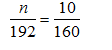
To
solve this proportion, we find the value of the variable that makes this equation
true.
This
can be done by finding equivalent fractions with a common denominator…

Since
the denominators are equal the numerators must also be equal so we have 160n =
10(192)
What
do you do NOW?

divide
carefully
n
= 12
Notice
that this results could also have been obtained by cross-multiplying in the
original proportions. That is
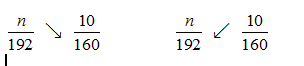
to
get
160n
= 10(192)
n
= 12
There
for the school will need 12 teachers next year.
Property
of Proportions

with b≠ 0
and d ≠ 0 Then
ad = bc

3n
= 8(12)
3n
= 96
divide
both sides by 3
n
= 32
But
WAIT—could you have done this another way?
Sure
What
do you do to 3 to get 12? ( multiply by 4)
…
so what must you do to 8? ( multiply by
4)
that’s
a great check.
So
what happens if you have

from
the textbook we learned
m2
= 3(27)
m2
= 81
Now,
we have worked with square roots before—so you should be able to solve this
problem.
Chapter
5 covered square roots.
Technically,
you perform the following

m= 9
Thursday, February 21, 2013
Math 6H (Period 3)
Ratios 6-1
In one of our our textbook, the example given involves the number of students --at what I called a mythical middle school --as well as the number of teachers. There are 35 teachers and 525 students. We can compare the number of teachers to the number of students by writing a quotient
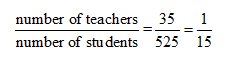

35
525
1/15
The quotient of one number divided by a second number is called the ratio of the first number to the second number.
We can write a ratio in the following ways:
1/15 1:15 1 to 15
All of these expressions are read one to fifteen.
If the colon notation is used the first number is divided by the second. A ratio is said to be lowest terms if the two numbers are “relatively prime.”
You do not change an improper fraction to a mixed number if the improper fraction represents a ratio
There are 9 players on a baseball team. Four of these are infielders and 3 are outfielders. Find each ratio in lowest terms.
a. infielders to outfielders
b. outfields to total players
# of infielders
# of outfielders
= 4/3 or 4:3 or 4 to 3
# of outfielders
# total of players
= 3/9 = 1/3 or 1:3 or 1 to 3
A baseball players batting average is the ratio of the number of hits to the number of office times at bat.
Example is Nomar Garciaparr who got 190 hits in his 523 times at bat.
190/5332 = 5/14
Normally, batting averages are given as decimals rounded to the nearest thousandths. But we can write this ratio as 5:14 or as " 5 to 14."
We then compares two ratios. We looked at two different fish tanks
tank A had 2 fish in it and was 40 quarts
Tank B had 3 fish in it and was 15 gallons
Fish in Tank A 2 fish
Fish in Tank B 3 fish
2
3
Volume in Tank A
Volume in Tank B
40 quarts
15 gallons
WAIT-- we must compare quantities in terms of common units. When a common unit is used, the ratio a:b does NOT have units!
4 quarts = 1 gallon so 40 quarts must be 10 gallons
10 gallons
15 gallons
10/15 = 2/3
The two ratios are equal
Comparing Three Ratios
We compared the records of three soccer teams from three different schools
Chestnut HS wins: 10 AND losses: 8
Mae Jennison wins: 12 AND losses: 8
Buena Vista wins: 16 AND losses: 12
Which team had the best record?
Two Methods:
A. Find the team with the greatest ratio of wins to losses
Chestnut : 10/8 = 5/4
Mae Jennison: 12/8 = 3/2
Buena Vista: 4/3
Mae Jennison has the best record
B. Find the team with the greatest ratio of wins to TOTAL games:
Chestnut: 10/18 = 5/9
Mae Jennison: 12/20 = 3/5
Buena Vista: 16/28 = 4/7
Because 3/5= 0.6 is greater than 5/9 (5/9= 0.55555) or 4/7( 4/7= 0.5714...)
Mae Jennison has the best record
Notice we change the fractions to decimals to compare. However, you can use your skills with fractions to easily compare the fractions.
A baseball players batting average is the ratio of the number of hits to the number of office times at bat.
Example is Nomar Garciaparr who got 190 hits in his 523 times at bat.
190/5332 = 5/14
Normally, batting averages are given as decimals rounded to the nearest thousandths. But we can write this ratio as 5:14 or as " 5 to 14."
We then compares two ratios. We looked at two different fish tanks
tank A had 2 fish in it and was 40 quarts
Tank B had 3 fish in it and was 15 gallons
Fish in Tank A 2 fish
Fish in Tank B 3 fish
2
3
Volume in Tank A
Volume in Tank B
40 quarts
15 gallons
WAIT-- we must compare quantities in terms of common units. When a common unit is used, the ratio a:b does NOT have units!
4 quarts = 1 gallon so 40 quarts must be 10 gallons
10 gallons
15 gallons
10/15 = 2/3
The two ratios are equal
Comparing Three Ratios
We compared the records of three soccer teams from three different schools
Chestnut HS wins: 10 AND losses: 8
Mae Jennison wins: 12 AND losses: 8
Buena Vista wins: 16 AND losses: 12
Which team had the best record?
Two Methods:
A. Find the team with the greatest ratio of wins to losses
Chestnut : 10/8 = 5/4
Mae Jennison: 12/8 = 3/2
Buena Vista: 4/3
Mae Jennison has the best record
B. Find the team with the greatest ratio of wins to TOTAL games:
Chestnut: 10/18 = 5/9
Mae Jennison: 12/20 = 3/5
Buena Vista: 16/28 = 4/7
Because 3/5= 0.6 is greater than 5/9 (5/9= 0.55555) or 4/7( 4/7= 0.5714...)
Mae Jennison has the best record
Notice we change the fractions to decimals to compare. However, you can use your skills with fractions to easily compare the fractions.
Some ratios compare measurements. In these cases we must be sure the measurements are expressed in the same units
It takes Matt 4 minutes to mix some paint for his science project. It takes him 3 hours to complete painting his science project. What is the ratio of the time it takes Matt to mix the paint to the time it takes Matt to paint his project?
Use minutes as a common unit for measuring time. You must convert the hours to minutes first
3h = 3 · 60min = 180 min
The ratio is :
min to mix
min to paint
= 4/180 = 1/45 or 1:45
Some ratios are in the form
40 miles per hour or 5 pencils for a dollar
“ I want my… I want my…. I want my … MPG!!”
These ratios involve quantities of different kinds and are called rates. Rates may be expressed as decimals or mixed numbers. Rates should be simplified to a per unit form. When a rate is expressed in a per unit form, such a rate is often called a unit rate.
Amir’s dad’s car went 258 miles on 12 gallons of gas. Express the rate of fuel consumption in miles per gallon.
The rate of fuel consumption is
258 miles
12 gallons
= 21 1/2 miles per gallon
Some of the most common units in which rates are given are the following:
mi/gal or mpg miles per gallon
mi/h or mph miles per hour
km/L kilometers per liter
km/h kilometers per hour
Page 229
1 What is the cost of grapes in dollars per kilogram if 4.5 kg of grapes costs $7.56?
$7.56/4.5 kg divide carefully and you discover it is $1.68/kg
2. THe index of refraction of a transparent substance is the ratio of the speed of light in space to the speed of light in the substance.
Using the table from the textbook (look at page 229) Find the index of refraction of
a) glass
300,000/200,000 straight from the chart, which can simplify to 3/2
b) water
300,000/225,000 again from the chart, which can simplify to 4/3
3. The mechanical advantage of a simple machine is the ratio of the weight lifted by the machine to the forse necessary to lift it.
What is the mechanical advantage of a jack that lifts a 3200 pound car with a force of 120 pounds?
3200/120 = 80/3
4. The C string of a cello vibrates 654 times in 5 seconds. How many vibrations per second is this?
654 vibrations/5seconds... divide carefully and you find... 130 4/5 vibrations per second
5. A four-cubic-foot volume of water at sea level weights 250 pounds. What is the density of water in pound per cubic foot?
250 pounds/4 cubic ft ... divide carefully and you find 62 1/2 lb/ft3
6. A share of stock that costs $88 earned $16 last year. What was the price to earnings ratio?
88/16 = 11/2
7. we did in our spiral notebooks this year... please check
Math 6A ( Periods 2 & 4)
Ratios 7-6
In our textbook, the example given involves the number of
students --at what I called a mythical middle school --as well as the number of
teachers. There are 35 teachers and 525 students. We can compare the number of
teachers to the number of students by writing a quotient
35
525
1/15
The quotient of one number divided by a second number is
called the ratio of the first number to the second number.
We can write a ratio in the following ways:
1/15 1:15
1 to 15
All of these expressions are read one to
fifteen.
If the colon notation is used the first number is divided by
the second. A ratio is said to be lowest terms if the two numbers are “relatively prime.”
You do not change an improper fraction to a mixed number if
the improper fraction represents a ratio
There are 9 players on a baseball team. Four of these are infielders
and 3 are outfielders. Find each ratio in lowest terms.
a. infielders to outfielders
b. outfields to total players
# of infielders
# of outfielders
= 4/3 or 4:3 or 4 to 3
# of outfielders
# total of players
= 3/9 = 1/3 or 1:3
or 1 to 3
Some ratios compare measurements. In these cases we must be
sure the measurements are expressed in the same units
It takes Matt 4 minutes to mix some paint for his science
project. It takes him 3 hours to complete painting his science project. What is
the ratio of the time it takes Matt to mix the paint to the time it takes Matt
to paint his project?
Use minutes as a common unit for measuring time. You must
convert the hours to minutes first
3h = 3 ·
60min = 180 min
The ratio is :
min to mix
min to paint
= 4/180 = 1/45
or 1:45
Some ratios are in the form
40 miles per
hour or 5 pencils for a dollar
“ I want my… I want my…. I want my … MPG!!”
These ratios involve quantities of different kinds and are
called rates. Rates may be expressed as decimals or mixed numbers. Rates should
be simplified to a per unit form. When a rate is expressed in a per unit form,
such a rate is often called a unit rate.
Dani’s dad’s car went 258 miles on 12 gallons of gas.
Express the rate of fuel consumption in miles per gallon.
The rate of fuel consumption is
258 miles
12 gallons
= 21 1/2 miles per gallon
Some of the most common units in which rates are given are
the following:
mi/gal or mpg miles
per gallon
mi/h or mph miles
per hour
km/L kilometers
per liter
km/h kilometers
per hour
Page 229
1 What is the cost of grapes in dollars per kilogram if 4.5 kg of grapes costs $7.56?
$7.56/4.5 kg divide carefully and you discover it is $1.68/kg
2. The index of refraction of a transparent substance is the ratio of the speed of light in space to the speed of light in the substance.
Using the table from the textbook (look at page 229) Find the index of refraction of
a) glass
300,000/200,000 straight from the chart, which can simplify to 3/2
b) water
300,000/225,000 again from the chart, which can simplify to 4/3
3. The mechanical advantage of a simple machine is the ratio of the weight lifted by the machine to the forse necessary to lift it.
What is the mechanical advantage of a jack that lifts a 3200 pound car with a force of 120 pounds?
3200/120 = 80/3
4. The C string of a cello vibrates 654 times in 5 seconds. How many vibrations per second is this?
654 vibrations/5seconds... divide carefully and you find... 130 4/5 vibrations per second
5. A four-cubic-foot volume of water at sea level weights 250 pounds. What is the density of water in pound per cubic foot?
250 pounds/4 cubic ft ... divide carefully and you find 62 1/2 lb/ft3
6. A share of stock that costs $88 earned $16 last year. What was the price to earnings ratio?
88/16 = 11/2
7. we did in our spiral notebooks this year... please check
Algebra Honors ( periods 5 & 6)
Tickets to the LCMS play cost $5 Production expenses are $500. The
school’s profit, p, will depend on n, the number of tickets sold.
profit - $5 ( number of tickets) - $500 or
p = 5n – 500
The equation p = 5n – 500 describes a correspondence between
the number of tickets sold and the profit.
The correspondence is a function whose domain is the set of
tickets that could be possibly sold
domain D = { 0, 1, 2, 3, ….}
The range is the set of profits that are possible including “
negative profits” or losses if too few tickets are sold.
Range R= {-500, - 495, - 490, -485…}
If we call this profit function P we can use arrow notation
and write the rule
P: nà
5n – 500
which is read
“ the function P that assigns 5n – 500 to n”
or “ the function P that pairs n with 5n – 500.” We could also use function notation: P(n) = 5n – 500
Which is read
“P of n equals 5n – 500” or
“ the value of P at n
is 5n – 500.”
To specify a function completely, you must describe the
domain of the function as well as give the rule. The numbers assigned by the
rule then form the range of the function.
List the range of
g:xà4
+ 3x- x2 If the domain D =
{ -1, 0, 1, 2}
Create a chart or an
xy table
replace x with each member of D ( the domain) to find the
members of the range R
When x = -1 y = 0
When x = 0 , y = 4
when x = 1 , y = 6
when x = 2 , y = 6
R = { 0, 4, 6}
Notice that the function g assigns the number 6 to both 1
and 2. In listing the range of g, however, we only name 6 once.
Members of the range of a function are called values of the function.
The values of this example are 0, 4, and 6.
To indicate that a function g assigns to 2 the value 6, you write g(2) = 6
which is read “ g of 2 equals 6” or “ the value of g at 2 is
6.”
Note the g(2) is NOT the product of g and 2. It names the
number that g assigns to 2.
Wednesday, February 20, 2013
Algebra Honors ( Periods 5 & 6)
Determining an
Equation of a Line 8-5
Write an equation of a line that has slope 2 and y-intercept
3
Easy! remember
y = mx + b
just substitute in what you have… y = 2x + 3
Write an equation of a line that has slope -4 and
x-intercept 3.
This is a little different.
The x-intercept is the x-coordinate
of the point where a line crosses the x-axis. So here the point must be (3,0)
so now you can substitute into y=mx + b and find b.
First substitute in -4 for m
y = -4x +b
To find b , substitute 3 for x and 0 for y in y = -4x + b
so
0=-4(3) + b
0=-12 + b
12=b
Therefore the equation must be y = -4x + 12
Write an equation of the line passing through the points (
-2, 5) and ( 4, 8)
Since it doesn't give us the slope, we must find it using


Substitute ½ for m in
y = mx + b
y = x/2 + b
Choose one of the points, say (4, 8) and substitute 4 for x
and 8 for y.
8 = (1/2)(4) + b
8 = 2 + b
6 = b
Therefore the equation is y = (1/2)x + 6
or y = x/2 + 6
Note: that we could have used the point ( -2, 5) and the
resulting equation would have been the same!
Write an equation in STANDARD FORM for the following line
described
The line that is parallel to x – 2y + 7 = 0 and contains (
-4, 0)
The first thing we need to do is change the given line into
slope-intercept form
y = mx + b
-2y = -x – 7 becomes y = x/2 + 7/2
If the line we are trying to find is parallel to that line its
slope must also be ½
Now using y = mx + b and the point on the line
0 = (1/2)(-4) + b
0= -2 + b
b = 2
so the line is y = x/2 + 2
BUT that is not in standard form Ax + By = C
Where A, B, and C are integers and A is a whole number
-x/2 + y = 2
Now multiply everything by -2
x- 2y = -4
Find a line passing through ( -2, 3), (2, 5) and (6, k) Find k
First find the slope using the two given points

y = (1/2)x +b
Using ( -2,3)
3 = (1/2)(-2) + b
3 = -1 + b
4 = b
y = (1/2)x + 4 is the
equation of the line so to solve for k
k = (1/2)(6) + 4
k = 3 + 4 = 7
Subscribe to:
Posts (Atom)
