Rises Up... run out...
Monday, February 18, 2013

Thursday, February 14, 2013
Algebra Honors ( Periods 5 & 6)
For every real number, the graph of the equation y = mx is
the line that has slope m and asses thrugh the origin.
For all real numbers m and b, the graph of the equation
y = mx + b
is the line whose slop is m and whose y-intercept is b.
This is called the slope intercept form of an equation of a
line.
Find the slope and y-intercept of

We know m = 3/5 and b = 2
so the slope is 3/5and the y-intercept is 2

The slope = -3/4 and the y-intercept is 6
Since the y-intercept is 6 you plot (0, 6)
Since the slop is -3/4 move 3 units down and 4 units to the
right to locate a second point.
Draw the line between the two points and write the equation
of the line directly above the line.
(Check our textbook)
Use only the slope and y-intercept to graph
2x – 5y = 10
Solve for y to transform the equation into the form y = mx +
b
2x -5y = 10
-5y = -2x + 10

the slope is 2/5 and the y intercept is -2
Since the y intercept is -2, plot ( 0, -2)
Since the slope is 2/5 move 2 units up and 5 units to the
right to locate the second point. Draw the line through the two points and
write the equation directly above the line.
SEE TEXBOOK for the accurate graph
Lines in the same plane that do not intersect are PARALLEL.
Different lines with the same slope are parallel
Parallel lines that are not vertical have the same slope.
Show that the lines whose equations are 2x + y = 8 and y =
-2x + 6 are parallel
write each equation in slope-intercept form
2x + y = 8 becomes y = -2x + 8
and the 2nd one is y - -2x + 6
Slope of both is -2
Since both lines have the same slope AND different y–intercepts,
they are parallel.
Perpendicular Lines
Any two lines that intersect to form right angles are
perpendicular.
In a plane, two lines that are not horizontal or vertical are
perpendicular if and only if the product of their slopes is -1.
In a plane vertical lines and horizontal lines are
perpendicular.
Show that the graphs of the following lines are perpendicular

Write 6y + 8x = 7 in slope intercept form

The slope is -4/3
The slope of the first equation is ¾
(3/4)(-4/3) = -1
Therefore the lines are perpendicular
What about y = x + 6
and y = -x +4
they are perpendicular because (1)(-1) = -1
Wednesday, February 13, 2013
Math 6H ( Period 3)
The Tangram Story
(One of the activities we did while students were at Astro Camp)
Once upon a time, long, long ago, in a faraway magical land lived a little boy named Tan. The emperor of the land had entrusted Tan with a very special task. The emperor had given Tan a magical square tile and asked him to deliver it to one of the emperor’s subjects who lived in the countryside. Tan was instructed to go directly to the subject’s house and not stop along the way. But, along the way, Tan encountered a group of his friends playing along the river. Tan thought he would stop for just a few minutes to rest and play … when alas; the tile flew out of his pocket and broke into seven pieces. Tan and his friends were so upset that they tried for days to put the tile back together again. They were able to form many beautiful designs of birds and animals and flowers but never the square tile. His designs have been handed down form generation to generation for over 3000 years and are known as Tangram puzzles.
If you would like to enjoy creating some of these puzzles or are interested in how to create your own tile, come in before or after school.
Math 6A (Periods 2 & 4)
The Tangram Story
(One of the activities we did while students were at Astro Camp)
Once upon a time, long, long ago, in a faraway magical land lived a little boy named Tan. The emperor of the land had entrusted Tan with a very special task. The emperor had given Tan a magical square tile and asked him to deliver it to one of the emperor’s subjects who lived in the countryside. Tan was instructed to go directly to the subject’s house and not stop along the way. But, along the way, Tan encountered a group of his friends playing along the river. Tan thought he would stop for just a few minutes to rest and play … when alas; the tile flew out of his pocket and broke into seven pieces. Tan and his friends were so upset that they tried for days to put the tile back together again. They were able to form many beautiful designs of birds and animals and flowers but never the square tile. His designs have been handed down form generation to generation for over 3000 years and are known as Tangram puzzles.
If you would like to enjoy creating some of these puzzles or are interested in how to create your own tile, come in before or after school.
(One of the activities we did while students were at Astro Camp)
Once upon a time, long, long ago, in a faraway magical land lived a little boy named Tan. The emperor of the land had entrusted Tan with a very special task. The emperor had given Tan a magical square tile and asked him to deliver it to one of the emperor’s subjects who lived in the countryside. Tan was instructed to go directly to the subject’s house and not stop along the way. But, along the way, Tan encountered a group of his friends playing along the river. Tan thought he would stop for just a few minutes to rest and play … when alas; the tile flew out of his pocket and broke into seven pieces. Tan and his friends were so upset that they tried for days to put the tile back together again. They were able to form many beautiful designs of birds and animals and flowers but never the square tile. His designs have been handed down form generation to generation for over 3000 years and are known as Tangram puzzles.
If you would like to enjoy creating some of these puzzles or are interested in how to create your own tile, come in before or after school.
Tuesday, February 12, 2013
Algebra Honors (periods 5 & 6)
Points, Lines, and Their Graphs 8-2
We reviewed graphing or plotting an ordered pair as a point on a coordinate plane.
Horizontal axis is the x-axis
vertical axis is the y-axis
origin is at (0,0)
an ordered pair (3,2) lists the coordinates of a point. In this instance we called the Point A
3 is the x-coordinate also know as the abscissa of A
2 is the y-coordinate also known as the ordinate of A
the x- and y-axes are also called coordinate axes and the number plane is often called the coordinate plane. The coordinate axes separate a coordinate plane into four quadrants identified by Roman Numerals. See page 354 for details.
Points on the coordinate axes are NOT considered to be in any quadrant.
The graph of an equation in two variables consists of all the poins that are the graphs of the solutions of the equations.
x + 2y = 6 has the following ordered pairs:
(0,3)
(2,2)
(4,1)
(6,0)
There are infinite number of solutions-- such as
(-2,4)
(1, 2.5)
The graph of all the solutions lie on the straight line that is drawn when the points are connected.
x + 2y = 6 is a linear equation because its graph is a line.
All linear equations in the variables x and y can be written in the form
ax + by = c
or
Ax + By = C
where a, b, and c are real numbers with a and b noth both zero. If a, b, and c are integers, then the equation is said to be in standard form.
2x -5y = 7 and 4x + 9y = 0 and y = 3 are examples of linear equations in standard form
(1/2)x + 4y = 12 is not
y = 3x -1 is not
neither is x2y + 3y = 4
nor xy = 6
Although you only need two points to determine a line, I suggest you plot 3-- whenever possible to guard against mistakes.
The easiest solutions to find are those where the line crosses
the x-axis ( y = 0) and
the y-axis ( x = 0)
We reviewed graphing or plotting an ordered pair as a point on a coordinate plane.
Horizontal axis is the x-axis
vertical axis is the y-axis
origin is at (0,0)
an ordered pair (3,2) lists the coordinates of a point. In this instance we called the Point A
3 is the x-coordinate also know as the abscissa of A
2 is the y-coordinate also known as the ordinate of A
the x- and y-axes are also called coordinate axes and the number plane is often called the coordinate plane. The coordinate axes separate a coordinate plane into four quadrants identified by Roman Numerals. See page 354 for details.
Points on the coordinate axes are NOT considered to be in any quadrant.
The graph of an equation in two variables consists of all the poins that are the graphs of the solutions of the equations.
x + 2y = 6 has the following ordered pairs:
(0,3)
(2,2)
(4,1)
(6,0)
There are infinite number of solutions-- such as
(-2,4)
(1, 2.5)
The graph of all the solutions lie on the straight line that is drawn when the points are connected.
x + 2y = 6 is a linear equation because its graph is a line.
All linear equations in the variables x and y can be written in the form
ax + by = c
or
Ax + By = C
where a, b, and c are real numbers with a and b noth both zero. If a, b, and c are integers, then the equation is said to be in standard form.
2x -5y = 7 and 4x + 9y = 0 and y = 3 are examples of linear equations in standard form
(1/2)x + 4y = 12 is not
y = 3x -1 is not
neither is x2y + 3y = 4
nor xy = 6
Although you only need two points to determine a line, I suggest you plot 3-- whenever possible to guard against mistakes.
The easiest solutions to find are those where the line crosses
the x-axis ( y = 0) and
the y-axis ( x = 0)
Friday, February 8, 2013
Algebra Honors ( Periods 5 & 6)
Simple Radical Equations 11-10
Solving equations involving radicals are solved by isolating the radical on one side of the equals sign and then squaring both sides of the equation.
140 = √2(9.8)d all under the √
140 = √19.6d
(140)2 = (√19.6d)2
19600 = 19.6d
1000=d
The solution set is {1000}
Solve
√(5x+1) + 2 = 6
√(5x+1) = 4
[√(5x+1)]2 = (4)2
5x + 1 = 16
5x = 15
x = 3
The solution set is {3}
When you square both sides of an equation, the new equation may NOT be equivalent to the original equation Therefore, you must CHECK EVERY POSSIBLE ROOT IN THE ORIGINAL EQUATION to see whether it is indeeed a root.
Solve
√(11x2 -63) - 2x = 0
√(11x2 -63) = 2x
√(11x2 -63)2 = (2x)2
11x2 -63 = 4x2
7x2 = 63
x2 = 9
x = ± 3
Now we need to check for BOTH + 3 and - 3
Rewrite the original equation
√(11x2 -63) - 2x = 0
√(11(3)2 -63) - 2(3) = 0
√99-63 - 6 = 0
√36 - 6 = 0
6-6 = 0
That's true
Now for x = -3
√(11(-3)2 -63) - 2(-3) = 0
√(99 -63) + 6 = 0
√36 + 6 = 0
12 ≠ 0
So -3 is NOT a solution
Fractional Exponents
In chapter 4 we reviewed the law of exponents:
am ⋅an = am+n
Thus you know
24⋅25= 29
What do you notice? What would be the value of n in the equation
2n⋅2n = 2
Using what we know from above,
2n⋅2n = 2n+n = 22n
The bases are equal ( and NOT -1, 0 or 1). Therefore the exponents must be equal.
That says
2n = 1
n = 1/2
and you have
21/2⋅21/2=2
Because √2⋅√2 = 2 and (-√2)(-√2) = 2 we note that 21/2 as either the positive or negative square root of 2
Selecting the positive or principal square root we define,
21/2 = √2
Radicals are not restricted to square roots. The symbol ∛ represents the third ( or cube) root, ∜ represents the fourth root and so on...
As you have learned the root index is omitted when n = 2
Just as the inverse of squaring a number is finding the square root, the inverse of cubing a number is finding the cube root. Since 23 = 8
∛8 ( read the cube root of 8) is 2.
Likewise (-2)3 = -8
∛(-8) = -2
BE CAREFUL---> While ∛-8 is a real number √-8 is not
In general, you CAN find ODD roots of negative numbers but not EVEN Roots!!
Solve
4n⋅4n⋅4n= 4
43n = 4
Since the bases are EQUAL ( that's the KEY), the exponents are also!!
so 3n = 4
n = 3/4
You know that ∛7 = 7 1/3 So How would you write (∛7) 2 in exponential form?
(∛7) 2 = (71/3)2 = 7(1/3)2 = 72/3
Simplify:
163/4
First write as
∜163
Now change 16 into 24 Why?
You end up with ∜(24)3
Looking at just ∜24 you realize you have 2
and so you are left with
23 = 8
Thursday, February 7, 2013
Algebra Honors (Periods 5 & 6)
Multiplication of Binomials Containing Radicals 11-9
Chapter 5 taught us how to multiply binomials-- we can use those methods when multiplying binomials that contain square root radicals.
(6 + √11)(6 - √11)
The pattern is
(a +b)(a -b) = a2 - b2
so using that we get
62 - (√11)2
36 - 11 = 25
Simplify (3 + √5)2
The pattern here is
(a + b)2 = a2 + 2ab + b2
so ( 3 + √5)2 =
32 + 2[(3)(√5)] + (√5)2 =
9 + 6√5 + 5 =
14 + 6√5
Simplify (2 √3 - 5√7)2
The pattern here is (a - b)2 = a2 - 2ab + b2
(2 √3 - 5√7)2 =
(2 √3)2 -2[(2)(5)(√3)(√7)] +(5√7)2 =
4(3) -20√21 +25(7) =
12 -20√21+ 175 =
187 -20√21
If both b and d are nonnegative, then the binomials
a√b + c√d AND a√b - c√d are called conjugates of one another. COnjugates differ ONLY in the sign of one term
if a, b, c, and d are all integers then the product (a√b + c√d)(a√b - c√d) will be an integer... see the first example!!
Conjugates can be used to rationalize binomial denominators that contain radicals.. getting rid of the radicals in the denominator
Rationalize
3/(5- 2√7)
3/(5- 2√7) = [ 3/(5- 2√7)] × [((5+ 2√7)/(5+2√7)]
This doesn't show well here hopefully you can remember what was done in class...
= 3(5 +2√7)/25-(2√7)2 =
(15+6√7)/25-28 =
(15+6√7)/-3 =
15/-3 +6√7/-3 =
-5 -2√7
√√
Chapter 5 taught us how to multiply binomials-- we can use those methods when multiplying binomials that contain square root radicals.
(6 + √11)(6 - √11)
The pattern is
(a +b)(a -b) = a2 - b2
so using that we get
62 - (√11)2
36 - 11 = 25
Simplify (3 + √5)2
The pattern here is
(a + b)2 = a2 + 2ab + b2
so ( 3 + √5)2 =
32 + 2[(3)(√5)] + (√5)2 =
9 + 6√5 + 5 =
14 + 6√5
Simplify (2 √3 - 5√7)2
The pattern here is (a - b)2 = a2 - 2ab + b2
(2 √3 - 5√7)2 =
(2 √3)2 -2[(2)(5)(√3)(√7)] +(5√7)2 =
4(3) -20√21 +25(7) =
12 -20√21+ 175 =
187 -20√21
If both b and d are nonnegative, then the binomials
a√b + c√d AND a√b - c√d are called conjugates of one another. COnjugates differ ONLY in the sign of one term
if a, b, c, and d are all integers then the product (a√b + c√d)(a√b - c√d) will be an integer... see the first example!!
Conjugates can be used to rationalize binomial denominators that contain radicals.. getting rid of the radicals in the denominator
Rationalize
3/(5- 2√7)
3/(5- 2√7) = [ 3/(5- 2√7)] × [((5+ 2√7)/(5+2√7)]
This doesn't show well here hopefully you can remember what was done in class...
= 3(5 +2√7)/25-(2√7)2 =
(15+6√7)/25-28 =
(15+6√7)/-3 =
15/-3 +6√7/-3 =
-5 -2√7
√√
Wednesday, February 6, 2013
Math 6A (Periods 2 & 4)
Division of Fractions 7-4
Certain numbers when multiplied together have the product 1
5 X 1/5 = 1
3/4 X 4/3 = 1
Two numbers whose product is 1 are called reciprocals of each other.
Thus 3/4 is the reciprocal of 4/3.
Zero does not have a reciprocal
Look at the following:
We know 18 = 3 X 6 and we know 18 ÷ 6 = 3 as well as 18 X 1/6 = 3
Dividing a number by a fraction is the same as multiplying the number by the RECIPROCAL of the fraction
a/b ÷ c/d = a/b ÷ d/c
Remember- you are using the reciprocal of the divisor... that is , as students want to say "You FLIP the 2nd number!!"
42/ 55 ÷ 36/11
you must rewrite the problem using the reciprocal of the 2nd number
42/55 X 11/36
Now using your skills of observing GCF simplify before you multiply ( MUCH EASIER and FASTER)
42/ 5 X 1/36 which becomes 7/5 X 1/ 6 = 7/30
Tuesday, February 5, 2013
Math 6A (Periods 2 & 4)
Multiplication of Fractions 7-3
If a rectangle is divided into 4 equal parts, each part is ¼ of the whole. If each of these parts is then divided into 3 parts, that is into thirds, then there are 12 equal parts and each is 1/(3 ∙4) or 1/12 of the whole.
That is 1/3 of 1/4 is 1/(3 ∙4) or 1/12 and 1/3 ∙ 1/4 = 1/12 is
so another example 2/3 of 4/5 is 2∙4 /(3∙8) or 2/3 ∙4/5 = 8/15
Notice, that the numerator of the product, 8, is the product of the numerators 2 and 4. The denominator of the product, 15, is the product of the denominators 3 and 5
Rule
If a, b, c, and d are whole numbers with b ≠ 0 and d ≠ 0 , then
a/b(c/d) = a∙c/(b∙d)
When multiplying two fractions, you can simplify the multiplication by dividing either of the numerators and either of the denominators by common factors
6/35 ( 7/3) we can simplify first because both 6 and 3 are divisible by 3
2/35 (7/1) and then both 35 and 7 are divisible by 7 so 2/5 (1(1) = 2/5
Try the following
25/6 ( 42/5) What can we do there?
7/8(20/21) How about with these two sets of fractions?
19/20 ( 25/38) … and these fractions?
What happens when you have
15/2(7/8- 5/24)
What must we do first?
PEMDAS... in my classroom...
15/2( 21/24 - 5/24)
= 15/2(16/24)
= 15/2(2/3)
then simplify to
15/1(1/3)
= 5
What about
8/9∗ 15/32∗ 9/10 = 3/8
or 16/11 × 33/20 × 5/3 = 4
Thursday, January 24, 2013
Math 6A (Periods 2 &4)
Addition & Subtraction of Mixed Numbers 7-2
To add or subtract mixed numbers we could first change the mixed numbers to improper fractions and then use the method from 7-1 .
1 4/9 + 3 1/9 = 13/9 + 28/9 = 41/9 = 4 5/9 but that was 5th grade….
In the second method, and the one I prefer, you work separately with the fractional and whole number parts of the given mixed numbers.
STACK THEM!!
3 4/9
1 7/9
4 11/9 = 5 2/9
If the fractional parts of the given mixed numbers have different denominators, we find equivalent mixed numbers whose fractional parts have the same denominator, usually the LCD.
5 3/10 + 7 7/15
Stack
5 3/10
+7 7/15
Draw a line separating the fractional part from the whole numbers Find the LCM of the denominators the LCD and add…
9 5/9 - 4 13/15
To add or subtract mixed numbers we could first change the mixed numbers to improper fractions and then use the method from 7-1 .
1 4/9 + 3 1/9 = 13/9 + 28/9 = 41/9 = 4 5/9 but that was 5th grade….
In the second method, and the one I prefer, you work separately with the fractional and whole number parts of the given mixed numbers.
STACK THEM!!
3 4/9
1 7/9
4 11/9 = 5 2/9
If the fractional parts of the given mixed numbers have different denominators, we find equivalent mixed numbers whose fractional parts have the same denominator, usually the LCD.
5 3/10 + 7 7/15
Stack
5 3/10
+7 7/15
Draw a line separating the fractional part from the whole numbers Find the LCM of the denominators the LCD and add…
9 5/9 - 4 13/15
Math 6A (Periods 2 & 4)
Addition and Subtraction of Fractions 7-1
Most of you already know how to add and subtract fractions, although some of you may need just a little review.
5/9 + 2/9 = 7/9
13/12 - 5/12 = 8/12 = 2/3
and that
7/9 – 2/9 = 5/9
13/12 - 5/12 = 8/12 = 2/3
a/c + b/c = (a +b)/c where c does not equal 0
a/c - b/c = (a -b)/c
The properties of addition and subtraction of whole numbers also apply to fractions.
If the denominators are the same— add or subtract the numerators AND use the numerator!!
In order to add two fractions with different denominators, we first find two fractions, with a common denominator, equivalent to the given fractions. Then add these two fractions.
The most convenient denominator to use as a common denominator is the least common denominator of LCD, of the two fractions. That is, the least common multiple of the two denominators.
LCD ( a/b, c/d) = LCM(b, d) where b and d both cannot be equal to 0
For example LCD ( 3/4, 5/6) = LCM(4,6) =12
3/4 = 9/12 and 5/6 = 10/12
Let’s do:
7/15 + 8/9
First find the LCD
LCM(15, 9) Do your factor trees or inverted division – or just by knowing!!
15 = 3• 5
9 = 32
So LCM(15,9) = [every factor to its greatest power] 32•5 = 45
Then find equivalent factions with a LCD of 45, and add
7/15 = 21/45
8/9 = 40/45
21/45 + 40/45 = 61/45 = 1 16/45
5/6- 11/24
Stack them and use the LCD
5/6 = 20/24
-11/24 = -11/24
9/24 = 3/8
7/12 + 4/9 + 3/4
several strategies ca be used. You can find the LCD for all three you can use the C+ and the A+
and change it to
(7/12 + 3/4) + 4/9
then add the first two factions
7/12 + 3/4 becomes 7/12 + 9/12 = 16/12 = 4/3
then add 4/3 + 4/9
change 4/3 to 12/9
12/9 + 4/9 = 16/9 = 1 7/9
What about 17/10 - ( 3/5 + 5/6)
You must do the parenthesis first
so 3/5 + 5/6
3/5 = 18/30
5/6 = 25/30
43/30
Now you have
17/10 - 43/30
stack those
17/10 = 51/30
51/30
-43/30
8/30 = 4/15
Most of you already know how to add and subtract fractions, although some of you may need just a little review.
5/9 + 2/9 = 7/9
13/12 - 5/12 = 8/12 = 2/3
and that
7/9 – 2/9 = 5/9
13/12 - 5/12 = 8/12 = 2/3
a/c + b/c = (a +b)/c where c does not equal 0
a/c - b/c = (a -b)/c
The properties of addition and subtraction of whole numbers also apply to fractions.
If the denominators are the same— add or subtract the numerators AND use the numerator!!
In order to add two fractions with different denominators, we first find two fractions, with a common denominator, equivalent to the given fractions. Then add these two fractions.
The most convenient denominator to use as a common denominator is the least common denominator of LCD, of the two fractions. That is, the least common multiple of the two denominators.
LCD ( a/b, c/d) = LCM(b, d) where b and d both cannot be equal to 0
For example LCD ( 3/4, 5/6) = LCM(4,6) =12
3/4 = 9/12 and 5/6 = 10/12
Let’s do:
7/15 + 8/9
First find the LCD
LCM(15, 9) Do your factor trees or inverted division – or just by knowing!!
15 = 3• 5
9 = 32
So LCM(15,9) = [every factor to its greatest power] 32•5 = 45
Then find equivalent factions with a LCD of 45, and add
7/15 = 21/45
8/9 = 40/45
21/45 + 40/45 = 61/45 = 1 16/45
5/6- 11/24
Stack them and use the LCD
5/6 = 20/24
-11/24 = -11/24
9/24 = 3/8
7/12 + 4/9 + 3/4
several strategies ca be used. You can find the LCD for all three you can use the C+ and the A+
and change it to
(7/12 + 3/4) + 4/9
then add the first two factions
7/12 + 3/4 becomes 7/12 + 9/12 = 16/12 = 4/3
then add 4/3 + 4/9
change 4/3 to 12/9
12/9 + 4/9 = 16/9 = 1 7/9
What about 17/10 - ( 3/5 + 5/6)
You must do the parenthesis first
so 3/5 + 5/6
3/5 = 18/30
5/6 = 25/30
43/30
Now you have
17/10 - 43/30
stack those
17/10 = 51/30
51/30
-43/30
8/30 = 4/15
Monday, January 21, 2013
Math 6High (Period 3)
Solving Addition
Equations 5.3
Although you are very capable of doing many of these
equations in your head, this lesson is about the process à rather than just
getting the correct solution.
n + 8 = 17
The goal of solving equations is to isolate the variable on
one side of the equation (all alone on one side of the equals sign)
To do that we use inverse operations. Inverse operations are
operations that “undo” each other, such as addition and subtraction.
Subtraction Property of Equality
Subtracting the same number for EACH SIDE of an equation
produces a new equation having the same solution as the original.
x + a = b à
x + a - a = b -a
So with n + 8 = 17
We need to isolate n from EVERYTHING else.
Since currently 8 is being added to our variable, we need to
undo addition. The Inverse Operation we will use is subtraction. BUT, we need
to subtract 8 from BOTH SIDES OF THE EQUATION.

Formal Check is easy:
Rewrite the equation first
Substitute in your solution for n written in (hugs) Put a “?” over the equals sign at this point.
DO THE MATH… that is… Make sure the left side = the right side
Rewrite the equation first
Substitute in your solution for n written in (hugs) Put a “?” over the equals sign at this point.
DO THE MATH… that is… Make sure the left side = the right side
n + 8 = 17
(9) + 8 = 17
17 = 17
What about the following
x + 9 = 4
To isolate the variable, we need to undo addition again. We
need to subtract 9 from both sides of the equation.

x = -
But wait!
Look at the right side of the equation now! We have
different signs for Integers. We must follow the rules for Different Signs.
First we determine who has the larger absolute value ( That’s our “who wins?”)
We stack the winner on top. We know that our solutions MUST include a NEGATIVE.
so let’s set up the solution with x = -
so we don’t forget.
Then after stacking the winner on top, we take the
difference and discover that x = -5
FORMAL CHECK:
Rewrite the original equation
Substitute in our solution using (hugs)
DO THE MATH
Substitute in our solution using (hugs)
DO THE MATH
x + 9 = 4
(-5) + 9 = 4
Use a side bar to check -5 + 9
We have different signs here as well. Who wins? The +9, by
how much?
Stack them

so
x + 9 = 4
(-5) + 9 = 4
4 = 4
We did the following in class
n + 8 = -2
4 = x + 9
-12 = 11 + p
46 + b = -4
n + 7 = -7
You will be required to show all the balancing stepsà even f you could do these
equations in your head.
You will also need to do a Formal Check for a few of the
problems.
Algebra Honors (Period 5 & 6)
Rational Square Roots
11-3
You know that subtraction undoes addition, and that division
by a nonzero number undoes
multiplication, Similarly squaring a number can be undone by finding a square
root.
If a2 =b
then a is a square root of b
Notice that 72= 49 and so does (-7)2 = 49 So 7 and -7 are square roots of 49
the radical symbol √ is used to write the principal or positive square root of a
positive number.

is read “The
positive square root of 49 equals 7
A negative square root is associated with the symbol - √

is read “The negative
square root of 49 equals -7”
Let’s use ± to indicate both the
positive (also called the principal) square root and negative square root so

means the positive or
negative square root of 49 or
±7
Let’s look at

the number written
beneath the radical sign (such as 49) is called the radicand.

For all positive real numbers a:
Every positive real number a has two square roots
Every positive real number a has two square roots
The symbol

denotes the principal
square root of a
Zero has only one square
root—itself.


Because the square of every real
number is either positive or zero—>NEGATIVE NUMBERS DO NOT HAVE SQUARE ROOTS
IN THE SET OF REAL NUMBERS.

does not have a
solution in the set of real numbers!!
Notice that

and that

so...

Product Property of Square Roots
For any non-negative real numbers a and b,
For any non-negative real numbers a and b,

Find:

Let’s say you forgot your perfect
squares—OH MY!!
but looking at 225, using your skills
from previous years you realize 225 = 9 · 25
so

If you cannot see any perfect squares that divide the
radicand—begin by factoring it!! Then see if you have any perfect squares. USE INVERTED DIVISION!!

Always use PERFECT SQUARES when using inverted division. We practiced in class.
Use inverted division along with divisibility rules to find perfect squares Look for the largest perfect square factors ... and you discover that

Quotient Property of Square Roots
For any non negative real number a and any positive real
number:

Find the indicated square root


If you don’t see any perfect squares—especially with numbers like these—simplify your fraction first

so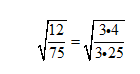 is really
is really
and that's easy to do... it is 2/5
What about

Express as a decimal
first then it should become easier

Let’s look at

Subscribe to:
Posts (Atom)
