Welcome to Room K 101's Blog

Check out the Weekly Notes from your class

With Math ... you can do anything

Wednesday, March 12, 2014

Algebra Honors ( Periods 6 & 7)

Direct & Inverse Variations  8-9 and 8-10

Direct Variations  8-9
 f(x) = mx + b
It is a linear function. the f(x) is dependent on the x value.

A direct variation is a function defined by an equation in the form
y = kx, where k is a non zero constant. When graphing, k is  the slope
You can say that y varies directly as x
that is, as x goes up in value so does y or
as x decreases à so does y

When the domain is the set of all real numbers, the graph of a direct variation is a straight line with slope k that passes through the origin.

Given that m varies directly as n, and that m= 42 when n = 2, the constant of variation can be found by writing m = kn and substituting in those values. You find that
42 = 2k , so k = 21.
You can write the function as m = 21n.
Now when asked to find the value of m when n = 3 you just plug and chug…
m = 21(3)  so m = 63

Could we have found this a different way? YES..


Suppose ( x1, y1) and  ( x2, y2) are two ordered pairs of a direct variation defined by
y = kx and you know that neither  x1 nor  x2  are zero.
You know that
y1 = kx1    and that y2= kx2 
Solving both for k you discover that
y1/x1 = k and so does y2/x2 = k
Since each ratio equals k, the ratios are equal and you can set them in an equation

y1/x1 = y2/x2  and you read this… “y1 is to x1 as y2 is to x2.”
This is a proportion!!

For this reason k is sometimes called the constant of proportionality  and
y is said to be directly proportional to x
When you use a proportion to solve a problem, you will want to recall that the product of the extremes equals the product of the means.

We reviewed a few equations and found the following to be direct variations:
y = 3x
p = 9s
d = 3.3t
even y/x = -5
But the following were determined NOT to be direct variations:
y = 3x2
xy = 4

Eample:
y varies directly as x
y = 6 and x = 72 Find the constant of variation
y = kx
6 = k(72)
6 = 72k
k = 1/12

Inverse Variations 8-10
An inverse variation is a function defined by an equation in the form:
xy = k where k is a NON ZERO constant
or  y = k/x  where x ≠ 0
You say that y varies inversely as x or that y is inversely proportional to x.

The constant k is the constant of variation.
The graph of an inverse function is NOT a straight line!
xy = k is NOT linear!

Your graph can be a hyperbola
When k is positive the branches of the graph are in Quadrants I and III
When k is negative the branches of the graph are in Quadrants II and IV

Similarly to direct variation, you can compare two ordered pairs of the same inverse variation. Since the coordinates must satisfy the equation xy = k you know that
x1y1=k and x2y2= k
or
x1y1= x2y2

Reviewing :
Direct Variation is y = kx    or y1/x1 = y2/x2

Inverse Variation  is xy = k or x1y1= x2y2

These equations show that for direct variation the quotients of the coordinates are constant and for inverse variation the products of the coordinates are constant.

Is it Direct or Inverse Variation?
y/x = k  (careful this becomes   y = kx    so its direct)
y= k/x           inverse
p = k/z          inverse
xy = 25         inverse
d= 40t          direct

m/n= 5/8      direct
x/y = 1/k      direct
kxy = 5        inverse


WORD PROBLEMS FOR DIRECT & INVERSE VARIATIONS ( 2nd day of lesson)
Several examples were given in class:

Truck rental Company charges $35 a day plus 21 cents per mile. Normally your questions in the past were "What is the cost for a rental of a truck for ...:
1 day and 340 miles?" or
"2 days and 450 miles?"
You would just plug in and figure out the exact cost...

Then we discussed the rental of a chain saw (from the textbook)... remember it is for cutting down trees... like those which were knocked down by those tremendous winds we had last year… remember those winds…

We are given that the rental is $5.90 a hour and you must pay $6.50 for 1 can of gas. Again, in the past your questions would be something like...
"How much would it cost for 7.5 hours?"
But... you could write a linear function to represent the cost for all different rental hours.
Let h represent the hours
s(h) = 5.9h + 6.5
Now, no matter how many hours you rent the chain saw, you can figure out the cost.

Phone bills in the past charged 15 cents per message + a base charge. Let's say you were given the July bill of $18 which included 62 messages. What was the base charge?
First find out the cost of the messages (.15)(62) = $9.30 and subtract that from $18.
Or just realize it would be 18 - (.15)(62) = $ 8.70

Then you could write a linear function p(x) = .15x + 8.7

August had 76 messages... what was the bill becomes easy to solve-- just use the linear equation.
p(76) = .15(76) + 8.7 = 20.10. August bill was $20.10


Turn to Page 394
#20
distance on a map varies directly to actual distance
m= distance on the map
d= actual distance
m = kd
Given that 1 in on the map ---> 10 miles
1 = k(10)
1 = 10k
k = 0.1
so formula is m = 0.1d
writing as a proportion you would have
1/10 = m2 / d2

# 22 Volume directly proportional to temp T in Kelvin
5 Liters 300 degrees
V = kT
5= 300k
k = 1/60
so formula is V = (1/60)T
and as a formula before you simplify
5/300 = V2 /T2
or 1/60 = V2 /T2

Math 6A ( Periods 1 & 2)

Scale Drawing 7-9

Using the book’s drawing on page 237, find the length and width of the room shown, if the scale of the drawing is 1cm: 1.5 m

Measuring the drawing, we find that it has a length of 4 cm and a width of 3 cm
Method 1: write a proportion for the length
Let l = the actual length
1/1.5 = 4/ l
l= 4 (1.5)
l = 6
The room is 6 m long
Write a proportion for the width
Let w = the actual width
1/1.5 = 3/w
w = 3 (1.5)
w = 4.5 m
The room is 4.5 m wide

A scale drawing is a diagram of an object where its length and width aare proportional to the actual length and width.

The scale for the drawing gives the relationship between the drawing's measurements and the actual measurements.
For example 1 inch represents 2 feet

The Scale Factor is the ratio of the length in the drawing to the corresponding actual lenth.

A Scale Factor on a matchbox car of 1/64 would mean that every part of the matchbox car was 1/64 of the actual car-- the windshield, the door, the wheels, the roof... would all have the same relationship.

Scale Factor MUST HAVE the same units of measurements.


Method 2 : Use the scale ratio

1 cm/ 1.5 m = 1/cm/150 cm = 1/150
You need to change the units to the same and then set up a ratio

The actual length is 150 times the length in the drawing so
l =150 (4) = 600 cm = 6 m
w =150 (3) = 450 cm = 4.5 m

The scale on a map is 1 cm to 240 m


Open your books to Page 237, you will notice a drawing of a house. In this drawing of the house, the actual height of 9 meters is represented by a length of 3 centimeters, and the actual length of 21 meters is represented by a length of 7 centimeters.
This means that 1 cm in the drawing represents 3 m in the actual building. Such a drawing in which all lengths are in the same ratio to actual lengths is called a scale drawing.
The relationship of length in the drawing to actual length is called the scale. In the drawing of the house the scale is 1cm: 3m

We can express the scale as a ratio, called the scale ratio, if a common unit of measure is used. Since 3 m = 300 cm, the scale ratio is 1/300

The distance from Ryan’s house to his school is 10 cm on the map. What is the actual distance?
let d = the distance from Ryan’s house to school
1/240 = 10/d so d = 240(10)
d = 2400m or
The distance from Ryan's house to school is 2.4 km


A picture of an insect has a scale 7 to 1. The length of the insect in the picture is 5.6 cm. What is the actual length of the insect in millimeters ?
Let a= the actual length of the insect in cm

7/1 = 5.6/ a
7a = 5.6
a = .8 cm

or 7/a = 56/
The actual length of the insect is 0.8 cm which is 8 mm

OR change the given 5.6 cm into 56 mm to begin with!
this time
let a = the actual length of the insect in mm
7/1 = 56/a
Now we can simplify easily
a = 8
so
the actual length of the insect is 8 mm

Algebra Honors ( Periods 6 & 7)

Linear and Quadratic Functions 8-8
This lesson will be completed in two parts:
Linear Functions:
The function g defined by g(x) = 2x - 3  is called a linear function
Notice the word line in linear
If its domain is the set of all real numbers  then the straight line that is the graph of
y = g(x) = 2x - 3  is the graph of g . 
The slope of the graph is 2 and the y-intercept is -3.

A function f defined by f(x) = mx + b is a linear function
If the domain of f is the set of all real numbers, then its graph is the straight line with slope m and y-intercept b.

Relations:
A relation is any set of ordered pairs.
The set of the first coordinates of the ordered pairs is the domain of the relation
The set of the second coordinates of the ordered pair is the range.

A function is a relation in which different ordered pairs have different FIRST coordinates.


Tuesday, March 11, 2014

Math 7 (Period 4)

Multiplying and Dividing Powers 6.7
 We are discovering the basic multiplication rules for powers having the same bases.
Multiplying Powers
a5 ∙a3= a∙a∙a∙a∙a∙a∙a∙a = a8
 RULE….to multiply two powers with the SAME BASES just add their exponents
am ∙ an = am+n
32∙33 = 35
( -½)2 (-½ )  = (-½ )3
Multiplygin Variable Expressions:
2x2∙3x4 = (2∙3)(x2∙x4) = 6x2+4 = 6x6

Dividing Powers
c5/c3
c∙c∙c∙c∙c
c∙c∙c
= c∙c
= c2

c5/c3 = c5-3 = c2
To divide two powers with the SAME BASES just subtract the exponents
am/an = am-n
27/24= 27-4 = 23
(-5)3/-5
Careful with this one… it is really
(-5)3/(-5)1
Now they are the same base so it is just a subtraction problem with the exponents
(-5)3-1 =(-5)2 = (-5)(-5) = 25
So let’s look at two examples
(-2)5 means (-2)(-2)(-2)(-2)(-2) = -32
But
(-2)4 means  (-2)(-2)(-2)(-2) = + 16
(-2)11 à negative
(-2)10 à positive

***Odd/Even Rule with powers***
If there is a negative inside the parentheses
odd # of negative signs or odd  power à it will be negative
even # of negative signs or even power à it will be positive

(-4) 55 à negative
(-4)56 à positive

(-1)15 = -1
(-1)100 = +1

If there is a negative but NO parentheses (NO HUGS!!)
such as -25 or -24
….IT will ALWAYS be negative

-25 means take the opposite of 25
and -24 means take the opposite of 24

-25 = -2∙2∙2∙2∙2 = -32

-24 =   -2∙2∙2∙2 = -16

(-10)4/(-10)2 = (-10)4-2 = (-10)2
Be careful
-102 ≠ (-10)2
-100 ≠ 100

(2/5)6
(2/5)3
= (2/5)6-3

=8/125

Math 6A ( Periods 1 & 2)

Problem Solving: Using Proportion 7-8

Proportions can be used to solve word problems. Use the following steps to help you in solving problems using proportions
~ Decide which quantity is to be found and represent it by a variable
~ Determine whether the quantities involved can be compared using ratios (rates)
~ Equate the ratios in a proportion
~ Solve the proportion

Mrs. Nelson bought 4 tires for her car ( an Infiniti- what else would a math teacher own!) at a cost of $264. How much would 5 tires cost at the same rate?
Let c = the cost of 5 tires. Set up a proportion

4/264 = 5/c
Solve the proportion
4c = 5(264)
Now divide both sides by 4
4c/4 = 5(264)/4
c = 330
Therefore, 5 tires would cost $330

Notice, the proportion in this example could also have been written as

2/264 = c/5
In fact--Any of the following proportions can be used to solve the problem

4/5 = 264/c 5/4 = c/264 4/264 = 5/c 264/4 = c/ 5
All of the above proportions result in the same equation

4c = 5(264)
But be careful you need to use a proportion that does relate.
4/5 DOES NOT EQUAL c/264. That is not an accurate proportion and would result in an inaccurate solution.

tires ___________ = _____________tires
cost _____________=_____________cost


If 4 bars of soap cost $1.50, how much would 6 bars of soap cost?

let x = the cost of 6 bars of soap

bars ___________ = _____________bars
cost _____________=_____________cost
4/1.50 = 6/x
simplify first up and down ( BUT NEVER DIAGONALLY!!)
x = 3 (.75)
x = 2.25
$2.25
6 bars would cost $2.25


If 9 kg of fertilizer will feed 300 m2 of grass, how much fertilizer would be required to feed 500 m2 of grass?

kg ___________ = _____________kg
m2 _____________=_____________m2

9/300 = n/500
SIMPLIFY FIRST
9/3 = n/5
3/1 = n/5
n = 15
15kg of fertilzer


For every 5 sailboats in a harbor, there are 3 motorboats. If there are 30 sailboats in the harbor, how many motorboats are there?

Let m = the number of motorboats
5/3 = 30/m

5m = 3(30) divide both sides by 5 5m/5 = 3(30)/5


m=18
There are 18 motorboats in the harbor.

Some guidelines you can use to determine when it is appropriate to use a proportion to solve a word problem.

Ask the following questions

If one quantity increase does the other quantity also increase? (If one quantity decreases, does the other quantity decrease?) When the number of tires is increase, the cost is also increased.

Does the amount of change (increase or decrease) o one quantity depend upon the amount of change (increase or decrease) of the other quantity? The amount of increase in the cost depends upon the number of additional tires bought.

Does one quantity equal some constant times the other quantity? The total costs equals the cost of one tire times the number of tires. The cost of one tire is constant.

If the answers to all the questions above is YES, then it is appropriate to use a proportion.

Sometimes setting up a table can be useful


Although the problems in this lesson may be solved without using proportions, I must insist that you write a proportion for each problem and solve using this method. You may check your work using another other method you know.

Tuesday, March 4, 2014

Math 6A ( Periods 1 & 2)

Ratio 7-6 Word Problems
Since all of the word problems from Ratios 7-6 are excellent examples of using Ratios, I thought I would create a blog posting with the solutions. Although I will list the actually word problems, you might need to turn to the textbook and page 229 for any charts included.
Read each problem carefully and set up the solutions based on the question asked
Page 229
1. What is the cost of grapes in dollars per kilogram if 4.5 kg of grapes costs $ 7.56?
Since they want $/kg you need to have 7.56/ 4.5 = 1.68; so the grapes cost $ 1.68/kg.

2. This one looked confusing, but just read it a few times: The index of refraction of a transparent substance is the ratio of the speed of light in space to the speed of light in the substance. (Read it again—it is just a ratio). Using the table on Page 229, find the index of refraction of
A. Glass
B. Water

According to the table Speed of light in space is 300,000 km/sec
Speed of light in glass is 200,000 km/ sec.
So
300,000
200,000
or 3/2

Speed of Light in Water is 225,000

so that ratio is
300,000
225,000
This takes a little more time dividing but you can simplify it to 4/3 Since it is a ratio you want to LEAVE it as an improper fraction.


3. The mechanical advantage of a simple machine is the ratio of the weight lifted by the machine to the force necessary to lift it. Now—just read that again—you don’t need to truly understand physics to get this problem. It is a RATIO again!! What is the mechanical advantage of a jack that lifts a 3200-pound car with a force of 120 pounds?

3200 =
120
80/3; so the mechanical advantage is 80/3

4. The C-String of a cello vibrates 654 times in 5 seconds, How many vibrations per second is that? (We are finding unit rate)
It’s a rate of time/sec.
654/ 5 = 130 4/5 vibrations per second

5. A four cubic foot volume of water at sea level weighs 250 lb. What is the density of water in pounds per cubic foot? (Do you need to understand density to do this problem?) No—just unit rates!! We want lbs/cubic foot. Look at the information and place it with lbs/ft and then divide to get the unit rate.
250lb/ 4 ft3. That equals 62 1/2 lb/ft3 .

6. A share of stock that costs $88 earned $16 last year. What was the price-to-earnings ratio of this stock? (Wish that was happening now!!)
Price/earnings so look carefully 88/16 = 11/2 so the Ratio is 11/2

In exercises 7 and 8 you will need to look at the diagrams on page 230. You are finding the ratio in lowest terms.
Look at both the small and large triangles. For A you are finding the ratio between segment AB of the larger triangle and DE of the smaller triangle.
4.8
3.2
Simplify ( I like to clear decimals to make it easier but in this case you could easily divide
= 3/2
B.
Perimeter of Triangle ABC
Perimeter of Triangle DEF

First you need to find the perimeter of the larger triangle by adding up the three sides
6.3 + 4.8 + 3 = 14.1
and then finding the perimeter of the smaller triangle by adding up those three sides
4.2 + 3.2 + 2 = 9.4

14.1
9.4
I like to clear decimals by multiplying by 10
141
94
= 3/2

What did you notice?

8. Again look at Page 230 for the figure
We are finding the following Ratios:
PQ:TU 2.6:6.5 or 26:65 = 2:5
QR:UV 1.2:3 = 12:30 = 2:5

Perimeter of PQRS: Perimeter of TUVW
You need to add up all the sides of each of the figures
2.2 + 2.6 + 1.2 + 3 = 9
and 5.5 + 6.5 + 3 + 7.5 = 22.5
9:22.5 = 90:225 = 2:5

What did you notice here?


For exercised 9-12 you need to use the Table on Page 230 as well

9. The population of Centerville in 1980 to its population in 1970?
44/36 = 11/9

10. The growth in the population of Easton to its 1980 population.
You need to subtract the 1970 population from the 1980 population to get the growth so
28-16 = 12 12/18 = 3/7

11. The total population of both towns in 1970 to their total population in 1980
36 + 16 = 52 and 44 + 28 = 72 52/72 = 13/ 18

12. The total growth in the population of both towns to their total 1980 population
Like number 10 you need to subtract to find the growth
(44-36) + (28-16) = 8 + 12 = 20
44 + 28 = 72 (from before)
20/72 = 5/18

13. During a season a baseball player hit safely in 135times at bat; the player struck out or was fielded out in 340 times at bat. What is the player’s ratio of hits to times at bat?

You take the 135 + 340 = 475 (the total times at bat)
135/475 = 37/95

14. A fruit drink recipe requires fruit juice and milk in the ration 3:5. What fraction of the drink is milk? What fraction is juice? Remember we need to find the total first. 3 + 5 = 8
so the fraction that is milk is 5/8 and the fraction that is fruit juice is 3/8

Thursday, February 27, 2014

Math 6A ( Periods 1 & 2)

Proportions 7-7
Let’s continue our discussion of mythical middle schools
The 6th grade class at Madison Middle School has 160 students and 10 teachers.
The 6th grade class at Jefferson Middle School has 144 students and 9 teachers.
Let’s compare the two teacher to student ratios!


Thus the two ratios are equal

An equation that states that two ratios are equal is called a proportion.
The proportion above may be read as
10 is to 160   AS    9 is to 144

The numbers 10, 160, 9, and 144 are called the TERMS of the proportion.

Sometimes (especially in this textbook!) one of the terms of the proportion is missing—or is a variable.
For example, 
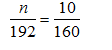
Let’s say we know that next year the student population  at Madison will be at 192 students. How many teachers will be needed if the teacher to student ratio is to remain the same?

First, write a “let statement” to identify your variable
Let n = the number of teachers needed next year

Then, if the teacher to student ratio is to be the same, we must have
To solve this proportion, we find the value of the variable that makes this equation true.
This can be done by finding equivalent fractions with a common denominator…


 Since the denominators are equal the numerators must also be equal so we have 160n = 10(192)
What do you do NOW?


divide carefully
n = 12
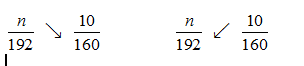
Notice that this results could also have been obtained by cross-multiplying in the original proportions. That is

to get

160n = 10(192)
n = 12
There for the school will need 12 teachers next year.
Property of Proportions                        
 with b≠  0 and d ≠ 0       Then ad = bc


3n = 8(12)
3n = 96
divide both sides by 3
n =  32
But WAIT—could you have done this another way?
Sure
What do you do to 3 to get 12? ( multiply by 4)
… so what must you do to 8?  ( multiply by 4)
that’s a great check.

So what happens if you have


from the textbook we learned
m2 = 3(27)
m2 = 81
Now, we have worked with square roots before—so you should be able to solve this problem.

Chapter 5 covered square roots.
Technically, you perform the following


m= 9

Monday, February 24, 2014

Algebra Honors ( Period 6 & 7)

Determining an Equation of a Line 8-5

Write an equation of a line that has slope 2 and y-intercept 3
Easy! remember           y = mx + b
just substitute in what you have… y = 2x + 3


Write an equation of a line that has slope -4 and x-intercept 3.
This is a little different. 
The x-intercept is the x-coordinate of the point where a line crosses the x-axis. So here the point must be (3,0) so now you can substitute into y=mx + b and find b.

First substitute in -4 for m  y = -4x +b

To find b , substitute 3 for x and 0 for y in y = -4x + b
so
0=-4(3) + b
0=-12 + b
12=b
Therefore the equation must be y = -4x + 12

Write an equation of the line passing through the points ( -2, 5) and ( 4, 8)
Since it doesn't give us the slope, we must find it using


Substitute  ½ for m in y = mx + b
y =  x/2 + b

Choose one of the points, say (4, 8) and substitute 4 for x and 8 for y.
8 = (1/2)(4) + b
8 = 2 + b
6 = b
Therefore the equation is y = (1/2)x + 6
or y = x/2 + 6

Note: that we could have used the point ( -2, 5) and the resulting equation would have been the same!


Write an equation in STANDARD FORM for the following line described
The line that is parallel to x – 2y + 7 = 0 and contains ( -4, 0)

The first thing we need to do is change the given line into slope-intercept form 
y = mx + b
-2y = -x – 7  becomes   y = x/2 + 7/2

If the line we are trying to find is parallel to that line its slope must also be ½
Now using y = mx + b and the point on the line

0 = (1/2)(-4) + b
0= -2 + b
b = 2
so the line is y = x/2 + 2
BUT that is not in standard form Ax + By = C
Where A, B, and C are integers and A is a  whole number
-x/2 + y = 2
Now multiply everything by -2
x- 2y = -4

Find a line passing through ( -2, 3), (2, 5) and (6, k)  Find k
First find the slope using the two given points


y = (1/2)x +b

Using ( -2,3)
3 = (1/2)(-2) + b
3 = -1 + b
4 = b
y = (1/2)x + 4  is the equation of the line so to solve for k
k = (1/2)(6) + 4
k = 3 + 4 = 7

Math 6A (Periods 1 & 2)

Ratios 7-6

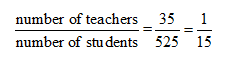
In one of our our textbook, the example given involves the number of students --at what I called a mythical middle school --as well as the number of teachers. There are 35 teachers and 525 students. We can compare the number of teachers to the number of students by writing a quotient


35
525

1/15

The quotient of one number divided by a second number is called the ratio of the first number to the second number.

We can write a ratio in the following ways:

1/15                 1:15                              1 to 15

All of these expressions are read   one to fifteen.

If the colon notation is used the first number is divided by the second. A ratio is said to be lowest terms if the two numbers are “relatively prime.”
You do not change an improper fraction to a mixed number if the improper fraction represents a ratio


There are 9 players on a baseball team. Four of these are infielders and 3 are outfielders. Find each ratio in lowest terms.

a. infielders to outfielders

b. outfields to total players

# of  infielders
# of outfielders
= 4/3  or  4:3 or 4 to 3


# of outfielders
# total of players
= 3/9 = 1/3  or  1:3   or 1 to 3

Some ratios compare measurements. In these cases we must be sure the measurements are expressed in the same units

It takes Aaron ( or Austin)  4 minutes to mix some paint for his science project. It takes him 3 hours to complete painting his science project. What is the ratio of the time it takes Aaron ( or Austin) to mix the paint to the time it takes Aaron ( or Austin) to paint his project?


Use minutes as a common unit for measuring time. You must convert the hours to minutes first

3h = 3 · 60min = 180 min

The ratio is :
min to mix
min to paint
  =   4/180 = 1/45    or 1:45

Some ratios are in the form

 40 miles per hour   or 5 pencils  for a dollar
“ I want my… I want my…. I want my … MPG!!”

These ratios involve quantities of different kinds and are called rates. Rates may be expressed as decimals or mixed numbers. Rates should be simplified to a per unit form. When a rate is expressed in a per unit form, such a rate is often called a  unit rate.

Amir’s dad’s car went 258 miles on 12 gallons of gas. Express the rate of fuel consumption in miles per gallon.

The rate of fuel consumption is

258 miles
12 gallons

= 21 1/2 miles per gallon

Some of the most common units in which rates are given are the following:
mi/gal or mpg                                                  miles per gallon
mi/h or mph                                                     miles per hour
km/L                                                                kilometers per liter
km/h                                                                kilometers per hour


This will be 2nd day:

A baseball players batting average is the ratio of the number of hits to the number of office times at bat.
Example is Nomar Garciaparr who got 190 hits in his 523 times at bat.
190/5332 = 5/14
Normally, batting averages are given as decimals rounded to the nearest thousandths. But we can write this ratio as 5:14 or as " 5 to 14."

We then compares two ratios. We looked at two different fish tanks
tank A had 2 fish in it and was 40 quarts
Tank B had 3 fish in it and was 15 gallons

Fish in Tank A   2 fish
Fish in Tank B   3 fish

2
3

Volume in Tank A
Volume in Tank B

40 quarts
15 gallons

WAIT-- we must compare quantities in terms of common units. When a common unit is used, the ratio a:b does NOT have units!
4 quarts = 1 gallon so 40 quarts must be 10 gallons

10 gallons
15 gallons

10/15 = 2/3

The two ratios are equal

Comparing Three Ratios
We compared the records of three soccer teams from three different schools
Chestnut HS   wins:  10   AND losses: 8
Mae Jennison wins:  12   AND losses: 8
Buena Vista  wins:  16   AND losses: 12

Which team had the best record?
Two Methods:
A. Find the team with the greatest ratio of wins to losses

Chestnut :  10/8 = 5/4
Mae Jennison: 12/8 = 3/2
Buena Vista:  4/3

Mae Jennison has the best record
B. Find the team with the greatest ratio of wins to TOTAL games:


Chestnut: 10/18 = 5/9
Mae Jennison: 12/20 = 3/5
Buena Vista: 16/28 = 4/7

Because 3/5= 0.6 is greater than 5/9 (5/9= 0.55555) or 4/7( 4/7= 0.5714...)
Mae Jennison has the best record

Notice we change the fractions to decimals to compare. However, you can use your skills with fractions to easily compare the fractions.Page 229
1 What is the cost of grapes in dollars per kilogram if 4.5 kg of grapes costs $7.56?
$7.56/4.5 kg divide carefully and you discover it is $1.68/kg
2. THe index of refraction of a transparent substance is the ratio of the speed of light in space to the speed of light in the substance.
Using the table from the textbook (look at page 229) Find the index of refraction of
a) glass
300,000/200,000 straight from the chart, which can simplify to 3/2
b) water
300,000/225,000 again from the chart, which can simplify to 4/3

3. The mechanical advantage of a simple machine is the ratio of the weight lifted by the machine to the forse necessary to lift it.
What is the mechanical advantage of a jack that lifts a 3200 pound car with a force of 120 pounds?
3200/120 = 80/3

4. The C string of a cello vibrates 654 times in 5 seconds. How many vibrations per second is this?
654 vibrations/5seconds... divide carefully and you find... 130 4/5 vibrations per second

5. A four-cubic-foot volume of water at sea level weights 250 pounds. What is the density of water in pound per cubic foot?
250 pounds/4 cubic ft ... divide carefully and you find 62 1/2 lb/ft3

6. A share of stock that costs $88 earned $16 last year. What was the price to earnings ratio?
88/16 = 11/2

7. we did in our spiral notebooks this year... please check

Tuesday, February 18, 2014

Algebra Honors ( Periods 6 & 7)

Points, Lines, and Their Graphs 8-2

We reviewed graphing or plotting an ordered pair as a point on a coordinate plane.
Horizontal axis is the x-axis
vertical axis is the y-axis

origin is at (0,0)

an ordered pair (3,2) lists the coordinates of a point. In this instance we called the Point A
3 is the x-coordinate also know as the abscissa of A
2 is the y-coordinate also known as the ordinate of A

the x- and y-axes are also called coordinate axes and the number plane is often called the coordinate plane. The coordinate axes separate a coordinate plane into four quadrants identified by Roman Numerals. See page 354 for details.
Points on the coordinate axes are NOT considered to be in any quadrant.

The graph of an equation in two variables consists of all the points that are the graphs of the solutions of the equations.
x + 2y = 6 has the following ordered pairs:
(0,3)
(2,2)
(4,1)
(6,0)
There are infinite number of solutions-- such as
(-2,4)
(1, 2.5)
The graph of all the solutions lie on the straight line that is drawn when the points are connected.

x + 2y = 6 is a linear equation because its graph is a line.
All linear equations in the variables x and y can be written in the form
ax + by = c
or
Ax + By = C
where a, b, and c are real numbers with a and b not both zero. If a, b, and c are integers, then the equation is said to be in standard form. We determined that A must be a whole number. A greater than or equal to 0.

2x -5y = 7 and 4x + 9y = 0 and y = 3 are examples of linear equations in standard form

(1/2)x + 4y = 12 is not
y = 3x -1 is not
neither is x2y + 3y = 4
nor xy = 6

Although you only need two points to determine a line, I suggest you plot 3-- whenever possible to guard against mistakes.

The easiest solutions to find are those where the line crosses
the x-axis ( y = 0) and
the y-axis ( x = 0)

Friday, February 14, 2014

Math 6A (Periods 1 & 2)

Multiplication & Division of Mixed Numbers  7-5
One of the best methods of finding the product of two mixed numbers is to first change them both to improper fractions and then multiply.
Multiply
6( 3 1/12)
First change 3 1/12 to 37/12
Then you have
(6/1) (37/12) =37/2 = 18  1/2

Estimates are a great way to check our computations.
5  3/4 X 4  2/3
First estimate 6 X 5 = 30
So our product should be a little less than 30
23/4 X 14/3 = 161/6 = 26 5/6
To divide one mixed number by another, we change the mixed numbers to improper fractions and use the method you learned in the previous lesson. Multiplying by the reciprocal
Divide 2 2/3 by  10 2/3
8/3 divided by 32/3
is really
8/3 X 3/32 = 1/4

Tuesday's lesson continued with
9/16  X  n = 21/20
We remembered to "squish the coefficient next to the variable..."
9n/16 = 21/20
Then we needed to isolate the variable by multiplying both sides by the reciprocal
(16/9)(9n/16) = 21/20(16/9)
We simplified as much as possible BEFORE we started multiplying.. and got
n = 28/15
n = 1  13/15

Another case was
4/7 X n =16/21
4n/7 = 16/21
Multiply both sides by the reciprocal of 4/7
(7/4)(4n/7) = 16/21 ( 7/4)
Simplify first
n = 4/3
n = 1  1/3


Thursday, February 13, 2014

Math 6A ( Periods 1 & 2)

Division of Fractions 7-4

Certain numbers when multiplied together have the product 1
5 X 1/5 = 1
3/4 X 4/3 = 1

Two numbers whose product is 1 are called reciprocals of each other.
Thus 3/4 is the reciprocal of 4/3.
Zero does not have a reciprocal


Look at the following:
We know 18 = 3 X 6 and we know 18 ÷ 6 = 3 as well as 18 X 1/6 = 3
Dividing a number by a fraction is the same as multiplying the number by the RECIPROCAL of the fraction
a/b ÷ c/d = a/b ÷ d/c
Remember- you are using the reciprocal of the divisor... that is , as students want to say "You FLIP the 2nd number!!"

42/ 55 ÷ 36/11
you must rewrite the problem using the reciprocal of the 2nd number
42/55 X 11/36
Now using your skills of observing GCF simplify before you multiply ( MUCH EASIER and FASTER)
42/ 5 X 1/36 which becomes 7/5 X 1/ 6 = 7/30