Welcome to Room K 101's Blog

Check out the Weekly Notes from your class

With Math ... you can do anything

Thursday, February 27, 2014

Math 6A ( Periods 1 & 2)

Proportions 7-7
Let’s continue our discussion of mythical middle schools
The 6th grade class at Madison Middle School has 160 students and 10 teachers.
The 6th grade class at Jefferson Middle School has 144 students and 9 teachers.
Let’s compare the two teacher to student ratios!


Thus the two ratios are equal

An equation that states that two ratios are equal is called a proportion.
The proportion above may be read as
10 is to 160   AS    9 is to 144

The numbers 10, 160, 9, and 144 are called the TERMS of the proportion.

Sometimes (especially in this textbook!) one of the terms of the proportion is missing—or is a variable.
For example, 
Let’s say we know that next year the student population  at Madison will be at 192 students. How many teachers will be needed if the teacher to student ratio is to remain the same?

First, write a “let statement” to identify your variable
Let n = the number of teachers needed next year

Then, if the teacher to student ratio is to be the same, we must have
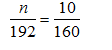
To solve this proportion, we find the value of the variable that makes this equation true.
This can be done by finding equivalent fractions with a common denominator…


 Since the denominators are equal the numerators must also be equal so we have 160n = 10(192)
What do you do NOW?


divide carefully
n = 12
Notice that this results could also have been obtained by cross-multiplying in the original proportions. That is
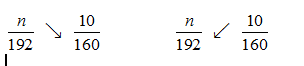
to get

160n = 10(192)
n = 12
There for the school will need 12 teachers next year.
Property of Proportions                        
 with b≠  0 and d ≠ 0       Then ad = bc


3n = 8(12)
3n = 96
divide both sides by 3
n =  32
But WAIT—could you have done this another way?
Sure
What do you do to 3 to get 12? ( multiply by 4)
… so what must you do to 8?  ( multiply by 4)
that’s a great check.

So what happens if you have


from the textbook we learned
m2 = 3(27)
m2 = 81
Now, we have worked with square roots before—so you should be able to solve this problem.

Chapter 5 covered square roots.
Technically, you perform the following


m= 9

Monday, February 24, 2014

Algebra Honors ( Period 6 & 7)

Determining an Equation of a Line 8-5

Write an equation of a line that has slope 2 and y-intercept 3
Easy! remember           y = mx + b
just substitute in what you have… y = 2x + 3


Write an equation of a line that has slope -4 and x-intercept 3.
This is a little different. 
The x-intercept is the x-coordinate of the point where a line crosses the x-axis. So here the point must be (3,0) so now you can substitute into y=mx + b and find b.

First substitute in -4 for m  y = -4x +b

To find b , substitute 3 for x and 0 for y in y = -4x + b
so
0=-4(3) + b
0=-12 + b
12=b
Therefore the equation must be y = -4x + 12

Write an equation of the line passing through the points ( -2, 5) and ( 4, 8)
Since it doesn't give us the slope, we must find it using


Substitute  ½ for m in y = mx + b
y =  x/2 + b

Choose one of the points, say (4, 8) and substitute 4 for x and 8 for y.
8 = (1/2)(4) + b
8 = 2 + b
6 = b
Therefore the equation is y = (1/2)x + 6
or y = x/2 + 6

Note: that we could have used the point ( -2, 5) and the resulting equation would have been the same!


Write an equation in STANDARD FORM for the following line described
The line that is parallel to x – 2y + 7 = 0 and contains ( -4, 0)

The first thing we need to do is change the given line into slope-intercept form 
y = mx + b
-2y = -x – 7  becomes   y = x/2 + 7/2

If the line we are trying to find is parallel to that line its slope must also be ½
Now using y = mx + b and the point on the line

0 = (1/2)(-4) + b
0= -2 + b
b = 2
so the line is y = x/2 + 2
BUT that is not in standard form Ax + By = C
Where A, B, and C are integers and A is a  whole number
-x/2 + y = 2
Now multiply everything by -2
x- 2y = -4

Find a line passing through ( -2, 3), (2, 5) and (6, k)  Find k
First find the slope using the two given points


y = (1/2)x +b

Using ( -2,3)
3 = (1/2)(-2) + b
3 = -1 + b
4 = b
y = (1/2)x + 4  is the equation of the line so to solve for k
k = (1/2)(6) + 4
k = 3 + 4 = 7

Math 6A (Periods 1 & 2)

Ratios 7-6

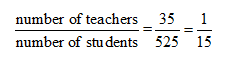
In one of our our textbook, the example given involves the number of students --at what I called a mythical middle school --as well as the number of teachers. There are 35 teachers and 525 students. We can compare the number of teachers to the number of students by writing a quotient


35
525

1/15

The quotient of one number divided by a second number is called the ratio of the first number to the second number.

We can write a ratio in the following ways:

1/15                 1:15                              1 to 15

All of these expressions are read   one to fifteen.

If the colon notation is used the first number is divided by the second. A ratio is said to be lowest terms if the two numbers are “relatively prime.”
You do not change an improper fraction to a mixed number if the improper fraction represents a ratio


There are 9 players on a baseball team. Four of these are infielders and 3 are outfielders. Find each ratio in lowest terms.

a. infielders to outfielders

b. outfields to total players

# of  infielders
# of outfielders
= 4/3  or  4:3 or 4 to 3


# of outfielders
# total of players
= 3/9 = 1/3  or  1:3   or 1 to 3

Some ratios compare measurements. In these cases we must be sure the measurements are expressed in the same units

It takes Aaron ( or Austin)  4 minutes to mix some paint for his science project. It takes him 3 hours to complete painting his science project. What is the ratio of the time it takes Aaron ( or Austin) to mix the paint to the time it takes Aaron ( or Austin) to paint his project?


Use minutes as a common unit for measuring time. You must convert the hours to minutes first

3h = 3 · 60min = 180 min

The ratio is :
min to mix
min to paint
  =   4/180 = 1/45    or 1:45

Some ratios are in the form

 40 miles per hour   or 5 pencils  for a dollar
“ I want my… I want my…. I want my … MPG!!”

These ratios involve quantities of different kinds and are called rates. Rates may be expressed as decimals or mixed numbers. Rates should be simplified to a per unit form. When a rate is expressed in a per unit form, such a rate is often called a  unit rate.

Amir’s dad’s car went 258 miles on 12 gallons of gas. Express the rate of fuel consumption in miles per gallon.

The rate of fuel consumption is

258 miles
12 gallons

= 21 1/2 miles per gallon

Some of the most common units in which rates are given are the following:
mi/gal or mpg                                                  miles per gallon
mi/h or mph                                                     miles per hour
km/L                                                                kilometers per liter
km/h                                                                kilometers per hour


This will be 2nd day:

A baseball players batting average is the ratio of the number of hits to the number of office times at bat.
Example is Nomar Garciaparr who got 190 hits in his 523 times at bat.
190/5332 = 5/14
Normally, batting averages are given as decimals rounded to the nearest thousandths. But we can write this ratio as 5:14 or as " 5 to 14."

We then compares two ratios. We looked at two different fish tanks
tank A had 2 fish in it and was 40 quarts
Tank B had 3 fish in it and was 15 gallons

Fish in Tank A   2 fish
Fish in Tank B   3 fish

2
3

Volume in Tank A
Volume in Tank B

40 quarts
15 gallons

WAIT-- we must compare quantities in terms of common units. When a common unit is used, the ratio a:b does NOT have units!
4 quarts = 1 gallon so 40 quarts must be 10 gallons

10 gallons
15 gallons

10/15 = 2/3

The two ratios are equal

Comparing Three Ratios
We compared the records of three soccer teams from three different schools
Chestnut HS   wins:  10   AND losses: 8
Mae Jennison wins:  12   AND losses: 8
Buena Vista  wins:  16   AND losses: 12

Which team had the best record?
Two Methods:
A. Find the team with the greatest ratio of wins to losses

Chestnut :  10/8 = 5/4
Mae Jennison: 12/8 = 3/2
Buena Vista:  4/3

Mae Jennison has the best record
B. Find the team with the greatest ratio of wins to TOTAL games:


Chestnut: 10/18 = 5/9
Mae Jennison: 12/20 = 3/5
Buena Vista: 16/28 = 4/7

Because 3/5= 0.6 is greater than 5/9 (5/9= 0.55555) or 4/7( 4/7= 0.5714...)
Mae Jennison has the best record

Notice we change the fractions to decimals to compare. However, you can use your skills with fractions to easily compare the fractions.Page 229
1 What is the cost of grapes in dollars per kilogram if 4.5 kg of grapes costs $7.56?
$7.56/4.5 kg divide carefully and you discover it is $1.68/kg
2. THe index of refraction of a transparent substance is the ratio of the speed of light in space to the speed of light in the substance.
Using the table from the textbook (look at page 229) Find the index of refraction of
a) glass
300,000/200,000 straight from the chart, which can simplify to 3/2
b) water
300,000/225,000 again from the chart, which can simplify to 4/3

3. The mechanical advantage of a simple machine is the ratio of the weight lifted by the machine to the forse necessary to lift it.
What is the mechanical advantage of a jack that lifts a 3200 pound car with a force of 120 pounds?
3200/120 = 80/3

4. The C string of a cello vibrates 654 times in 5 seconds. How many vibrations per second is this?
654 vibrations/5seconds... divide carefully and you find... 130 4/5 vibrations per second

5. A four-cubic-foot volume of water at sea level weights 250 pounds. What is the density of water in pound per cubic foot?
250 pounds/4 cubic ft ... divide carefully and you find 62 1/2 lb/ft3

6. A share of stock that costs $88 earned $16 last year. What was the price to earnings ratio?
88/16 = 11/2

7. we did in our spiral notebooks this year... please check

Tuesday, February 18, 2014

Algebra Honors ( Periods 6 & 7)

Points, Lines, and Their Graphs 8-2

We reviewed graphing or plotting an ordered pair as a point on a coordinate plane.
Horizontal axis is the x-axis
vertical axis is the y-axis

origin is at (0,0)

an ordered pair (3,2) lists the coordinates of a point. In this instance we called the Point A
3 is the x-coordinate also know as the abscissa of A
2 is the y-coordinate also known as the ordinate of A

the x- and y-axes are also called coordinate axes and the number plane is often called the coordinate plane. The coordinate axes separate a coordinate plane into four quadrants identified by Roman Numerals. See page 354 for details.
Points on the coordinate axes are NOT considered to be in any quadrant.

The graph of an equation in two variables consists of all the points that are the graphs of the solutions of the equations.
x + 2y = 6 has the following ordered pairs:
(0,3)
(2,2)
(4,1)
(6,0)
There are infinite number of solutions-- such as
(-2,4)
(1, 2.5)
The graph of all the solutions lie on the straight line that is drawn when the points are connected.

x + 2y = 6 is a linear equation because its graph is a line.
All linear equations in the variables x and y can be written in the form
ax + by = c
or
Ax + By = C
where a, b, and c are real numbers with a and b not both zero. If a, b, and c are integers, then the equation is said to be in standard form. We determined that A must be a whole number. A greater than or equal to 0.

2x -5y = 7 and 4x + 9y = 0 and y = 3 are examples of linear equations in standard form

(1/2)x + 4y = 12 is not
y = 3x -1 is not
neither is x2y + 3y = 4
nor xy = 6

Although you only need two points to determine a line, I suggest you plot 3-- whenever possible to guard against mistakes.

The easiest solutions to find are those where the line crosses
the x-axis ( y = 0) and
the y-axis ( x = 0)

Friday, February 14, 2014

Math 6A (Periods 1 & 2)

Multiplication & Division of Mixed Numbers  7-5
One of the best methods of finding the product of two mixed numbers is to first change them both to improper fractions and then multiply.
Multiply
6( 3 1/12)
First change 3 1/12 to 37/12
Then you have
(6/1) (37/12) =37/2 = 18  1/2

Estimates are a great way to check our computations.
5  3/4 X 4  2/3
First estimate 6 X 5 = 30
So our product should be a little less than 30
23/4 X 14/3 = 161/6 = 26 5/6
To divide one mixed number by another, we change the mixed numbers to improper fractions and use the method you learned in the previous lesson. Multiplying by the reciprocal
Divide 2 2/3 by  10 2/3
8/3 divided by 32/3
is really
8/3 X 3/32 = 1/4

Tuesday's lesson continued with
9/16  X  n = 21/20
We remembered to "squish the coefficient next to the variable..."
9n/16 = 21/20
Then we needed to isolate the variable by multiplying both sides by the reciprocal
(16/9)(9n/16) = 21/20(16/9)
We simplified as much as possible BEFORE we started multiplying.. and got
n = 28/15
n = 1  13/15

Another case was
4/7 X n =16/21
4n/7 = 16/21
Multiply both sides by the reciprocal of 4/7
(7/4)(4n/7) = 16/21 ( 7/4)
Simplify first
n = 4/3
n = 1  1/3


Thursday, February 13, 2014

Math 6A ( Periods 1 & 2)

Division of Fractions 7-4

Certain numbers when multiplied together have the product 1
5 X 1/5 = 1
3/4 X 4/3 = 1

Two numbers whose product is 1 are called reciprocals of each other.
Thus 3/4 is the reciprocal of 4/3.
Zero does not have a reciprocal


Look at the following:
We know 18 = 3 X 6 and we know 18 ÷ 6 = 3 as well as 18 X 1/6 = 3
Dividing a number by a fraction is the same as multiplying the number by the RECIPROCAL of the fraction
a/b ÷ c/d = a/b ÷ d/c
Remember- you are using the reciprocal of the divisor... that is , as students want to say "You FLIP the 2nd number!!"

42/ 55 ÷ 36/11
you must rewrite the problem using the reciprocal of the 2nd number
42/55 X 11/36
Now using your skills of observing GCF simplify before you multiply ( MUCH EASIER and FASTER)
42/ 5 X 1/36 which becomes 7/5 X 1/ 6 = 7/30

Wednesday, February 12, 2014

Math 6A ( Periods 1 & 2)

Multiplication of Fractions 7-3

If a rectangle is divided into 4 equal parts, each part is ¼ of the whole. If each of these parts is then divided into 3 parts, that is into thirds, then there are 12 equal parts and each is 1/(3 ∙4) or 1/12 of the whole.

That is 1/3 of 1/4 is 1/(3 ∙4) or 1/12 and 1/3 ∙ 1/4 = 1/12 is

so another example 2/3 of 4/5 is 2∙4 /(3∙8) or 2/3 ∙4/5 = 8/15


Notice, that the numerator of the product, 8, is the product of the numerators 2 and 4. The denominator of the product, 15, is the product of the denominators 3 and 5

Rule
If a, b, c, and d are whole numbers with b ≠ 0 and d ≠ 0 , then

a/b(c/d) = a∙c/(b∙d)


When multiplying two fractions, you can simplify the multiplication by dividing either of the numerators and either of the denominators by common factors

6/35 ( 7/3) we can simplify first because both 6 and 3 are divisible by 3
2/35 (7/1) and then both 35 and 7 are divisible by 7 so 2/5 (1(1) = 2/5

Try the following

25/6 ( 42/5) What can we do there?

7/8(20/21) How about with these two sets of fractions?

19/20 ( 25/38) … and these fractions?

What happens when you have
15/2(7/8- 5/24)
What must we do first?

PEMDAS... in my classroom...
15/2( 21/24 - 5/24)
= 15/2(16/24)
= 15/2(2/3)
then simplify to
15/1(1/3)
= 5

What about
8/9∗ 15/32∗ 9/10 = 3/8


or 16/11 × 33/20 × 5/3 = 4

Tuesday, February 11, 2014

Math 6A (Periods 1 & 2)

Addition & Subtraction of Mixed Numbers 7-2

To add or subtract mixed numbers we could first change the mixed numbers to improper fractions and then use the method from 7-1 .
1 4/9 + 3 1/9 = 13/9 + 28/9 = 41/9 = 4 5/9 but that was 5th grade….
In the second method, and the one I prefer, you work separately with the fractional and whole number parts of the given mixed numbers.


STACK THEM!!
3 4/9
1 7/9
4 11/9 = 5 2/9


If the fractional parts of the given mixed numbers have different denominators, we find equivalent mixed numbers whose fractional parts have the same denominator, usually the LCD.

5 3/10 + 7 7/15

Stack

5 3/10
+7 7/15

Draw a line separating the fractional part from the whole numbers Find the LCM of the denominators the LCD and add…

9 5/9 - 4 13/15

Monday, February 10, 2014

Math 6A ( Periods 1 & 2)

Addition and Subtraction of Fractions 7-1

Most of you already know how to add and subtract fractions, although some of you may need just a little review.

5/9 + 2/9 = 7/9
13/12 - 5/12 = 8/12 = 2/3
and that
7/9 – 2/9 = 5/9


13/12 - 5/12 = 8/12 = 2/3
a/c + b/c = (a +b)/c where c does not equal 0
a/c - b/c = (a -b)/c

The properties of addition and subtraction of whole numbers also apply to fractions.
If the denominators are the same— add or subtract the numerators AND use the numerator!!

In order to add two fractions with different denominators, we first find two fractions, with a common denominator, equivalent to the given fractions. Then add these two fractions.

The most convenient denominator to use as a common denominator is the least common denominator of LCD, of the two fractions. That is, the least common multiple of the two denominators.

LCD ( a/b, c/d) = LCM(b, d) where b and d both cannot be equal to 0

For example LCD ( 3/4, 5/6) = LCM(4,6) =12

3/4 = 9/12 and 5/6 = 10/12

Let’s do:
7/15 + 8/9

First find the LCD

LCM(15, 9) Do your factor trees or inverted division – or just by knowing!!

15 = 3• 5
9 = 32

So LCM(15,9) = [every factor to its greatest power] 32•5 = 45

Then find equivalent factions with a LCD of 45, and add

7/15 = 21/45

8/9 = 40/45

21/45 + 40/45 = 61/45 = 1 16/45

5/6- 11/24
Stack them and use the LCD
5/6 = 20/24
-11/24 = -11/24

9/24 = 3/8
7/12 + 4/9 + 3/4
several strategies ca be used. You can find the LCD for all three you can use the C+ and the A+
and change it to
(7/12 + 3/4) + 4/9
then add the first two factions
7/12 + 3/4 becomes 7/12 + 9/12 = 16/12 = 4/3
then add 4/3 + 4/9
change 4/3 to 12/9
12/9 + 4/9 = 16/9 = 1 7/9

What about 17/10 - ( 3/5 + 5/6)
You must do the parenthesis first
so 3/5 + 5/6
3/5 = 18/30
5/6 = 25/30
43/30
Now you have
17/10 - 43/30
stack those
17/10 = 51/30


51/30
-43/30


8/30 = 4/15

Thursday, January 30, 2014

Math 7 ( Period 4)

LEAST COMMON MULTIPLE  5.3

Mrs. Lovetoteach had her kindergarten class sorting a pile of buttons. When they separated the pile into groups of 5, there were 3 leftover. When they separated them into groups of 7, there were 3 leftover. When they separated the pile into groups of 9, there were NONE leftover. what is the LEAST number of buttons the kindergarteners could have had?  Hint; you may want to set up a guess and check chart or draw pictures of what’s happening, or use another strategy that you think might work?

You’re taking care of your next door neighbor’s house for the next five week while they are away. These are your chores
1) Take the mail and newspaper in each day
2) Feed the fish every 3 days
3) Take out the garbage every 6 days
4) Feed the snake every 4 days
What is the first day that you will be doing all 4 chores on the same day? How often will you be doing all 4 chores on the same day during those 5 weeks?


This question CANNOT be answered using the GCF
You are NOT trying to find a factor of the days—but instead a Multiple

How to find the LCM  smallest number that your numbers can go into.
Just like the GCF let’s look at the letters backwards to understand it
MULTIPLE  each number given in the problem must go into this number multiples of 2: 2, 34, 6, 8,…
Multiples of 3: 3, 6, 9, 12…
Multiples of 5: 5, 10, 15, 20…
COMMON—must be a number that ALL of the numbers can go into

LEAST  must be the SMALLEST number that all of the numbers go into

There are the same ways to find it as the GCF
1) List all the multiples of each number and circle the smallest one that is common to all the numbers (Yuk- way too much work, if you ask me)
2) Circle every factor in the prime factorization of each number that is different and multiply
3) List the EXPANDED FORM prime factorization in a table and bring down ONE of EACH COLUMN. Then multiply (or you can do this with exponential form- you need the HIGHEST power of each column.

WINDOW BOX Method- My favorite
Create the window BOX method as if you are finding the GCF. The GCF will be on the left as usual.  But your LCM makes a capital L – find the product of the GCF and the last row of your window box ( the last row must be relatively prime) . You can also  multiply one of your numbers with the bottom relatively prime number of the opposite number.

The difference between GCF and LCM
For the GCF you need the LEAST POWER of only the COMMON FACTORS.
For the LCM you need the product of  GREATEST POWER of EVERY FACTOR

Why do we need EVERY FACTOR this time?
because it is a multiple of all your numbers
Mutiples start with each number so all the factors that make up each number have to be in the common multiple of the numbers.
Finding the LCM of 12 and 15. That multiple must be a multiple of 12
12: 12, 24, 36, …AS WELL AS
15: 15, 30, 45, ….
So the COMMON multiple just include
12: 2  x 2 x 3
and 15: 3 x 5
The LCM must have two 2’s and one 3 or 12 won’t do into it. It must also have that same 3 that 12 needs and one 5 or it won’t be a multiple of 15
Find the LCM 54 and 36
You could list all the multiples
This is more difficult than listing method for GCF for 2 reason
You don’t know where to stop as you list the first number—multiples go on forever…
the numbers get big very fast because they are multiples—not factors

Prime Factorization
54 = 2x3 x3 x3
36= 2 x 2 x 3 x 3
The LCM will be one of each factor of each number. (don’t double count a factor that is common to both numbers.
LCM = 2 x 2 x 3 x 3 x 3 = 108

What if by mistake you double up on a factor and use all of them? You will still get a common multiple—it won’t be the least common multiple. Generally you will get a really big number and the bigger the number is, the harder it is to use.
BOX Method


Checking the LCM to make sure it works

To show that the LCM works or each number, use the fraction simplifying concept. The LCM is on the top and the numbers are on the bottom each time
LCM =108
The numbers were 36 and 54
108/36 = 3
and
108/54 = 2
Use this same approach to prove the GCF works but this time you would put the GCF in the Denominator because it needs to go into the numbers
The numbers are still 36 and 54
We found that the GCF was 18
36/18 = 2

54/18 = 3

Wednesday, January 29, 2014

Math 7 ( Period 4)

GREATEST COMMON  FACTOR 
Factoring OUT the GCF
( the Distributive Property backwards—revisited. At the beginning of the year we reviewed the DP and talked about using it BACKWARDS to look at whether it was easier to simply use O3 to simplify—rathr than distribute. Today I will revisit this concept but we will call it FACTORING the GCF Factor the GCF means
1) find the GCF of 2 or more terms
2) set up a pair of (  )
3) Place the GCF in front of the ( )
4) divide the GCF OUT OF EACH term and place the quotients inside the (  ) with the applicable sign ( + or - )
Factor 36 + 45
the gcf is 9
9(4 + 5)
Notice when you look side the (    ) there shouldn’t be an common factors of the 2 terms—OR you did not USE the GCF.
Notice: You will get the same results either way because FACOTRING THE GCF DOESN’T change the value EVER!!!
36 + 45 = 81
9(4 + 5) = 9(4) + 9(5) = 81
The reason we need to know this is because of variables – so let’s look at a couple of algebraic terms
Factor 36a2b2c2 – 45a2c5d
The GCF is 9a2c2
 9a2c2 (4b2-5c3d)
If you now distribute back, you will get exactly what you started with.
If you look inside the (  )’s you will see that there are no longer any common factors between the 2 terms—they are now relatively prime. This example shows that you get c3 because you factored out 2 of the c’s leaving 3 more of them 
inside the (  )’s.


Tuesday, January 28, 2014

Math 7( Period 4)

Simplifying & Comparing Fractions 5.4
Equivalent Fractions- just multiply the numerator and the denominator by the same number and you will get an equivalent ( equal fraction to the one you started with.

GOLDEN RULE OF FRACTIONS à do unto the numerator as you do unto the denominator

Simplifying fractions
(your parents & MS Baril call this reducing)
Two great ways:
1) Just divide both the numerator and the denominator by the GCF
2) Rewrite the numerator and the denominator into prime factorization (use factor trees or inverted division) Then simply cross out (cross cancel) each common factor on the numerator and the denominator (they cross out because each becomes 1  such as 4/4 =1)  You are left with the simplified fraction every time!

THE GCF METHOD
One of the reasons we learn the GCF is because it is the FASTEST way to simplify fractions in one easy step!
Just divide both the numerator and the denominator by the GCF
(The problem with this method is if you are not comfortable finding the GCF, you really can’t do this method easily)

The best reason to use this method is because it is the fastest. So imagine you have a “GCF Magical Voice” in your hear.. the voice tells you the GCF of the numerator and the denominator.. you simply use that GCF to divide both the top and the bottom of your fraction and your done… It’s a “gut feeling” – combined with your knowledge of the divisibility rules.. and YOU CAN DO IT!

THE PRIME FACTORIZATION METHOD:
This is sort of the GCF “Incognito” ( In disguise)  Rewrite the numerator and the denominator in prime factorization form (Use Factor Trees or Inverted Division to find the prime factorization, if necessary)
Then simply cross out each common factor on the top with the bottom. You are actually using the ID Property of Multiplication because each “cross out_ is really a quotient of 1 – again 4/4 = 1 You will be left with the simplified fraction every time.
If you actually multiplied together all the “cross outs” you would get the GCF—so you are using the GCF without ever computing it.
THE CROSS OUT METHOD:
You simply think of the first number that comes to your mind that “GOZ-into” both the numerator and the denominator and keep going until its simplified. If the numbers are both even—many students start dividing it in half. and then half again—if both are still even… This probably takes the longest, but in practice, most people use this method!
The problem with this method—you may think that a fraction is simplified but you miss a factor—this especially happens when the number is odd and you are always using 2 to divide.
The best reason to use this method –no one ever forget how to do this method—it comes rather naturally and there are no “precise” steps to do.  
Comparing Fractions
I. Benchmarks
0, ¼1/4, ½ 1/2 , 3/4 ¾ , and 1 (using your gut feeling).

How do you figure out which benchmark to use?

When the numerator is close to the denominator , the fraction is approaching 1 ( 9/11 or  45/55)

When you double the numerator and that is close to the denominator the fraction is close to ½ ½1/2. ( 4/9)

When the numerator is very far from the denominator the fraction is approaching zero ( 1/9 )

Also if one number is improper or a mixed number and the other is a proper fraction, then obviously the number greater than 1 will be bigger.

II. LCD—give them all the same denominator using the LCM as the LCD.

III. Use cross multiplication—sometimes several times to compare

IV. Change them to decimals ( my least favorite)

Comparing negative fractions
1) if one is positive and the other negative—the positive is always bigger… no matter what!

If both NEGATIVEà remember that the one closest to ZERO is bigger.

2) both proper fractions  if you have -3/4 and -1/4 then -1/4 is BIGGER because it is closer to ZERO ( It is to the right of -3/4 on the number line)

3) One is a proper fraction and the other is a improper (or mixed number) the proper negative fraction  will always be bigger because IT IS CLOSER to ZERO
-1/4 will always be bigger than – 5 1/4¼.¼

When cross multiplying with negative fractions—be careful Remember that these cross products are NEGATIVE so use integer concepts.
-3/4 vs – 5/6
Using cross products
(-3)(6) and (4)(-5)
-18 > -20 (integer concept)
-3/4 > -5/6