Solving Problems Involving Quadratic Equations 12-6
You can use quadratic equations to solve problems...
We used the examples in the book to start with:
The park commission wants a new recantangluar sign with an area of 25 m2 for the visitor center. The lenthght of the sign is to be 4 m longer than the width . To the nearest tenth of a meter, what wil be the length and the width of the sign?
Always make sure you check before AND after-- to see wht the problem is really asking for...
Let x = the width in meters
then x + 4 = the length in meters
Use the formula for the area of a recntagle to write an exquation
x(x+4) = 25
solve it
x(x +4) = 25 becomes
x2 + 4x = 25
You can use two methods: the quadratic formula would be my second choice since completing the square works easily here
x2 + 4x + 4 = 25 + 4
(x + 2)2 = 29
x + 2 = ±√29
You can use your calculator, or the table of square roots... or approximately easily using the method taught in class earlier this year
but to the nearest tenth you get
-2 + √29 ≈3.4
-2 - √29 ≈-7.4
Since you can't have a negative root since a negative length has no meaning... you know the width must be about 3.4 meters and therefore the length is 3.4 +4 or approximately 7.4 meters
Problem 2:
The sum of a number and its square is 156. Find the number
Let x = the number
then
x2 + x = 156
x2 + x - 156 =0
Using the skills you have for factoring
(x +13)(x-12) = 0
so
x = 13 and x = 12
You have two solutions to this question!!
Problem 3:
The altitude of a triangle is 9 cm less than the base. The area is 143 cm2
What are the altitude and base?
Remember the formula for the area of a triangle is A = ½bh
Let b = the length of the base
then the altitude ( the height) is b-9
so
½(b)(b-9) = 143
b2 -9b = 286
b2 -9b - 286 = 0
(b -22)(b +13) = 0
b = 22 and b= -13
You can't have a negative length so
the base is 22 cm and the altitude is 13 cm
An object that moves through the air and is solely under the influence of gravity is called a projectile. The approximate height (h) in meters of a projectile at t seconds after it begins its flight from the ground with initial upward velocity v0 is given by the formula
h = -5t2 + v0t
We can find when such a projectile is at ground level (h=0) by solving
0 = -5t2 + v0t.
If a projectile begins its flight at height c, its approximate height at time t is
h = -5t2 + v0t + c .
We can find when it hits the ground by solving h=0 or
0 = -5t2 + v0t +c.
When a projectile is thrown into the air with an initial vertical velocity of r feet per second, its distance (d) in feet above the starting point t seconds after it is thrown is approximately
d = rt – 16t2
Thursday, March 8, 2012

Wednesday, March 7, 2012
Math 6 Honors ( Periods 1, 2, & 3)
Subtracting Integers 11-3
The life story about someone who was so negative-- you wanted to take a little negativity away but since you can't do that you add a little positiveness-- works in math as well!!
Instead of subtracting ... "ADD THE OPPOSITE!"
We proved it in class with our little red and yellow tiles... If you need to review, make your own out of red and yellow paper-- or whatever colors you want!!
In life-- to take away a little negative-- add some positive
To take away an integer... add its opposite.
Rule from our textbook
for all integers a and b
a - b = a + (the opposite of b) or
a - b = a + (-b)
Instead of subtracting.. "ADD THE OPPOSITE"
make sure you do the check, check.. you need to have two check marks.. one changing the subtraction to addition and the other changing the sign of the 2nd number to its opposite.
5 - - 2=
5 + + 2= 7
-2 - 5 =
- 2 + - 5 =
before I give you the answer look... we are looking at
-2 + -5
We are adding two negatives.. so we are back to the rules from Section 11-2...
when adding the same sign just add the number and use their sign so
- 2 + - 5 = -7
But what about -2 - -5 ?
adding the opposite, we get
-2 + + 5 .
Now, the signs are different so the rule from Section 11-2 is
ask yourself... "Who wins?" and "By how much?"
Okay, here the positive wins so I know the answer will be +
and by how much means.. to take the difference
5-2 = 3
so -2 + + 5 = +3
Do you need to put the + sign? No, but I like to in the beginning to show that I checked WHO WON!!
What about
-120 - -48?
add the opposite
-120 + + 48 follows the
Different signs rule... so
ask yourself
Who wins? answer: the negative.. so I know the answer will be negative..
And "By How Much?" take the difference 120-48 = 72
so
-120 + + 48 = -72
NEVER EVER CHANGE THE FIRST NUMBER'S SIGN!!
WALK THE LINE, the number line-- that is!!
Remember... Attitude is such a little thing... but it makes a BIG difference!!
Always start with a positive attitude!!
When you walk the line, Which way are you always facing when you start???
Always attempt to get everything into addition so we can follow the rules of Section 11-2 Adding Integers.
1) SAME SIGN rule---> just add the numbers and use their sign
-4 + -5 = -9
2) DIFFERENT SIGNS rule
ask yourself those 2 important questions
a) Who wins? (answer is either negative or positive)
b) By how much? (Take the difference)
Page 376 answers to # 2-18 (evens)
2. -9
4. -5
6. 22
8. -9
10. -74
12. -32
14. -160
16. 498
18. -284
Tuesday, March 6, 2012
Math 6 Honors ( Periods 1, 2, & 3)
Adding Integers 11-2
Rules: The sum of two positive integers is a positive integer.
The sum of two negative integers is a negative integer.
So- if the two numbers have the same sign, use their sign and just add the numbers.
-15 + -13 = - 28
-10 + -4 = -14
Rules: The sum of a positive integer and a negative integer is :
POSITIVE… IF the positive number has a greater absolute value
NEGATIVE… IF the negative number has a greater absolute value
ZERO… IF both numbers have the same absolute value
Think of a game between two teams- The POSITIVE TEAM and The NEGATIVE TEAM.
30 + -16 … ask yourself the all important question…
“WHO WINS?
in this case the positive and then ask
“BY HOW MUCH?”
take the difference 14
14 + - 52…
“WHO WINS?”
the negative… “BY HOW MUCH?”
38
so the answer is -38
(-2 + 3) + - 6 you can work this 2 ways
(-2 + 3) + - 6 = 1 + -6 = -5 or
using all the properties that work for whole numbers
Commutative and Associative properties of addition
can change expression to (-2 + -6) + 3 or -8 + 3 = -5 you still arrive at the same solution.
You want to use these properties when you are adding more than 2 integers.
First look for zero pairs—you can cross them out right away!!
3 + (-3) = 0
-9 + 9 = 0
Then you can use C(+) to move the integers around to make it easier to add them together rather than adding them in the original order. In addition, you can use A(+) to group your positive and negative numbers in ways that make it easier to add as well.
One surefire way is to add all the positives up… and then add all the negatives up.
At this point ask yourself that all important question… WHO WINS? …
use the winner’s sign..
and then ask yourself..
BY HOW MUCH?
example:
-4 + 27 +(-6) + 5 + (-4) + (6) + (-27) + 13
Taking a good scan of the numbers, do you see any zero pairs?
YES—so cross them out and you are left with
-4 + 5 + (-4) + 13
add your positives 5 + 13 = 18
add your negatives and use their sign – 4 + -4 = -8
Okay, Who wins? the positive
By how much? 10
so
-4 + 27 +(-6) + 5 + (-4) + (6) + (-27) + 13 = 10
Algebra Honors (Period 6 & 7)
Methods of Solutions 12-5
You have learned four different methods of solving quadratics.. picking the best one is the challenge
Here are some tips on when to use each method:
Quadratic Formula--> when to use: ax2 +bx + c = 0 (It always works) Great when you have a calculator
Factoring--> when to use: ax2 +bx + c = 0 you see the factors easily or you have ax2 +bx = 0
Using the Property of SQRT's --> when to use: ax2 + c = 0
Completing the square --> when to use: x2 +bx + c = 0 especially when b is even
Which method would you use for the following?
x2 +5x - 6 = 0
Answer: Factoring
x2 -2x = 1
Answer: Completing the square
11x2 = 44
Answer: SQRTing
3x2 -5x = 4
Answer: Quadratic Formula
Monday, March 5, 2012
Algebra Honors (Period 6 & 7)
Graphs of Quadratic Equations:The Discriminant 12-4
Sometimes it is NOT necessary to draw the graph of an equation.
Knowing the relationships between an equation and its graph— you can obtain important information from the equation itself.
Today’s lesson illustrates the relationship between the number of roots of a quadratic equation and the number of x-intercepts of the related parabola.
In the parabola the x coordinate of a point where the curve intersects the x axis is called an x-intercept of the curve.
Looking at the parabola on page 572 you notice that this parabola has two x-intercepts, -1 and 3 because y = 0 for both of these values of x.
you can also see that
x2- 2x – 3 = 0 or (x +1)(x-3) = 0
has -1 and 3 as its roots, solutions, zeros… {-1,3}
The algebraic fact that a quadratic equation can have two, one or no real number roots corresponds to the fact that a parabola can have two, one or no x-intercepts…
and we can find that out by just working with the quadratic equations—rather than having to graph…
However… let’s graph a few
Example 1: x2 + 4x + 1 = 0
find –b/2a
-4/2 = -2
f(-2) = (-2)2 + 4(-2) + 1 = 4 -8 + 1 = -3
so (-2,-3) is the vertex
x = -2 is the axis of symmetry
Create an x y table
f(-1) = (-1)2 +4(-1) + 1 = 1 -4 +1 = -2
f(0) = 02 + 4(0) + 1 = 1
x y
-1 -2
0 1
Now solve
Solving x2 + 4x + 1 = 0
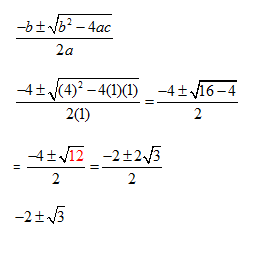
Now graph
Number of roots: two real roots Number of x-intercepts: two
Example 2 : x2 + 2x + 1 = 0
find -b/2a -2/2 = -1
f(-1) = (-1)2 + 2(-1) + 1 = 1 -2 + 1 = 0
(-1.0) is the vertex
and x = -1 is the axis of symmetry
create an xy table
f(0)=02 + 2(0) + 1 = 1
f(1) = (1)2 +2(1) + 1 = 4
x y
0 1
1 4
Now graph
Now Solve
Solving x2 + 2x + 1 = 0
We can solve easily but let’s use the quadratic formula

= -1
The solution set is {-1}
Number of roots: 1 real root Number of x- intercepts: one
Example 3: x2 -4x + 7 = 0
find –b/2a= +4/2 = 2
f(2) = (2)2 -4(2) + 7 = 4 -8 + 7 = 3
vertex ( 2, 3)
and x= 2 is the axis of symmetry
create an xy table
f(1) = (1)2 -4(1) + 7
f(0) = (0)2 -4(0) + 7
x y
1 4
0 7
Now graph
Now solve
x2 -4x + 7 = 0

There is NO REAL number root since does not represent a real number
Number of roots: no real number roots Number of x intercepts: None
In each of these examples the value of b2-4ac in the quadratic formula is the key to the number of real roots.

When b2-4ac is negative, there is no real number root of the equation ax2 + bx + c = 0 because square roots of negative numbers do not exist in the set of real numbers.
Because the value of b2-4ac discriminates, or points out differences, among these 3 cases above, it is called the discriminant of the quadratic equation.
The discriminant is only part of the quadratic formula and simpliy helps one determine the number of roots.
Sometimes it is NOT necessary to draw the graph of an equation.
Knowing the relationships between an equation and its graph— you can obtain important information from the equation itself.
Today’s lesson illustrates the relationship between the number of roots of a quadratic equation and the number of x-intercepts of the related parabola.
In the parabola the x coordinate of a point where the curve intersects the x axis is called an x-intercept of the curve.
Looking at the parabola on page 572 you notice that this parabola has two x-intercepts, -1 and 3 because y = 0 for both of these values of x.
you can also see that
x2- 2x – 3 = 0 or (x +1)(x-3) = 0
has -1 and 3 as its roots, solutions, zeros… {-1,3}
The algebraic fact that a quadratic equation can have two, one or no real number roots corresponds to the fact that a parabola can have two, one or no x-intercepts…
and we can find that out by just working with the quadratic equations—rather than having to graph…
However… let’s graph a few
Example 1: x2 + 4x + 1 = 0
find –b/2a
-4/2 = -2
f(-2) = (-2)2 + 4(-2) + 1 = 4 -8 + 1 = -3
so (-2,-3) is the vertex
x = -2 is the axis of symmetry
Create an x y table
f(-1) = (-1)2 +4(-1) + 1 = 1 -4 +1 = -2
f(0) = 02 + 4(0) + 1 = 1
x y
-1 -2
0 1
Now solve
Solving x2 + 4x + 1 = 0
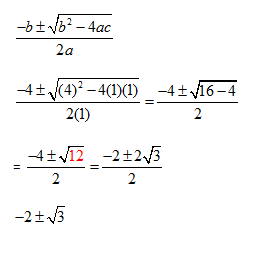
Now graph
Number of roots: two real roots Number of x-intercepts: two
Example 2 : x2 + 2x + 1 = 0
find -b/2a -2/2 = -1
f(-1) = (-1)2 + 2(-1) + 1 = 1 -2 + 1 = 0
(-1.0) is the vertex
and x = -1 is the axis of symmetry
create an xy table
f(0)=02 + 2(0) + 1 = 1
f(1) = (1)2 +2(1) + 1 = 4
x y
0 1
1 4
Now graph
Now Solve
Solving x2 + 2x + 1 = 0
We can solve easily but let’s use the quadratic formula

= -1
The solution set is {-1}
Number of roots: 1 real root Number of x- intercepts: one
Example 3: x2 -4x + 7 = 0
find –b/2a= +4/2 = 2
f(2) = (2)2 -4(2) + 7 = 4 -8 + 7 = 3
vertex ( 2, 3)
and x= 2 is the axis of symmetry
create an xy table
f(1) = (1)2 -4(1) + 7
f(0) = (0)2 -4(0) + 7
x y
1 4
0 7
Now graph
Now solve
x2 -4x + 7 = 0

There is NO REAL number root since does not represent a real number
Number of roots: no real number roots Number of x intercepts: None
In each of these examples the value of b2-4ac in the quadratic formula is the key to the number of real roots.

When b2-4ac is negative, there is no real number root of the equation ax2 + bx + c = 0 because square roots of negative numbers do not exist in the set of real numbers.
Because the value of b2-4ac discriminates, or points out differences, among these 3 cases above, it is called the discriminant of the quadratic equation.
The discriminant is only part of the quadratic formula and simpliy helps one determine the number of roots.
Math 6 Honors ( Periods 1, 2, & 3)
Negative Numbers 11-1
On a horizontal number line we use negative numbers for the coordinates of points to the left of zero. We denote the number called ‘negative four’ by the symbol -4. The symbol -4 is normally read ‘ negative 4’ but we can also say ‘ the opposite of 4.’
The graphs of 4 and -4 are the same distance from 0—>but in opposite directions. Thus they are opposites. -4 is the opposite of 4.
The opposite of 0 is 0
Absolute Value is a distance concept. Absolute value is the distance of a number from 0 on a number line. The absolute value of a number can NEVER be negative!!
Counting (also known as Natural) numbers: 1, 2, 3, 4, ….
Whole numbers 0, 1, 2, 3, 4….
Integers are natural numbers and their opposites AND zero
…-4, -3, -2, -1, 0, 1, 2, 3, 4….
The opposite of 0 is 0.
The integer 0 is neither positive nor negative.
The farther we go to the right on a number line--- the bigger the number. We can compare two integers by looking at their position on a number line.
if x < 0 what do we know? x is negative number if x > 0, what do we know? x is a positive number
We have been practicing representing integers by their graphs, that is, by points on a number line.
Make sure that your number line includes arrows at both ends and a line indicating where zero falls on your number line.
The graph of a number MUST have a closed dot right on the number line at that specific number.
Please see our textbook page 366 for an accurate example.
Thursday, March 1, 2012
Algebra Honors (Period 6 & 7)
The Quadratic Formula: 12-3
Method 5:
THE QUADRATIC FORMULA
Let's all sing it to "Pop Goes the Weasel!
" x = -b plus or minus the square root of b squared minus 4ac all over 2a
x =
-b ± √ (b2 - 4ac)
2a
Notice how the first part is the x value of the vertex -b/2a
The plus or minus square root of b squared minus 4ac represents how far away the two x intercepts (or roots) are from the vertex!!!!
Very few real world quadratics can be solved by factoring or square rooting each side.
And completing the square always works, but it long and cumbersome!
All quadratics can be solved by using the QUADRATIC FORMULA.
You will find out that some quadratics have NO REAL solutions, which means that there are no x intercepts - the parabola does not cross the x axis!
Think about what kinds of parabolas would do this....ones that are smiles that have a vertex above the x or ones that are frowns that have a vertex below the x axis.
You will find out in Algebra II that these parabolas have IMAGINARY roots
So now you know 5 ways that you know to find the roots:
1. graph
2. factor if possible
3. square root each side
4. complete the square - that's what the quadratic formula is based on!
5. plug and chug in the Quadratic Formula - This method always works if there's a REAL solution!
DON'T FORGET TO PUT THE QUADRATIC IN STANDARD FORM BEFORE PLUGGING THE VALUES INTO THE QUADRATIC FORMULA!
You should know that for the quadratic formula, you don't need the "a" coefficient to be positive!
That's important if you use factoring, SQRTing each side, and completing the square.
But for the quadratic formula, either way, you'll get the same roots!
EXAMPLE: x2 + 8x = 48
You can move the 48 over or move the x2 + 8x over and you'll get the same answers!
Let's look at:
"a" coefficient positive *****vs***** "a" coefficient negative
x2 + 8x - 48 = 0 ****VS**** -x2 - 8x + 48 = 0
First x2 + 8x - 48 = 0
-8 ± √[64 - 4(1)(-48)]
2(1)
-8 ± √(64 + 192)
2
-8 ± √(256)
2
-8 ± 16
2
(-8 + 16)/2 and (-8 - 16)/2
8/2 and -24/2
4 and -12
Now let's compare -x2 - 8x + 48 = 0
8 ± √[64 - 4(-1)(48)]
-2(1)
8 ± √(64 + 192)
-2
8 ± √(256)
-2
8 ± 16
-2
(8 + 16)/-2 and (8 - 16)/-2
24/-2 and -8/-2
-12 and 4
So all the signs are simply the opposite of each other and therefore the answers are the same
Algebra Honors (Period 6 & 7)
Completing the Square: 12-2
METHOD 4:
Now this is completely new to you!!!
When does the square root = ± square root method work well?
When the side with the variable is a PERFECT SQUARE! We saw that in the previous section.
perfect square = k ( when k ≥ 0)
So what if that side is not a perfect BINOMIAL SQUARED?
It may be possible to trasform it into one... by COMPLETING THE SQUARE
You can follow steps to make it into one!
Why is this good?
Because then you can just square root each side to find the roots!
THIS METHOD ALWAYS WORKS!
EXAMPLE:
x2 - 3x -18 = 0
(Head's up-- I wouldn't use this method here because I can see that it factors easily... into (x-6)(x+3) = 0 so the solution set is {-3,6}
However, knowing what I need to get for my solutions might be a good way to practice Completing the square..
so
x2 - 3x = 18
Step 1) b/2
That is, take half of the b coefficient ,
or in this case (- 3/2)
Step 2) Square b/2
(b/2)2
(-3/2 ⋅ -3/2 = 9/4)
Step 3) Add (b/2)2 to both sides of the equation
x2 - 10x + 9/4 = 18 +9/4
Step 4) Factor to a binomial square
(x - 3/2)2 = 18 + 9/4 = 81/4
Step 5) Square root each side and solve
√(x - 3/2)2 = √ 81/4
x - 3/2 = ± 9/2
x = 3/2 ± 9/2
x = 3/2 + 9/2 AND x = 3/2 - 9/2
x = 6 and x = -3
{-3, 6}
We got the same solutions !! Yay!!
x2 - 10x = 0
Not a TRINOMIAL SQUARE so it would not factor to a BINOMIAL SQUARED.
But here's how you can make it one!
Step 1) b/2
That is, take half of the b coefficient ,
or in this case (- 10/2 = -5)
Step 2) Square b/2
(b/2)2
(-5 x -5 = 25)
Step 3) Add (b/2)2 to both sides of the equation
x2 - 10x + 25 = +25
Step 4) Factor to a binomial square
(x - 5)2 = 25
Step 5) Square root each side and solve
√(x - 5)2 = √ 25
x - 5 = ± 5
Step 6) ADD 5 TO BOTH SIDES
x - 5 = ± 5
+ 5 = +5
x = 5 ± 5
Step 7) Simplify if possible
x = 5 + 5 and x = 5 - 5
x = 10 and x = 0
So the 2 roots (solutions/zeros/x intercepts) are 0 and 10.
YOU DON'T NEED TO GRAPH THE PARABOLA, BUT IF YOU DID, IT WOULD CROSS THE X AXIS AT 0 AND 10.
I don't know where the vertex is, but I don't need to because it's not the solution to the quadratic (although I certainly could find the vertex by using x = -b/2a)
Notice that I could also factor x2 - 10x = 0 to get the solution more easily.
So don't complete the square if the quadratic factors easily!
IF THERE IS A "c", first move the c constant to the other side of the equation before completing the square:
x2 - 10x - 11 = 0
x2 - 10x - 11 + 11 = 0 + 11
x2 - 10x = 11
NOW COMPLETE THE SQUARE AS ABOVE:
x2 - 10x + 25 = +25 + 11
(x - 5)2 = 36
√ (x - 5)2 = √ 36
x - 5 = ± 6
x = 5 ± 6
x = 11 and x = -1
Again, this one factored easily so I wouldn't have even used completing the square. ALWAYS CHECK IF IT FACTORS FIRST!
Now an example that DOES NOT FACTOR: x2 - 10x - 18 = 0
x2 - 10x - 18 = 0
x2 - 10x - 11 + 18 = 0 + 18
x2 - 10x = 18
NOW COMPLETE THE SQUARE AS ABOVE:
x2 - 10x + 25 = +25 + 18
(x - 5)2 = 43
√ (x - 5)2 = √ 43
x - 5 = ± √ 43
x = 5 ± √ 43
x = 5 + √ 43 and x = 5 - √ 43
When there is an IRRATIONAL square root, always SIMPLIFY if possible!
IF THERE IS AN "a" COEFFICIENT, YOU MUST DIVIDE EACH TERM BY IT BEFORE YOU CAN COMPLETE THE SQUARE:
Example: 2x2 - 3x - 1 = 0
Move the 1 to the other side of the equation: 2x2 - 3x = 1
Divide each term by the "a" coefficient:
x2 - 3/2 x = 1/2
Now find the completing the square term and add it to both sides:
[(-3/2)(-3/2)]2 = 9/16
x2 - 3/2 x + 9/16 = 1/2 + 9/16
(x - 3/4)2 =8/16 + 9/16
(x - 3/4)2 = 17/16
√[(x - 3/4)2 ] = ±√ [17/16]
x - 3/4 = ±[√17] /4
x = 3/4 ±[√ 17] /4
x = (3 ± [√17]) /4
or written better x =
3 ± √ 17
4
Monday, February 27, 2012
Algebra Honors (Period 6 & 7)
Quadratic Equations with Perfect Squares 12-1
In Chapter 5 you learned how to solve certain quadratic equations by factoring and in Chapter 11 you learned how to solve quadratics in the for
x2 = k
as in x2 = 49
x = ±7
This lesson extend to any quadratic equation involving a perfect square
if we have x2 = k
if:
k > 0 then x2 = k has two real-numbered roots with x = ±√k
if k = 0 then x2 = k has one real numbered root x = 0
if k<0 sup="" then="" x="">2 = k has no real numbered roots
m2 = 49
√(m2) = ±√49
m = ±7
{-7, 7}
5r2= 45
5r2 /5= 45/5
r2= 9
√r2= ±√9
r = ±3
{-3,3}
(x + 6)2 = 64
√(x+6)2 = ±√64
x+6 = ±8
be careful here
you now have
x = -6±8 which means
x = -6-8 = -14 AND x = -6+8 = 2
{-14, 2}
9r2 = 121
9r2/9 = 121/9
r2 = 121/9
√r2= ±√121/9
r = ±11/3
Make sure too check your solutions to insure that they both work
(x-3)2 = 100
√ (x-3)2 = ±√100
(x-3) = ±10
x = 3 ±10
x = 3 +10 = 13 and x = 3-10 = -7
{-7, 13}
5(x-4)2 = 40
5(x-4)2/5 = 40/5
(x-4)2 = 8
√ (x-4)2 = ±√8
Now you need to simplify the Radical
s
√ (x-4)2 = ±2√2
(x-4) = ±2√2
x = 4 ±2√2
{4 - 2√2, 4 + 2√2}
7(x - 8)2 = -28
7(x-8)2?7 = -28/7
(x-8)2 = -4
WAIT!!! that can't happen no real numbered solutions...
An equation that has a negative on one side and a perfect square as the other has NO REAL # Solutions
y2 + 6y + 9 = 49
(y+3)2 = 49
√(y+3)2 = ±√49
(y+3) = ±7
y = -3 ±7
y = -3-7 = -10 and y = -3 +7 = 4
{-10. 4}
Perfect Squares like (x -4) 2 and ( y + 3) 2
The square of any real number is always a non negative real number.
2(3x-5)2 + 15 = 7 becomes
2(3x -5)2 = -8
or (3x -5)2 = -4... NO REAL number solution!!
Algebra Honors (Period 6 & 7)
Introduction to Quadratic Equations
We learned from Chapter 8 that a quadratic function is a function that can be defined by an equation of the form
ax2 + bx + c = y where a is not equal to 0. This is a parabola when the domain is the set of REAL numbers.
When y = 0 in the quadratic function ax2 + bx + c = y we have an equation of the form ax2 + bx + c = 0. An equation that can be written in this form is called a quadratic equation.
STANDARD FORM is ax2 + bx + c = 0
4x2 + 7x = 5 write in standard form and determine a, b, and c
4x2 + 7x – 5 = 0
a= 4
b = 7
c = -5
CHAPTER 12 gives you several different ways to SOLVE QUADRATICS
Solving a quadratic means to find the x intercepts of a parabola.
There are different ways of asking the exact same question:
Find the.....
x intercepts = the roots = the solutions = the zeros of a quadratic
We'll answer this question one of the following ways:
1) Read them from the graph (read the x intercepts) That’s where y = 0 or where the parabola crosses the x-axis!!
but...graphing takes time and sometimes the intercepts are not integers
2) Set y or f(x) = 0 and then factor (we did this in Chapter 5)
but...some quadratics are not factorable
3) Square root each side (+ or - square root on the answer side) We did this in Chapter 11
but...sometimes the variable side is not a perfect square (it's irrational)
4) If not a perfect square on the variable side, complete the square, then solve using #3 method
Now this method ALWAYS works, but...it takes a lot of time and can get complicated
5) Quadratic Formula (works for EVERY quadratic)
Really easy if you just memorize the formula and how to use it! :)
REVIEW:
Reading the x intercepts from a graph or factoring and solving using the zero products property.
METHOD 1:
Where the graph crosses the x axis is/are the x intercepts. (Remember, y = 0 here!)
The x intercepts are the two solutions or roots of the quadratic.
METHOD 2:
When we factored in Chapter 5 and set each piece equal to zero, we were finding the x value when y was zero.
That means we were finding these two roots!
y2 – 5y = 6 = 6y – 18
first put this in standard form
y2 – 11y + 24 = 0
(y -8) (y-3) = 0
y = 8 or y = 3
Substitute to verify that 8 and 3 are solutions!!
METHOD 3:
You did this in Chapter 11 for Pythagorean Theorem!
If there is no x term, it's easiest to just square root both sides to solve!
DIFFERENT FROM PYTHAGOREAN: NOT LOOKING FOR JUST THE PRINCIPAL SQUARE ROOT ANYMORE. NEED THE + OR - SYMBOL!!
This is also different from what we did when we had radical equations. Before we squared both sides to solve. It looks like these, but only after we squared both sides. Before we had to carefully check each answer—we had changed the equations by squaring. However, always check your solutions for any mistakes!!
3x2 = 18
divide both sides by 3 and get: x2 = 6
square root each side and get x = + SQRT 6 or - SQRT 6
(x - 5)2 = 9
SQRT each side and get: x - 5 = + or - 3
+ 5 to both sides: x = 5 + 3 or x = 5 - 3
So, the 2 roots are x = 8 or x = 2
(x + 2)2 = 7
SQRT each side and get: x + 2 = + or - SQRT of 7
-2 to both sides: x = -2+ SQRT 7 or x = -2 - SQRT 7
METHOD 4:
The Quadratic Formula!!
We will get to this one...
FORMULAS THAT ARE QUADRATICS:
Many formulas have a variable that is squared: compounded interest, height of a projectile (ball)
The formula for a projectile is h = -5t2 + v0t
We can find when a projectile is a ground level ( h= 0) by solving for
0 =-5t2 + v0t \If the projectile begins its flight at height c, its approximate height at time t is h = -5t2+v0t + c We can find when it hits the ground by solving 0 = -5t2 + v0t + c
For example: a slow-pitch softball player hits a pitch when the ball is 2 m above the ground. The ball pops up with an initial velocity of 9m/s If the ball is allowed to drop to the ground, how long will it be in the air?
When the ball hits the ground h = 0 so
0 = -5t2 + 9t + 2 or
-5t2 + 9t + 2 = 0
( 5t + 1)(t -2) = 0
5t = 1 and t = 2
t = -1/5 can’t be a solution since the answer should be positive t must be 2 seconds
Check out Purple Math for great help on quadratics
Friday, February 24, 2012
Math 6 Honors ( Periods 1, 2, & 3)
Scale Drawing 7-9
Using the book’s drawing on page 237, find the length and width of the room shown, if the scale of the drawing is 1cm: 1.5 m
Measuring the drawing, we find that it has a length of 4 cm and a width of 3 cm
Method 1: write a proportion for the length
Let l = the actual length
1/1.5 = 4/ l
l= 4 (1.5)
l = 6
The room is 6 m long
Write a proportion for the width
Let w = the actual width
1/1.5 = 3/w
w = 3 (1.5)
w = 4.5 m
The room is 4.5 m wide
A scale drawing is a diagram of an object where its length and width aare proportional to the actual length and width.
The scale for the drawing gives the relationship between the drawing's measurements and the actual measurements.
For example 1 inch represents 2 feet
The Scale Factor is the ratio of the length in the drawing to the corresponding actual lenth.
A Scale Factor on a matchbox car of 1/64 would mean that every part of the matchbox car was 1/64 of the actual car-- the windshield, the door, the wheels, the roof... would all have the same relationship.
Scale Factor MUST HAVE the same units of measurements.
Method 2 : Use the scale ratio
1 cm/ 1.5 m = 1/cm/150 cm = 1/150
You need to change the units to the same and then set up a ratio
The actual length is 150 times the length in the drawing so
l =150 (4) = 600 cm = 6 m
w =150 (3) = 450 cm = 4.5 m
The scale on a map is 1 cm to 240 m
Open your books to Page 237, you will notice a drawing of a house. In this drawing of the house, the actual height of 9 meters is represented by a length of 3 centimeters, and the actual length of 21 meters is represented by a length of 7 centimeters.
This means that 1 cm in the drawing represents 3 m in the actual building. Such a drawing in which all lengths are in the same ratio to actual lengths is called a scale drawing.
The relationship of length in the drawing to actual length is called the scale. In the drawing of the house the scale is 1cm: 3m
We can express the scale as a ratio, called the scale ratio, if a common unit of measure is used. Since 3 m = 300 cm, the scale ratio is 1/300
The distance from Ryan’s house to his school is 10 cm on the map. What is the actual distance?
let d = the distance from Ryan’s house to school
1/240 = 10/d so d = 240(10)
d = 2400m or
The distance from Ryan's house to school is 2.4 km
A picture of an insect has a scale 7 to 1. The length of the insect in the picture is 5.6 cm. What is the actual length of the insect?
Let l = the actual length of the insect
7/1 = 5.6/ l
7l = 5.6
l = .8 cm
The actual length of the insect is 0.8 cm which is 8 mm
Wednesday, February 22, 2012
Math 6 Honors ( Periods 1, 2, & 3)
Problem Solving: Using Proportion 7-8
Proportions can be used to solve word problems. Use the following steps to help you in solving problems using proportions
~ Decide which quantity is to be found and represent it by a variable
~ Determine whether the quantities involved can be compared using ratios (rates)
~ Equate the ratios in a proportion
~ Solve the proportion
Dr Irshay bought 4 tires for her car at a cost of $264. How much would 5 tires cost at the same rate?
Let c = the cost of 5 tires. Set up a proportion
4/264 = 5/c
Solve the proportion
4c = 5(264)
Now divide both sides by 4
4c/4 = 5(264)/4
c = 330
Therefore, 5 tires would cost $330
Notice, the proportion in this example could also have been written as
2/264 = c/5
In fact--Any of the following proportions can be used to solve the problem
4/5 = 264/c 5/4 = c/264 4/264 = 5/c 264/4 = c/ 5
All of the above proportions result in the same equation
4c = 5(264)
But be careful you need to use a proportion that does relate.
4/5 DOES NOT EQUAL c/264. That is not an accurate proportion and would result in an inaccurate solution.
tires ___________ = _____________tires
cost _____________=_____________cost
If 4 bars of soap cost $1.50, how much would 6 bars of soap cost?
let x = the cost of 6 bars of soap
bars ___________ = _____________bars
cost _____________=_____________cost
4/1.50 = 6/x
simplify first up and down ( BUT NEVER DIAGONALLY!!)
x = 3 (.75)
x = 2.25
$2.25
6 bars would cost $2.25
If 9 kg of fertilizer will feed 300 m2 of grass, how much fertilizer would be required to feed 500 m2 of grass?
kg ___________ = _____________kg
m2 _____________=_____________m2
9/300 = n/500
SIMPLIFY FIRST
9/3 = n/5
3/1 = n/5
n = 15
15kg of fertilzer
For every 5 sailboats in a harbor, there are 3 motorboats. If there are 30 sailboats in the harbor, how many motorboats are there?
Let m = the number of motorboats
5/3 = 30/m
5m = 3(30) divide both sides by 5 5m/5 = 3(30)/5
m=18
There are 18 motorboats in the harbor.
Some guidelines you can use to determine when it is appropriate to use a proportion to solve a word problem.
Ask the following questions
If one quantity increase does the other quantity also increase? (If one quantity decreases, does the other quantity decrease?) When the number of tires is increase, the cost is also increased.
Does the amount of change (increase or decrease) o one quantity depend upon the amount of change (increase or decrease) of the other quantity? The amount of increase in the cost depends upon the number of additional tires bought.
Does one quantity equal some constant times the other quantity? The total costs equals the cost of one tire times the number of tires. The cost of one tire is constant.
If the answers to all the questions above is YES, then it is appropriate to use a proportion.
Sometimes setting up a table can be useful
Although the problems in this lesson may be solved without using proportions, I must insist that you write a proportion for each problem and solve using this method. You may check your work using another other method you know.
Tuesday, February 21, 2012
Algebra Honors (Period 6 & 7)
Quadratic Equations 8-8
A QUADRATIC FUNCTION IS NOT y = mx + b
(which is a LINEAR function),
but instead is
y = ax2 + bx + c
OR
f(x) = ax2 + bx + c
where a, b, and c are all real numbers and
a cannot be equal to zero because
it must have a variable that is squared (degree of 2)
Quadratics have a squared term, so they have 2 possible solutions (roots)
You already saw this when you factored the trinomial and used zero products property.
If the domain is all real numbers, then you will have a PARABOLA which looks like a smile when the a coefficient is positive or
looks like a frown when the a coefficient is negative.
What happens as the "a" coefficient gets really big or really small (fraction/decimal)? We'll look at that together on my graphing calculator.
But think, what happened when the "m" (slope) coefficient got big?
The slope got steeper.
So now think that both sides of the U get steeper at the same time.
What's happening to the shape of the U???
Now think, what happened when the "m" (slope) coefficient got tiny?
The slope was a bunny slope.
So now think that both sides of the U are bunny slopes at the same time.
What's happening to the shape of the U???
Putting in standard form:
Standard form is:
y = ax2 + bx + c
OR
f(x) = ax2 + bx + c
You can't read the sign of a, b, or c until it's in standard form (just like y = mx + b!)
Graphing quadratics:
You can graph quadratics exactly the way you graphed lines ...by plugging in your choice of an x value and using the equation to find your y value.
Because it's a U shape, you should graph 5 points as follows:
First MAKE SURE THE EQUATION IS IN STANDARD FORM!
y must be isolated on one side and then you can read the a and b coefficients.
y = ax2 + bx + c
Point 1) the vertex - the minimum value of the smile or the maximum value of the frown
The x value of the VERTEX = -b/2a
Plug that into the equation and then find the y value of the vertex
Next, draw the AXIS OF SYMMETRY :
x = -b/2a
a line through the vertex parallel to the y axis
Point 2) Pick an x value IMMEDIATELY to the right or left of the AXIS OF SYMMETRY and find its
y by plugging into the equation.
Point 3) Graph its mirror image on the other side of the AXIS OF SYMMETRY by counting from the axis of symmetry
Points 4 and 5) Repeat point 2 and 3 directions with another point ONE STEP FARTHER from the AXIS OF SYMMETRY.
JOIN YOUR 5 POINTS IN A SMOOTH "U" SHAPE ( not a V shape!)
AND EXTEND LINES WITH ARROWS ON END
Parabolas are functions whose domains are ALL REAL NUMBERS.
Their ranges depend on where the vertex is and also if the ‘a’ coefficient is positive or negative
EXAMPLE: f(x) = -3x2
the ‘a’ coefficient is negative so it is a frowny face
The vertex is called the maximum.
The x value of the vertex is -b/2a
a = -3 and b = 0 (it's missing!)
The x value of the vertex = -b/2a = -0/2(-3) = 0
Plug the x value of 0 back into the function to find the y value of the
vertex:
y = -3(02) = 0 So the vertex is (0, 0)
The domain is all real numbers.
The range is y is less than or equal to zero (It's a frowny face)
To graph this function:
1) Graph vertex (0, 0)
2) Draw the AXIS OF SYMMETRY –
a dotted line at x = 0 (actually this is the y axis!)
3) Pick x value immediately to the right of axis of symmetry, x = 1
Plug it in the equation to find the y value: y = -3(1) = -3
Plot (1, -3)
4) Count the same 1 step from axis of symmetry on the other side of the axis and place another point to the LEFT of axis at the same y value (-1, -3)
5) Pick another x value to the right 2 steps away from the axis of symmetry, x = 2
Plug it in the equation to find y:
y = -3(22) = -12 Plot (2, -12)
6) Count 2 steps from axis of symmetry on the other side of it and place another point to the LEFT of axis at the same y value (-2, -12)
JOIN YOUR 5 POINTS IN A "U" SHAPE AND EXTEND LINES WITH ARROWS ON END
Monday, February 20, 2012
Math 6 Honors ( Periods 1, 2, & 3)
Ratio 7-6 Word Problems
Since all of the word problems from Ratios 7-6 are excellent examples of using Ratios, I thought I would create a blog posting with the solutions. Although I will list the actually word problems, you might need to turn to the textbook and page 229 for any charts included.
Read each problem carefully and set up the solutions based on the question asked
Page 229
1. What is the cost of grapes in dollars per kilogram if 4.5 kg of grapes costs $ 7.56?
Since they want $/kg you need to have 7.56/ 4.5 = 1.68; so the grapes cost $ 1.68/kg.
2. This one looked confusing, but just read it a few times: The index of refraction of a transparent substance is the ratio of the speed of light in space to the speed of light in the substance. (Read it again—it is just a ratio). Using the table on Page 229, find the index of refraction of
A. Glass
B. Water
According to the table Speed of light in space is 300,000 km/sec
Speed of light in glass is 200,000 km/ sec.
So
300,000
200,000
or 3/2
Speed of Light in Water is 225,000
so that ratio is
300,000
225,000
This takes a little more time dividing but you can simplify it to 4/3 Since it is a ratio you want to LEAVE it as an improper fraction.
3. The mechanical advantage of a simple machine is the ratio of the weight lifted by the machine to the force necessary to lift it. Now—just read that again—you don’t need to truly understand physics to get this problem. It is a RATIO again!! What is the mechanical advantage of a jack that lifts a 3200-pound car with a force of 120 pounds?
3200 =
120
80/3; so the mechanical advantage is 80/3
4. The C-String of a cello vibrates 654 times in 5 seconds, How many vibrations per second is that? (We are finding unit rate)
It’s a rate of time/sec.
654/ 5 = 130 4/5 vibrations per second
5. A four cubic foot volume of water at sea level weighs 250 lb. What is the density of water in pounds per cubic foot? (Do you need to understand density to do this problem?) No—just unit rates!! We want lbs/cubic foot. Look at the information and place it with lbs/ft and then divide to get the unit rate.
250lb/ 4 ft3. That equals 62 1/2 lb/ft3 .
6. A share of stock that costs $88 earned $16 last year. What was the price-to-earnings ratio of this stock? (Wish that was happening now!!)
Price/earnings so look carefully 88/16 = 11/2 so the Ratio is 11/2
In exercises 7 and 8 you will need to look at the diagrams on page 230. You are finding the ratio in lowest terms.
Look at both the small and large triangles. For A you are finding the ratio between segment AB of the larger triangle and DE of the smaller triangle.
4.8
3.2
Simplify ( I like to clear decimals to make it easier but in this case you could easily divide
= 3/2
B.
Perimeter of Triangle ABC
Perimeter of Triangle DEF
First you need to find the perimeter of the larger triangle by adding up the three sides
6.3 + 4.8 + 3 = 14.1
and then finding the perimeter of the smaller triangle by adding up those three sides
4.2 + 3.2 + 2 = 9.4
14.1
9.4
I like to clear decimals by multiplying by 10
141
94
= 3/2
What did you notice?
8. Again look at Page 230 for the figure
We are finding the following Ratios:
PQ:TU 2.6:6.5 or 26:65 = 2:5
QR:UV 1.2:3 = 12:30 = 2:5
Perimeter of PQRS: Perimeter of TUVW
You need to add up all the sides of each of the figures
2.2 + 2.6 + 1.2 + 3 = 9
and 5.5 + 6.5 + 3 + 7.5 = 22.5
9:22.5 = 90:225 = 2:5
What did you notice here?
For exercised 9-12 you need to use the Table on Page 230 as well
9. The population of Centerville in 1980 to its population in 1970?
44/36 = 11/9
10. The growth in the population of Easton to its 1980 population.
You need to subtract the 1970 population from the 1980 population to get the growth so
28-16 = 12 12/18 = 3/7
11. The total population of both towns in 1970 to their total population in 1980
36 + 16 = 52 and 44 + 28 = 72 52/72 = 13/ 18
12. The total growth in the population of both towns to their total 1980 population
Like number 10 you need to subtract to find the growth
(44-36) + (28-16) = 8 + 12 = 20
44 + 28 = 72 (from before)
20/72 = 5/18
13. During a season a baseball player hit safely in 135times at bat; the player struck out or was fielded out in 340 times at bat. What is the player’s ratio of hits to times at bat?
You take the 135 + 340 = 475 (the total times at bat)
135/475 = 37/95
14. A fruit drink recipe requires fruit juice and milk in the ration 3:5. What fraction of the drink is milk? What fraction is juice? Remember we need to find the total first. 3 + 5 = 8
so the fraction that is milk is 5/8 and the fraction that is fruit juice is 3/8
Subscribe to:
Posts (Atom)
