Welcome to Room K 101's Blog

Check out the Weekly Notes from your class

With Math ... you can do anything

Wednesday, January 16, 2013

Math 6H (Period 3)


Writing Equations 5.2

An equation is a mathematical sentence; a statement that uses an equal sign to separate two equal expressions     expression = expression

An equation has two sides à a left side and a right side!

For example    x + 5 = 7
A solution of an equation involving one variable is a value of the variable that makes the equation true.  For example 2 is a solution of x + 5 = 7 because  2 + 5 = 7  is a TRUE statement.

Finding all the solutions of an equation is called solving the equation.

Some equations are simple enough to solve using mental math.  We will use those simple equations to build our understanding of the algebraic method of solving equations.

A phrase does not usually contain a verb but a sentence MUST contain a verb. The verb in an equation is usually either “is”, equals”  or “is equal to”

We practiced translating several sentences into algebraic equations, such as:

The sum of a number and 8 is 17à n + 8 =17
Five less than a number is 9 à  x - 5 = 9
Fourteen equals 8 times a number à 14 = 8m
The quotient of 12 and a number is 4 à 12/y = 4

Sometimes it is a good idea to break down the verbal sentences when translating to an algebraic equation.  Circle the operation  and place the algebraic sign for that operation.  We wrote out our verbal sentences and below the “is” we wrote +. Then we took each part and translated it carefully.

Another method is the following  example:
The sum ( write +) of 3 ( write 3 before the +) and a number (write n after the +) is (write =) 10 ( write 10 after the =)

Explain why the equations x + 3 = 5 and 3 + x = 5 have the same solutions but the equations x – 3 = 5 and 3 – x = 5 do not.

Tuesday, January 15, 2013

Math 6H (Period 3)


Writing Expressions 5.1
To use algebra in solving real-life problems, you need to translate words, phrases and sentences into mathematical symbols. Fist look for the words that indicate operations.
We went through several examples for each operation:

Translating Addition Phrases:
Ten more than a number     à x + 10
The sum of -8 and a number à -8 + y
A number plus 3 à n + 3

Translating Subtraction Phrases
Five minus a number à 5 - x
The difference of 3 and a number à  3 – n
Nine less than a number à  y – 9

Translating Multiplication Phrases
Five times a number à  5y
The product of 7 and a number à  7x
A number multiplied by -2 à -2m

Translating Division Phrases
The quotient of a number and 6 à x/6
Five divided by a number à  5/n

REMEMBER: Subtraction and division are NOT commutative. the order in which you write the numbers and variables changes the meaning of the variable expression.  

We then discussed the problem in our textbook on page 218
You join a health club that has a membership fee and a tennis court fee. According to the sign in the textbook, the membership is $25 a month and the court fee is $5 per use. We had to write an expression for your total  monthly cost.

MEMBERSHIP FEE   + COURT FEE · NUMBER OF TIMES YOU USED THE COURT
Let n = the number of times you use a court.
25 + 5n


We went through Problems # 24-27 on Page 219

A truck traveled 65 miles per hour for a number of hours, To find the number of miles traveled... youà multiply. The distance traveled equals the product of the rate of travel and the time traveled.

Your regular paycheck is increased by $65 for working overtime. To find the total amount of your paycheck... youà add; “increased by” indicated addition.

Sixty-five fewer people came than the number expected. To find the number of people who came ...you à subtract; “fewer” indicates subtraction

Your grandmother is 5 years younger than her brother. To find your grandmother’s age ...youà subtract; “younger than” indicates subtraction.


Monday, January 14, 2013

Math 6A (Periods 2 & 4)

Although we saw this You Tube video in class, several of you asked to see it again... so

Friday, January 11, 2013

Math 6 A (Periods 2 & 4)


Changing a Decimal to a Fraction 6-6

As we have seen, every fraction is equal to either a terminating decimal or a repeating decimal. It is also true that every terminating or repeating decimal is equal to a fraction.
To change a terminating decimal to a fraction in lowest terms, we write the decimal as a fraction whose denominator is a power of 10. We then write this fraction in lowest terms.

Change 0.385 to a fraction in lowest terms

0.385 = 385/1000 = 77/200

Change 3.64 to a mixed number in simple form


3.64 = 3+ 64/100 = 3 + 16/25 =  


We discovered that some fractions became repeating decimals.
For example
4/9 = 0.444444...
31/99= 0.31313131...
275/999= 0.275275275...
243/999 = 0.243243243...
and we found that you could write these with a vinculum.
so
We talked about the 9th's family.... and found the simple rule for changing a single digit decimal with the vinculum over it...

and then we saw that 
and
but we discovered that using our divisibility rules we could simplify 45/99  to 5/11
We then talked about the wonderful 11th's family and found the simple rule for changing those special fractions.

That that point we talked about


Again, using our divisibility rules we found we could simplify 243/999  because we saw that both the numerator and the denominator were divisible by 9. At that point we find that 243/999 = 27/111 But then we realize that both the numerator and the denominator are still divisible by 3. so we can simplify the fraction to 9/37.

This discussion continues with our next class! I can't wait! How about you?


Thursday, January 10, 2013

Math 6A (Periods 2 & 4)


Changing a Fraction to a Decimal 6-5
There are two methods that can be used to change a fraction to a decimal.

1) find an equivalent fraction whose denominator is a power of 10. (this method does not always work but when it does it becomes really easy to change to a decimal)

13/25 multiply the numerator and the denominator by 4 to get 52/100 and then just close your eyes and see Chapter 3... and 0.52


2) divide the numerator by the denominator. It's a great way to determine your score out of 100 and then figure out your percent.

If you got 67/75 on the last test

divide 67 by 75 carefully 0.8933333... you earned a B+

take 3/8 and divide 3 by 8 8 goes into 3 0.375 times

so 3/8 = 0.375

If the numerator is smaller than the denominator we know our number must be between 0 and 1--> it must be a decimal.


When the remainder is 0 as in the case of dividing 3 by 8, it is called a terminating decimal.


By examining a fraction in lowest terms, we can determine whether the fraction can be expressed as a terminating decimal.

If the denominator has no prime factors other than 2 or 5, the decimal representation will terminate.

7/40

looking at 40 we notice the prime factorization ( oh no, it's Chapter 5)
40 = 23·5 Since the only prime factors are 2 and 5

7/40 must terminate.

What about 5/12 ?

12 = 22· 3 Since 3 is a prime factor of the denominator, the fraction cannot be expressed as a terminating decimal.


What about 9/12 ? At first it looks the same as the one above, but look carefully and realize 9/ 12 = 3/4

Since 4 = 22 , 4 has no other prime factors except 2, this can be expressed as a terminating decimal.


Let's look at 15/22
Since 22 has the prime factor of 11 we know that this will not terminate. In fact when you divide 15 by 22 you end up with 0.681818181...


We write this as ( Please check page 196) Notice that the bar is only over the 81 and represents a block  numbers that continues to repeat indefinitely and is called a repeating decimal.


EVERY FRACTION CAN BE EXPRESSED AS EITHER A TERMINATING DECIMAL OR A REPEATING DECIMAL.


Let's look at 4/9 = 0.4444444....

5/9 =

7/9 =


31/99 = 0.3131313131...

8/ 11 = 72/99 = .72727272...

Tuesday, January 8, 2013

Algebra Honors (Periods 5 & 6)


Decimal Forms of Rational Numbers 11-2

Any common fraction can be written as a decimal by dividing the numerator by the denominator. If the remainder is zero, the decimal is called a terminating, or ending, or finite decimal.

3/8=  0.375
Actually this is one of the fractions you need to know by heart !
If you don’t reach a remainder of zero when dividing the numerator by the denominator, continue to divide until the remainder begins to repeat.
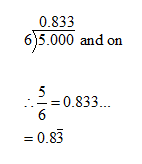
5/6
  

7/11


The decimal quotient above are nonterminating,  nonending, or infinite. The dots indicate that the decimals continue without end.

They are also called repeating or periodic because the same digit or block of digits repeats unendingly. A bar (vinculum) is used to indicate the block of digits that repeat.

What ones do you need to know by heart… same from 6th grade
1/3 family,   1/11 family,    and    let’s look at the 1/7 family (my favorite)

Let’s look at this algebraically… when you divide a positive integer n by a positive integer d, the remainder  r   at each step must be zero or a positive integer less than d.  For example, if the divisor is 6, the reminders will be 0, 1, 2, 3, 4, or 5 and the division will terminate or begin repeating within 5 steps after only zeros remain to be brought down.  Think about this!

For every integer   n and every positive integer   d, the decimal form of the rational number n/d either terminates or eventually repeats in a block of fewer than d digits.


To express a terminating decimal as a common fraction, express the decimal as a common fraction with a power of ten as the denominator. Then express in simplest form


To express a repeating decimal follow these steps :  


Try it with  

You should get    179/330


How about     

This one can be done easily if you remember the rule of matching the block of repeating digits with the digits in the decimal.
In this case        


All terminating and all repeating decimals represent rational numbers that can be written in the form n/d where n is an integer and d is a positive integer.


It is often convenient or even required that you use an approximation of a lengthy decimal. For example, you may approximate 7/13 as 0.53846, or 0.538, or 0.54       

As review: to round a decimal
1.       if the first digit dropped is greater than or equal to 5, add a 1 to the last digit retained.
2.       if the first digit dropped is less than 5, don’t change the last digit retained
Use the symbol    ≈   which means    “is approximately equal to”

Math 6A (Periods 2 & 4)


Comparing Fractions 6-4
When two fractions have equal denominators it is easy to tell which of the fractions is greater.
We simply compare their numerators.
3/11 < 5/11 since 3< 5 If the fractions have different denominators, there are a variety of methods to consider. We could find a common denominator, which we will need to do when we add or subtract fractions... but when comparing let's try other methods... Take 2/3 and 4/5 Comparing Fractions


Or compare 5/6 and 7/9

again this time you would multiply
5(9) = 45 and 7(6) = 42
so 5/6 > 7/9

Also if the numerator is the same
2/3, 2/7, 2/9, 2/11, 2/21, 2/35

The larger the denominator the smaller the fractions so to list in order from least to greatest start with the largest number in the denominator!!

and if you have fractions with the numerator just one away from the denominator
such as 3/4, 5/6, 7/8, 9/10, 23/24, 45/46
the smallest fraction will be the one with the smallest numbers
3/4 is the smallest fraction and that list is in order from least to greatest!!

What if you need to name a fraction between two fraction 1/6 and 3/8
you could find the LCD
1/6 = 4/24 and
3/8 = 9/24
so you could state
5/24, 6/24 ( but that is really 1/4), 7/24, or 8/24 ( but that is really 1/3.
There are actually an infinite number of fractions... these are only 4 of them

What if you need to find a fraction between 3/7 and 4/7
sometimes you need to change the denominators just to realize that there really are other fractions between
for instance, 3/7 = 6/14 and 4/7 = 8/ 14 so doesn't 7/14 ( or actually 1/2) work!!
... and that's just one of the fractions!!

If n > 0
Then
if a < b a/n < b/n Think about this one!! Plug in some numbers and see what happens and if a < b, then n/a > n/b
Again, plug in some numbers and see what happens!!

If a/b and c/d are fractions and if ad > bc, which fraction is greater,
a/b or c/d ?
Post your answer below in the comments for extra credit. Make sure to give your reasoning for your answer.


Ordering or comparing fractions:

Different ways:

I. Benchmarks - 0, 1/4, 1/2, 3/4, and 1 (using your gut feeling)
How do you figure out which benchmark to use?

When the numerator is close to the denominator, the fraction is approaching 1

(Ex: 9/11)

When you double the numerator and it's close to the denominator, the fraction is close to 1/2
(Ex: 4/9)

When the numerator is very far from the denominator, the fraction is approaching zero
(Ex: 1/8)

Also, if one number is improper or mixed number and other is a proper fraction,
then obviously the number greater than 1 will be bigger!

II. LCD - give them all the same denominator using the LCM as the LCD


III. Use cross multiplication when comparing two... do it several times when comparing a list of fractions

IV. Change them to decimals ( works well if you are great at decimals-- but I want you to become GREAT at fractions!!)

Algebra Honors (Periods 5 & 6)


Properties of Rational Numbers 11-1

A real number that can be expressed as the quotient of two integers is called a rational number
A rational number can be written as a quotient of integers in an unlimited number of ways.


To determine which of two rational numbers is greater, you can write them with the same positive denominator and compare the numerators

Which is greater                                                           

?


the LCD is 21   


For all  integers  a and b and all positive integers c and d

   if an only if ad > bc


 if and only if ad < bc
This method compares the product of the extremes with the product of the means
Thus 4/7 > 3/8 because (4)(8) > (3)(7)

Rational Numbers differ from Integers in several ways. For example, given an integer, there IS a next greater integer.

That is, -8 is greater than -9. 1 follows 0, 35 follows 34 and so on. There is no “Next Greater” rational number after a given rational number.

The Density Property for Rational Numbers
Between every pair of different rational numbers there is another rational number
The density property implies that it is possible to find an unlimited or endless number of rational numbers between two given rational numbers.


If a and b are rational numbers and a < b  then the number halfway from a to b is


 and the number one third of the way from a to b would be

and so on. 

Math 6High ( Period 3)


Comparing Positive and Negative Numbers 4.8

Up until now we have focused on positive and negative Integers—now we will look at Rational Numbers – negative Fractions, negative Decimals and negative Mixed Numbers!

Please review Page 202 for graphing Negative Decimals and Negative Fractions


Comparing Positive and Negative Numbers
Complete the statements using < , >,  or =
-1/6  ? -0.6

-9/8  ?  -1.125

-2 1/3  ?  -2.1

To find the correct solution for each of the above, rewrite the fractions and mixed numbers as decimals. Then graph the numbers on a number line and compare.

-1/6 is    - 0.1666… or rounded   -0.17
-0.17 is to the right of -0.6 so
-1/6 > -0.6


-9/8 = -1 1/8 = -1.125
so -9/8 is at the same point on the number line as -1.125 so
-9/8 = -1.125

-2 1/3 = -2.33333 or rounded to -2.3 which is to the left of -2.1
so
-2 1/3 < -2.1

Ordering Positive and Negative Numbers
Write  1.3 ,     -2 ½ ,  - 2.6  and 3/8 in order from least to greatest.

Solution
1.  First rewrite the fractions as decimals ( or the decimals  as fractions)
-2½ = -2.5  and 3/8 = 0.375

2. Then draw a number line. You can estimate to plot the points.
(See our textbook page 203)

From least to greatest
-2.6,    -2 ½ ,   3/8,   1.3


Monday, January 7, 2013

Algebra Honors (Periods 5 & 6)


Complex Fractions Chapter 6 Extra 

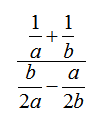
A complex fraction is a fraction whose numerator or denominator  contains one or more fractions. To express a complex fraction as a simple faction use one of the following methods:

Method 1:  Simply the numerator and the denominator.  Express the fraction as a quotient using the division symbol  ÷ .   Multiply by the reciprocal of the divisor. 

Method 2: Find the LCD of ALL the simple fractions in the complex    fraction. Multiply the numerator and the denominator of the complex  fraction by the LCD 


Using Method 1

Method 1:  Simply the numerator and the denominator.  Express the fraction as a quotient using the division symbol  ÷ .   Multiply by the reciprocal of the divisor. 


Simplify above to get

Using Method 2

Method 2: Find the LCD of ALL the simple fractions in the complex    fraction. Multiply the numerator and the denominator of the complex  fraction by the LCD 
   

Same problem as above but this time Find the LCD of all the simple fractions in the complex fraction... The LCD would be 2ab. Multiply each simple fraction by 2ab


Which simplifies to


Then you can factor:


Hopefully you realize you have been able to obtain the same simplified fraction using EITHER method. Use whichever method works BEST for you!

Wednesday, December 19, 2012

Math 6A ( Periods 2 & 4)


Fractions & Mixed Numbers 6-3

1/2 + 1/2 + 1/2 = 3/2

A fraction whose numerator is greater than or equal to its denominator is called an improper fraction.
Every improper fractions is greater than 1
proper fraction is a fraction whose numerator is less than its denominator.
Thus, a proper fraction is always between 0 and 1

1/4, 2/3, 5/9. 10/12 17/18 are all proper fractions

5/2, 8/3, 18/15, 12/5 are all improper fractions

You can express any improper fraction as the sum of a whole number and a fraction
a number such as 1 1/2 is called a mixed number

If the fractional part of a mixed number is a proper fraction in lowest terms, the mixed number is said to be in simple form.

To change an improper fraction into a mixed number in simple form, divide the numerator by the denominator and express the remainder as a fraction.
14/3 = 4 2/3
30/4 = 7 2/4 = 7 1/2

To change a mixed number to an improper fraction rewrite the whole number part as a fraction with the same denominator as the fraction part and add together.

or multiply the denominator by the whole number part and add the fractional part to that...
In class I showed the circle shortcut. If you were absent, check with a friend or ask me in class!!

2 5/6 =

(2 x 6) + 5
6
=17/6


Practice these:

785 ÷ 3

852÷ 5

3751÷ 16

98001÷231


post your answers below in the comments for extra credit !!

Tuesday, December 18, 2012

Math 6 High (Period 3)


Dividing Integers 4.6

According to your textbook, a useful way to divide integer  is to think of it as a multiplication problem. that is, when you consider   -15  ÷ 3  =?  rethink it as  3 · ? = -15.  

You know that  (3)(-5) = -15  so you can conclude that -15  ÷ 3  = -5   

Use similar reasoning for other division problems!

More generally, when dividing two integers, divide their absolute values and then use the same rules applied to multiplying integers:
Specifically:
The quotient of two positive integers is positive
The quotient of two negative integers is positive
The quotient of two integers with different signs is negative
The quotient of 0 and a non-zero integer is 0.

Note: an expression with 0 in the divisor  such as 4 ÷ 0 is undefined. You cannot divide  a number by 0.

Evaluating an expression such as   -18/x 

a) when x = -3

1.  First substitute in using parentheses for the number     -18/(-3)
2.  Then DO THE MATH  remembering that the quotient of two negative numbers is positive. 
3.  The solution is +6.

b) when x = 3

1. First substitute in using parentheses for the number   -18/(3)
2. Then DO THE MATH remembering that the quotient of two integers with different signs is always negative.   
3. The solution is -6.

Finding an Average With Integers

To find the average,   always add the numbers first.
The example in the book uses the following measurements (in feet) taken from the bottom of Lake Michigan and find the average lake bottom’s elevation to its surface….

-844,  -865, - 900,  -893,  -888

so to add do the following

-844 + (-865) + (-900) +(-893) + (-888)

Now, I recommend stacking them to add carefully.  
Remembering the rule for adding integers—when adding integers with the SAME sign, just add them and USE THEIR sign… so we know the total must still be negative since they are ALL negative… and we get – 4390

Now, there are 5 numbers so we divide by +5   
            -4390/5
We see that we have a negative divided by a positive.  
We know our quotient will be negative

-4390/5 = -878

So  the average of the lake’s bottom elevation is -878 feet or you could state it is 878 feet BELOW the lake surface.

Math 6 High (Period 3)


Multiplying Integers 4.5 

As we discovered any number multiplied by -1  is equal to its opposite.

-1 a = -a

We use this Multiplicative Property of -1  to develop general rules for multiplying integers.

 Specifically:

The product of two positive integers is positive
The product of two negative integers is positive
The product of two integers with different signs is negative
The product  of 0 and a non-zero integer is 0.

Examples
Multiplying Integers with the same sign:
(4)(7) = 28
(-11)(-4) = +44

Multiplying Integers with different  signs:
(5)(-5) = -25
(-8)(9) = -72


Evaluating an expression such as:

a)   x y     when x = -15 and y = -6

1.  First substitute in using parentheses for the numbers     (-15)(-6)
2.  Then DO THE MATH  remembering that the product of two negative numbers is positive. 
3.  The solution is +90.

b) ( -a)(b) when a = -4 and b = -8 

(
Be careful with these types—they can be tricky)

1. First substitute in using parentheses for the number   -(-4)(-8)
2. Now look at –(-4) first  that really says to take the opposite of -4 and we know that the opposite of -4 is 4 so we really have (4)(-8)
3. Then DO THE MATH remembering that the product of two integers with different signs is always negative.   
4. The solution is -32.

Multiplying Three or MORE  Integers
The following is our textbooks instructions:
  • To multiply three or more integers work from left to right, multiplying two numbers at a time.
  •   Find the product of the first two numbers, the multiply that product by the next number to the right
  •      Continue until all numbers have been multiplied to find the final product.


EXAMPLES:
(2)(-3)(4)  = (-6)(4) = -24

(-4)(5)(0) = (-20(0) = 0 

My Note:  But why even do the multiplication? Any number  multiplied by 0 is 0 so you know right away the solution is ZERO!!!


(-1)(-2)(-3)(-4) = (2)(-3)(-4) = (-6)(-4) = 24

We discussed in class to be a sign counter—If the number of negative signs (in your non-zero multiplication problem) is EVEN then your solution will be POSITIVE. If the number is ODD, then your solution will be NEGATIVE.  The sign of the product depends on the number of factors (assuming all are non-zero) that are negative.

The product of two integers with the same sign is POSITIVE
    The product of two integers with different signs is NEGATIVE